






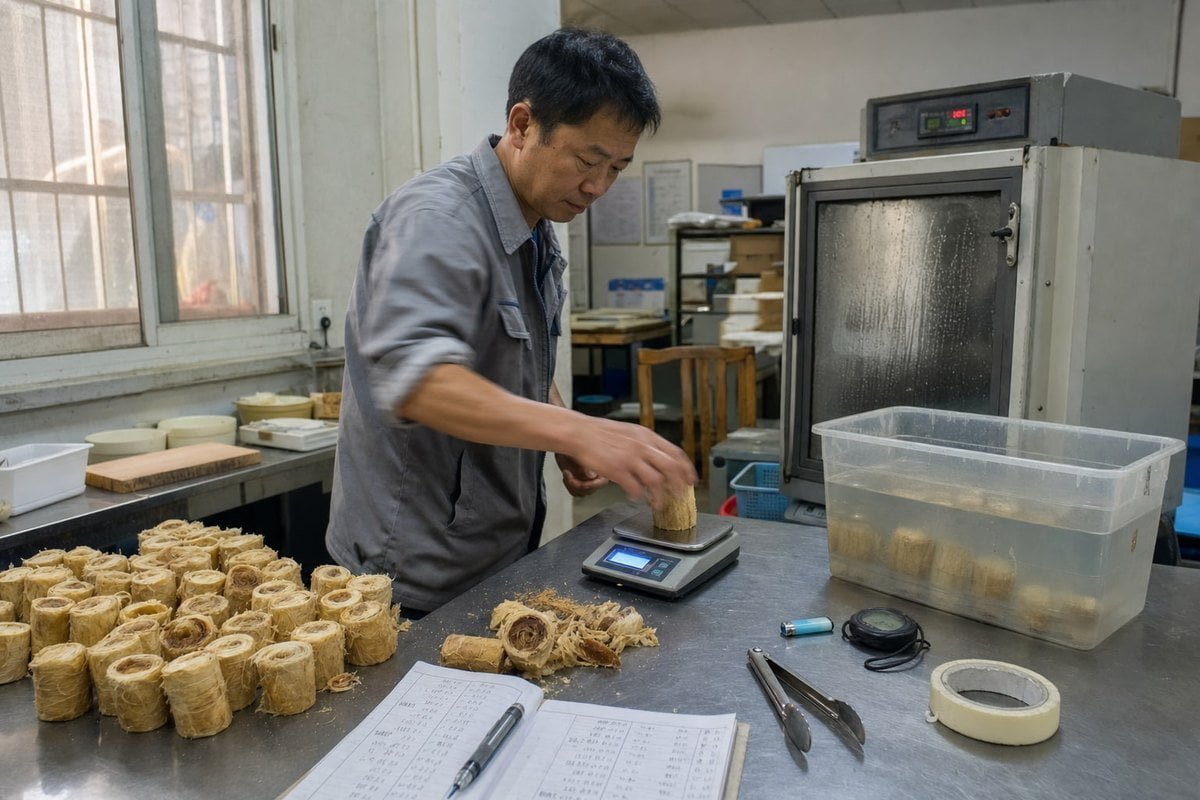
Moisture-resistant wood fire starters sound simple until a container sits in a humid port for six weeks. On our production line, we learned that lesson early — and it shaped how we test.
To test if wood fire starters are truly moisture-resistant, run four checks: a controlled humidity exposure, a timed submersion test, a before-and-after weight comparison, and a post-exposure ignition test. A starter passes only if it still lights reliably and holds its burn time after exposure.
That is the short answer. The longer answer covers lab protocols, supplier verification, certifications, and a field test you can run on your own desk. Let's walk through each one.
What lab tests confirm my wood fire starters can withstand humid or wet storage conditions?
During a QC cycle at our Ningbo facility, we once pulled samples from three different wax-dip batches and stress-tested them side by side. The differences only showed up under controlled humidity — never on visual inspection.
Four lab tests confirm moisture resistance: a 48-hour vapor saturation test at 90–95% humidity, a timed submersion test, a gravimetric water absorption test using precision scales, and a post-exposure ignition test measuring flame duration against a dry control sample.
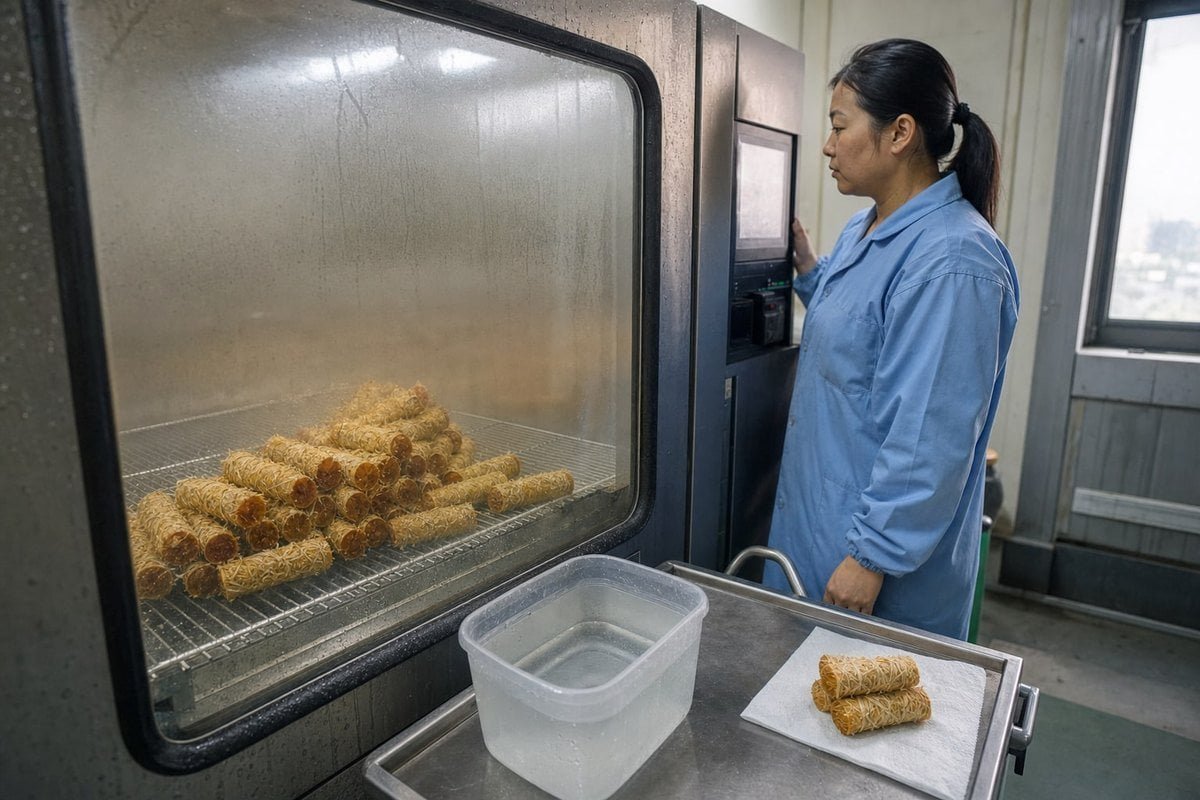
The key insight is that moisture resistance has two layers. First, ingress resistance — how well the Paraffinwachsbeschichtung 1 keeps water out of the wood fiber core. Second, function retention — whether the starter still ignites and burns long enough to light kindling after exposure. A proper lab protocol tests both.
The four core lab tests explained
| Test | Methode | What it reveals |
|---|---|---|
| Vapor saturation | 48 hours in a 90–95% humidity chamber | Resistance to damp storage and atmospheric moisture |
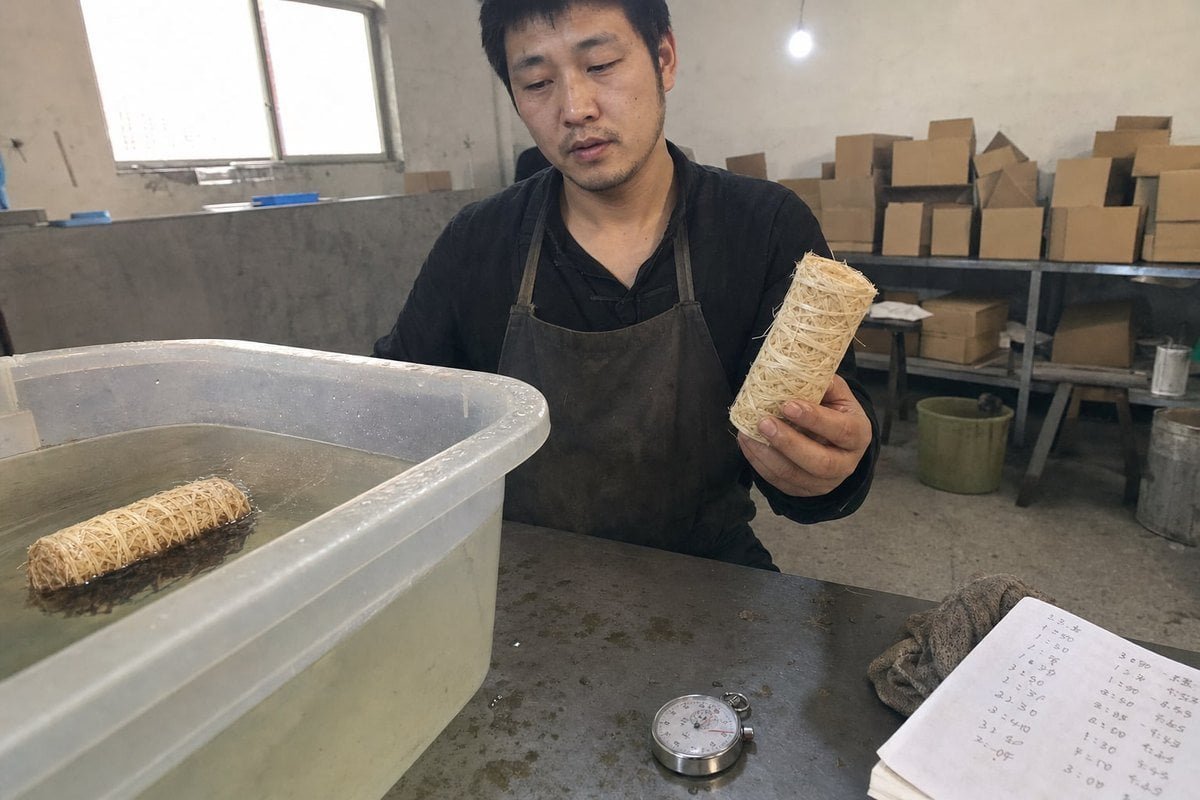
| Submersion test | Full dunk for 60 seconds to 24 hours, timed | Barrier integrity under direct liquid contact |
| Gravimetric absorption | Weigh before and after exposure on a milligram scale | Exact water uptake as a percentage of dry weight |
| Post-exposure ignition | Light exposed sample vs. dry control | Ignition reliability and burn time duration decay |
Humidity testing matters more than most buyers realize. Wood fiber is naturally hygroscopic — it pulls moisture straight from the air. A starter can fail in a humid warehouse without ever touching liquid water. That is why we treat vapor saturation and submersion as two separate tests, not one.
The gravimetric test is the most objective. Weigh each sample dry, expose it, blot the surface consistently, and weigh it again. A well-sealed wax-dipped wood roll should show minimal weight gain. Significant uptake means the paraffin wax coating has pinholes or micro-fractures.
Finally, the ignition test ties everything together. We measure time-to-ignition, flame height, and total burn time duration against a dry control. A small performance decay is acceptable. A starter that smolders, fizzles, or self-extinguishes has failed, regardless of how good its absorption numbers look.
How do I verify a supplier's moisture-resistance claims before placing a bulk order?
A German distributor once asked us a blunt question: "Why should I believe your spec sheet?" Fair point. After 17 years of exporting to 30+ countries, we tell buyers exactly how to check us.
Verify supplier claims by requesting third-party test reports, ordering samples for independent submersion and ignition testing, auditing the wax-to-fiber ratio on the composition label, and confirming that mass-production batches match the sample through documented batch QC records.
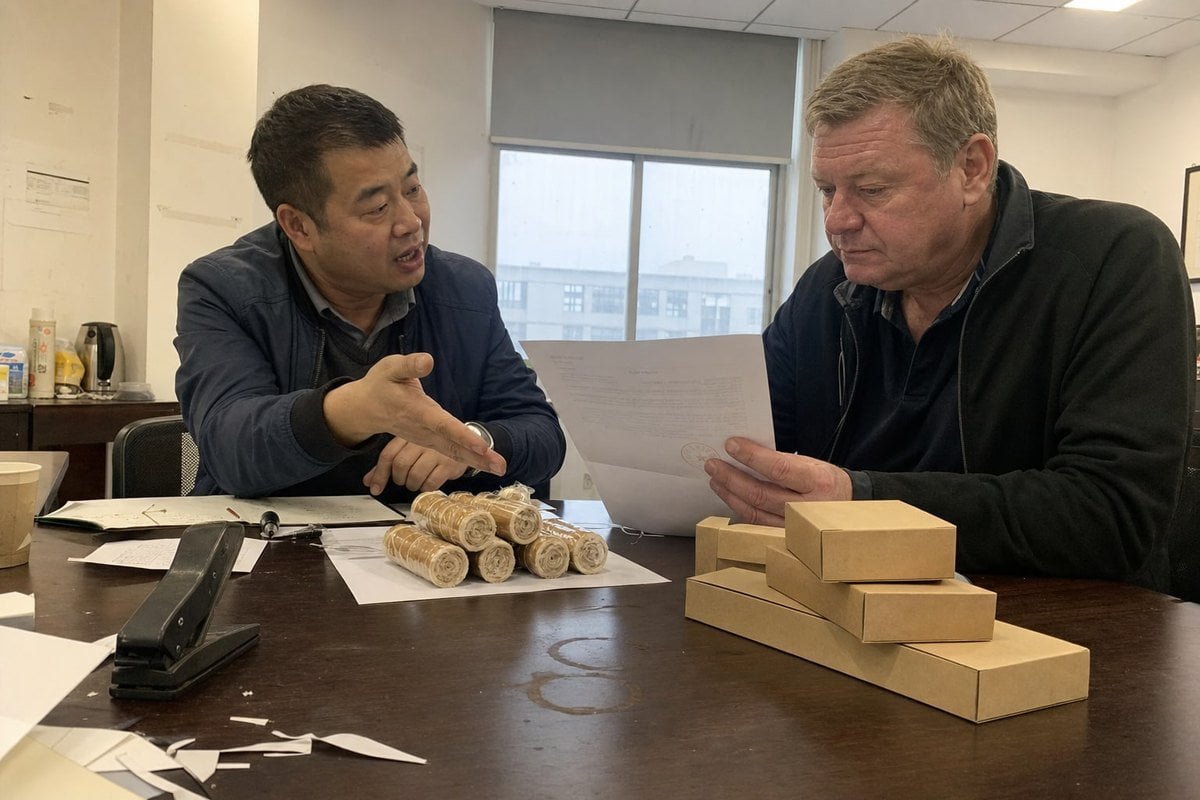
Never rely on marketing words like "waterproof" or "weatherproof." These terms have no fixed everyday standard for fire starters. Instead, follow a structured verification process before you commit to a bulk order.
A five-step supplier verification process
- Request the composition spec in writing. A typical wax-dipped starter lists something like 50% wood fiber and 50% paraffin. The wax ratio directly drives damp environment performance. A supplier who cannot state this ratio has weak process control.
- Order samples from a real production batch, not hand-picked "hero" units. Ask for samples pulled from current stock, ideally from two different batches.
- Run your own submersion test. Dunk samples, blot them, and attempt ignition. Compare against a dry control. Repeat with multiple units and average the results — never judge from a single sample.
- Ask how the first sample maps to mass production. In our factory, Chargen-zu-Chargen-Qualitätskontrolle 2 means the dip time, wax temperature, and fiber density are logged for every run. Ask your supplier for the same evidence.
- Check the packaging system, not just the product. A starter can be intrinsically humidity-tolerant yet still fail if the retail box or inner bag lets moisture in during Seefracht 3. Ask what barrier packaging is used for container shipments.
One more practical tip: test ignition with the tools your end customers actually use. If your market includes survival fire starting kits, confirm Ferrocerium-Stab 4 compatibility, not just match or lighter ignition. A starter that only lights with a sustained lighter flame will disappoint bushcraft customers.
Which certifications or test reports should I request to prove waterproof performance?
Compliance paperwork is the first thing serious buyers ask us for — usually before pricing. For our export clients in the US, Germany, and the UK, test reports are a hard requirement, not a nice-to-have.
Request SGS or Intertek third-party test reports covering ignition performance and material composition, plus ISO 9001 certification for process consistency, BSCI for factory ethics, and CE compliance where applicable. Supplement these with the supplier's internal humidity and submersion test records.
Here is the honest truth: there is no single universal "waterproof fire starter" certificate. So you build proof from a stack of documents, each covering a different risk. The table below shows how the pieces fit together.
Was jedes Dokument tatsächlich beweist
| Dokument | Issued by | What it proves for moisture resistance |
|---|---|---|
| SGS / Intertek Prüfbericht | Drittanbieterlabor | Material composition, burn behavior, and safety data are independently verified |
| ISO 9001 Zertifikat | Accredited auditor | The factory has a controlled, repeatable process — critical for consistent wax coating |
| BSCI-Audit | Zusammensetzung, Flammpunkt, Emissionen | The factory is a real, audited production site, not a trading company |
| CE-Konformitätsdokumentation | Manufacturer / notified body | The product meets applicable EU market requirements |
| Internal QC batch records | The factory itself | Each batch passed humidity, submersion, and ignition checks before shipping |
Pay special attention to the last row. Third-party certificates prove the system; internal batch records prove the shipment. At our Liuyang headquarters, we keep both, because a certificate from two years ago says nothing about the container leaving next month.
Also ask whether the test report matches the exact SKU you are buying. A report for Fatwood-Stöcke does not cover wax-dipped wood rolls. The wood species, resin content, and coating method all change moisture behavior. If a supplier offers OEM customization 5 — different sizes, burn times, or private-label packaging — confirm that the tested spec matches your customized spec. A longer burn time usually means more wax, which actually improves moisture resistance, but the report should still reflect your version.
Can I run a simple field test to compare moisture resistance across different fire starter samples?
Buyers visiting our showroom often ask for a demonstration before anything else. We keep a bucket of water and a fire pit ready — because a two-minute dunk-and-light demo settles more arguments than any spec sheet.
Yes. Dunk identical samples in water for 60 seconds, blot them once, and attempt ignition alongside a dry control. Score each sample on time-to-ignition, flame stability, and total burn time. Repeat three times per product and average the results.
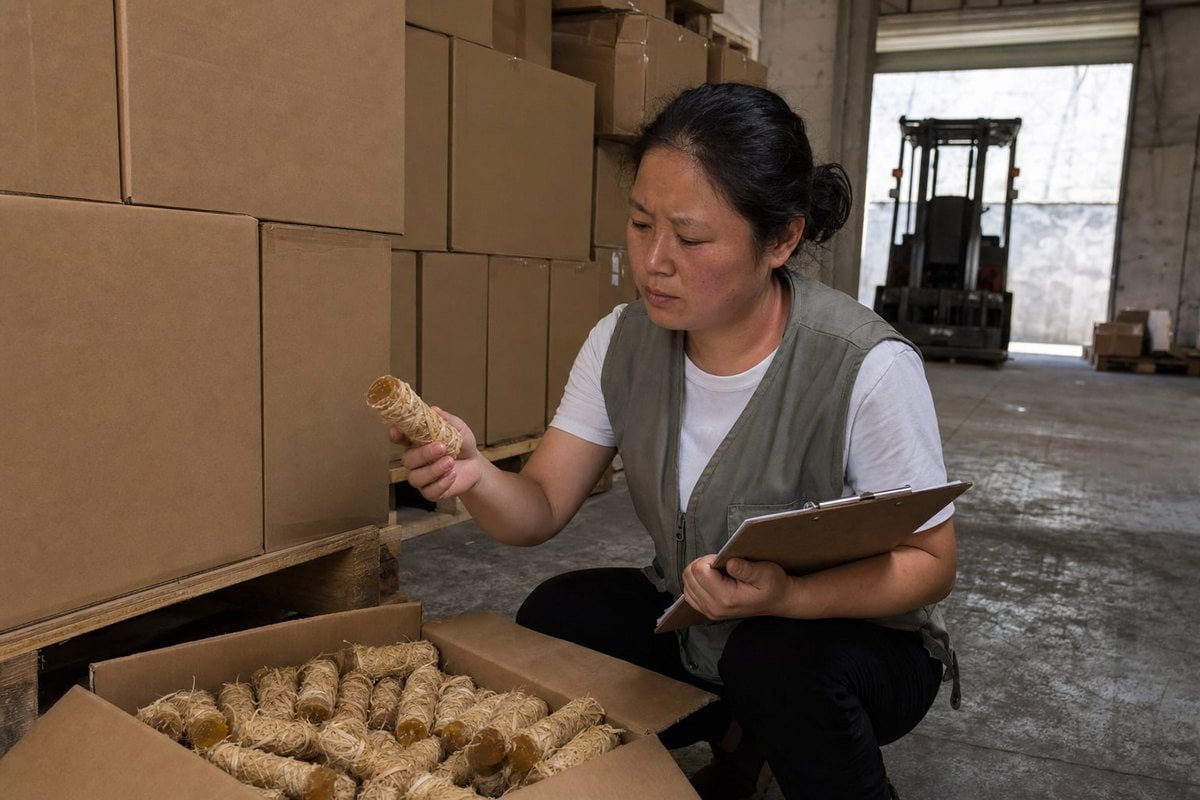
You do not need a lab to get useful data. You need consistency. The biggest mistake in field testing is changing conditions between samples — different soak times, different kindling, or different weather. Fix every variable except the product itself.
A repeatable desk-and-backyard protocol
Follow the same sequence for every sample:
- Label and weigh each starter. A kitchen scale works; a milligram scale is better.
- Expose all samples identically — 60-second submersion for a quick screen, or overnight in a sealed box with a damp sponge to simulate a humid shed.
- Blot each sample with one paper-towel press. No towel-drying beyond that.
- Light each one with the same tool. Use a lighter for a baseline, then a ferro rod if you sell into the survival market.
- Record time-to-ignition, flame behavior, and burn time duration.
A simple scoring table
| Kriterium | 3 points | 2 points | 1 point | 0 points |
|---|---|---|---|---|
| Ignition after exposure | Lights first try | Lights second try | Needs sustained flame | Will not light |
| Flammstabilität | Steady, full flame | Minor sputtering | Heavy smoking | Self-extinguishes |
| Burn time vs. dry control | 90%+ retained | 70–89% | 50–69% | Under 50% |
| Weight gain after soak | Minimal | Leicht | Noticeable | Soaked through |
Two bonus tests add depth. Stand a starter upright in 5mm of dyed water to check capillary wicking 6 through the fibers. And if you sell into Canada, Poland, or other cold markets, freeze soaked samples overnight, thaw them, and retest — a brittle wax barrier can crack under freeze-thaw cycles 7. Any product marketed as weatherproof tinder should survive both.
Schlussfolgerung
Vague "waterproof" claims cost buyers real money in returns and lost shelf trust. The fix is simple: demand test reports, run your own dunk-and-light protocol, and verify batch consistency before every bulk order.
Fußnoten
1. Explains the material science behind the wax barrier used for moisture ingress resistance. ↩︎
2. Links quality control practice to the ISO 9001 standard for process consistency. ↩︎
3. Authoritative trade body context for international shipping and packaging compliance concerns. ↩︎
4. Background on the ignition tool referenced for survival-market compatibility testing. ↩︎
5. Major B2B trade platform relevant to sourcing and OEM manufacturing verification. ↩︎
6. Defines the physical phenomenon used in the upright water-wicking bonus test. ↩︎
7. Government wood science lab studies how freeze-thaw stress affects wood-based materials. ↩︎



 English
  Spanish
  German
  French
  Arabic
  Portuguese
Diskutieren Sie mit