






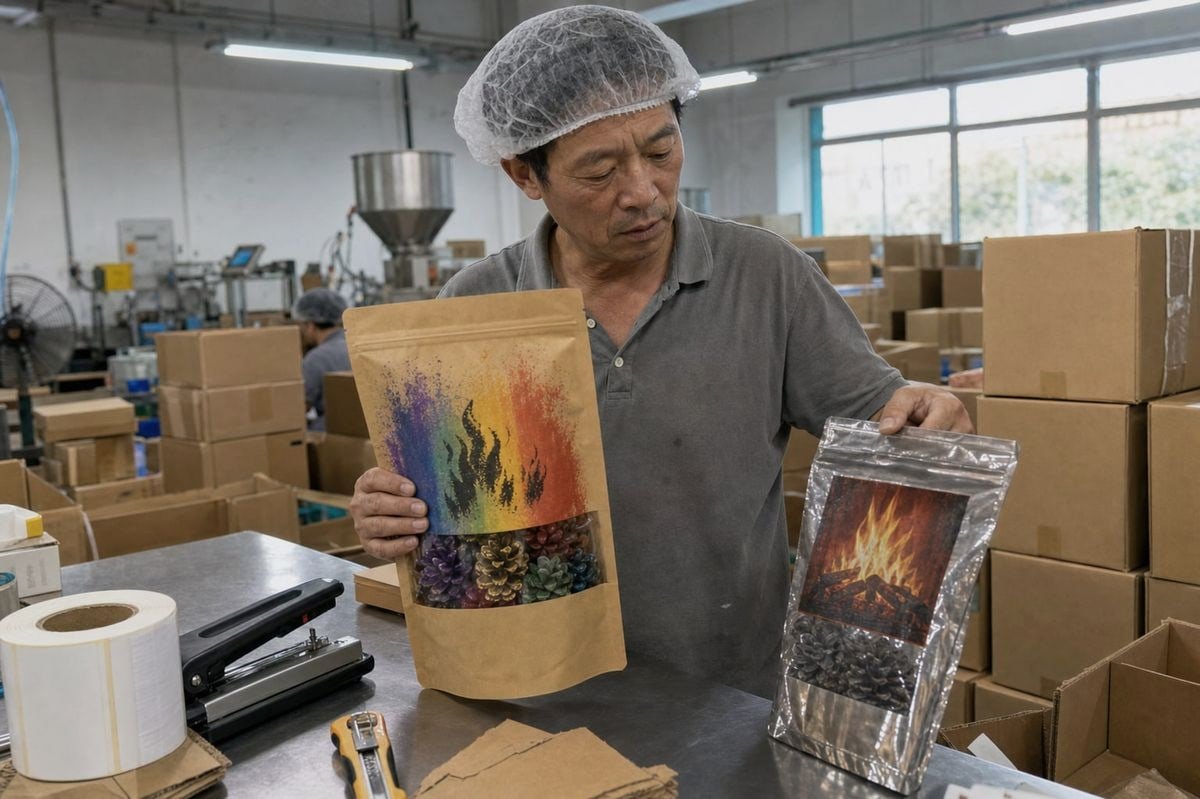
Revising fireplace colored pine cones packaging for outdoor fire pit use is a question our production team in Ningbo hears constantly from distributors chasing the backyard-entertainment boom.
To revise fireplace colored pine cones packaging for outdoor fire pit use, switch to a moisture-resistant resealable pouch, relabel the front panel for wood-burning fire pits and campfires, add gas/propane and "do not cook" warnings, and verify compliance documents such as SGS test reports and MSDS before shipping.
The problem is simple. Your package says "fireplace," but your fastest-growing buyers are shopping for fire pit accessories. If the label stays hearth-only, retailers shelve it in seasonal holiday aisles 1, it disappears by January, and you lose the year-round patio and camping market. The fix is a structured packaging revision, and I will walk you through it section by section below.
What certifications do I need to sell colored pine cones for outdoor fire pit use?
A German importer once asked us for paperwork before he even asked for a price. In our 17+ years exporting fire products to 30+ countries, that order of questions has become the norm.
You typically need third-party lab test reports (SGS or Intertek), an MSDS for the flame colorant chemicals, CE marking for the EU, and compliant warning labels. Factory-level credentials such as ISO 9001 and BSCI audits reassure retail buyers that quality and ethics are verified.

Moving a product from "fireplace novelty" to "outdoor fire pit accessory" does not usually change its legal category. It is still a combustible consumer good with flame colorant chemicals. But it does change who scrutinizes it. Outdoor retailers, camping brands, and big-box sourcing channels tend to run stricter compliance checks than seasonal gift traders. So the paperwork you could skate by with before now becomes a hard gate.
The core documents buyers will request
At our factory, every export batch of farbige Flammen-Kiefernkegel 2 ships with a documentation pack. Here is what a US or EU buyer will typically expect:
| Dokument | Zweck | Wer danach fragt |
|---|---|---|
| SGS / Intertek Prüfbericht | Confirms no harmful heavy metals or banned substances in the coating | Einzelhändler, Importeure |
| Sicherheitsdatenblatt (SDB) | Details chemical composition, handling, and first-aid info for MSDS compliance | Freight forwarders, customs, retail compliance teams |
| CE-Dokumentation | Required conformity marking for the EU market | Hören Sie nicht auf, PDFs zu sammeln. Fragen Sie, wann jedes Zertifikat zuletzt erneuert wurde. Fragen Sie, welches Labor die Prüfberichte ausgestellt hat und ob Sie die Berichtsnummer direkt beim Labor überprüfen können. Fragen Sie, ob das Sicherheitsdatenblatt mit der exakten Formulierung übereinstimmt, die Sie erhalten werden, und nicht mit einer generischen Version. In Liuyang, wo sich unser Hauptsitz im Feuerwerkscluster Chinas befindet, sehen wir viele Lieferanten, die Dokumente von verwandten Unternehmen ausleihen. Ein fünfminütiges Verifizierungsgespräch mit dem Prüflabor schließt diese Lücke vollständig. |
| ISO 9001 Zertifikat | Weist ein dokumentiertes Qualitätsmanagementsystem nach | Große Einzelhandels-Beschaffungskanäle |
| BSCI Auditbericht | Verifies ethical factory conditions | US and EU brand buyers |
Why outdoor positioning raises the bar
Market listings for this category are inconsistent. Some sellers market cones for Feuerstellen 3 and campfires freely; others stay fireplace-centered because outdoor use raises questions about food contact 4 and misuse near propane features. In my experience, the conservative sellers are not wrong to worry — they simply lack test data. When your lab reports confirm eco-friendly materials with no harmful chemicals, you can confidently print "for wood-burning fire pits, campfires, and chimineas" on the front panel. Certification is what lets your marketing expand without your liability expanding with it.
One more practical point: warning label content 5 itself must comply with the destination market's language and format rules. We prepare private-label warning panels in English, German, and French for our clients, because a compliant product with a non-compliant label still gets rejected at the retailer's inbound check.
How can I customize the packaging design without compromising burn safety?
There is a real trade-off we weigh on every OEM packaging project: the prettier the bag, the more it can bury the warnings. Our design team treats the warning panel as fixed real estate first, branding second.
Customize freely on materials, graphics, and format — burlap textures, kraft pouches, rainbow-flame artwork — but lock four elements in place: a front-panel fuel statement, a "toss into established wood fire" instruction, gas/propane and cooking prohibitions, and child-supervision warnings printed in high-contrast type.

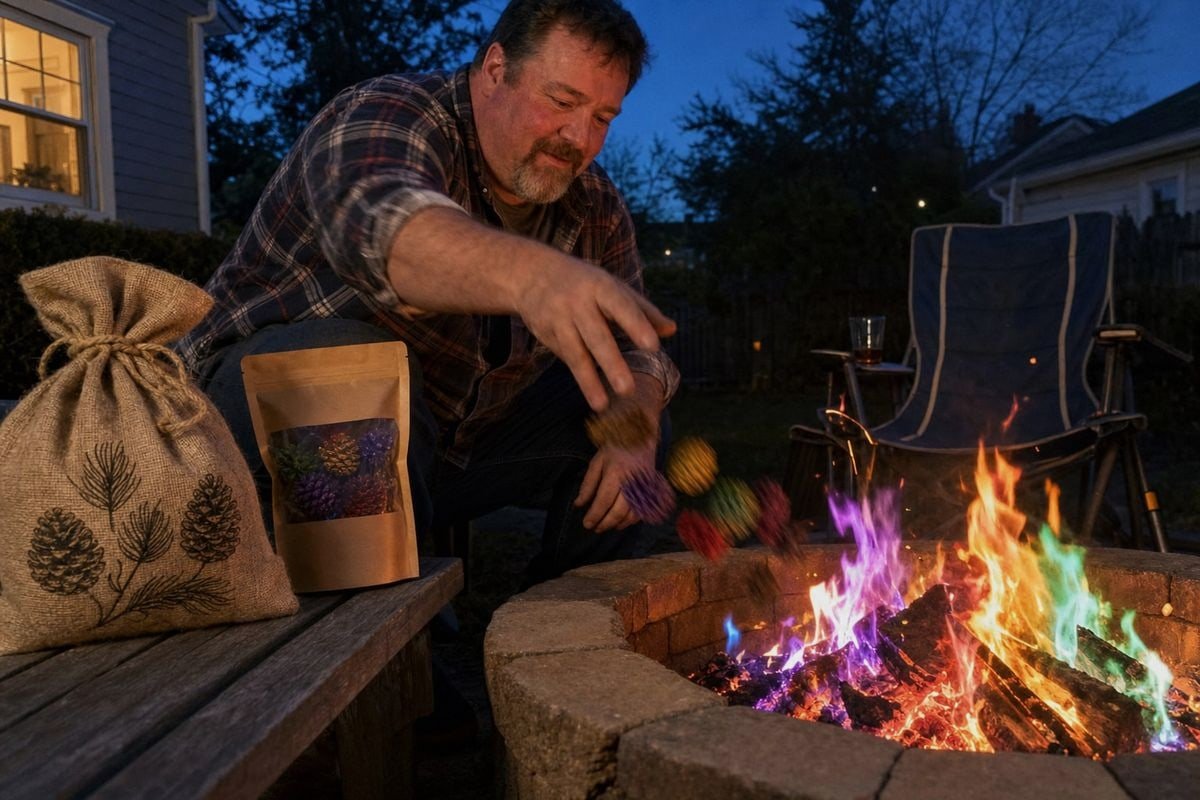
The market already shows you what sells: burlap sacks, refill bags, and gift-basket presentations that signal rustic, outdoor, giftable qualities. Your product views reflect exactly this — a drawstring burlap pouch and a kraft stand-up pouch with a clear window. Both work for fire pit positioning. The revision task is not to reinvent the look. It is to restructure the information hierarchy so an outdoor user cannot misread the product.
Build a four-panel instruction hierarchy
We recommend our clients organize copy across four zones:
- Front panel: "For Wood-Burning Fire Pits, Campfires, Fireplaces & Chimineas" — the use case, stated once, boldly.
- Usage panel: One clear verb. "Toss 2–3 cones into an established wood fire." Avoid the word "starter" unless the product genuinely ignites — the market confuses color additives with decorative fire starters, and ambiguous language creates returns and complaints.
- Warning panel: Chemical safety warnings in plain type — do not use with gas or propane fire pits, do not cook or roast food over treated cones, coating may be harmful if swallowed.
- Handling panel: Keep sealed until use, supervise children and pets, follow local campfire safety instructions and burn regulations.
Material choices that protect the product outdoors
Fireplace products live indoors. Fire pit products live on patios, in garages, and in camping bins. That changes the material spec:
| Verpackungselement | Fireplace version | Fire pit revision |
|---|---|---|
| Bag body | Simple burlap or paper sack | Resealable waterproof pouches or heavy-duty poly bags with a moisture-resistant barrier 6 |
| Closure | Jute drawstring | Zip-seal plus drawstring for repeated openings |
| Beschichtung | Standard print finish | UV-resistant finish so colorants and graphics do not degrade in sunlight |
| Sustainability | Optional | Eco-friendly packaging materials — kraft, biodegradable liners — that match outdoor buyers' values |
A humidity-swollen pine cone burns poorly and colors weakly. A resealable pouch with a proper moisture-resistant barrier protects the flame effect through morning dew, damp garages, and multi-trip camping use. Some SERP-ranking ideas go further — fully combustible zero-waste packaging 7 that doubles as kindling, or strike-on-box ignition strips. These are workable, and we have prototyped combustible wrappers, but I advise trial-order buyers to nail the core pouch revision first and treat these as second-generation upgrades.
What's the minimum order quantity for a trial run of revised packaging?
A Canadian distributor once told me he had been quoted a 20,000-unit MOQ elsewhere just to test a new bag design. That conversation shaped how we structure trial runs today.
Trial MOQs for revised colored pine cones packaging typically range from 500 to 2,000 units, depending on the format. Digitally printed kraft pouches allow the lowest entry point, while custom-woven burlap sacks and printed tins require larger commitments due to plate and tooling costs.

The honest answer is that MOQ is driven by printing method, not by the pine cones themselves. Our production lines fill pouches, sacks, and jars from the same batch of coated cones, so the product side is flexible. The packaging side is where numbers move.
How format drives your trial quantity
| Verpackungsformat | Typical trial MOQ | Warum |
|---|---|---|
| Digitally printed kraft pouch 8 with window | 500–1.000 Einheiten | No printing plates; artwork changes are cheap |
| Screen-printed burlap drawstring sack | 000–2.000 Einheiten | Screen setup cost spreads over volume |
| Gravure-printed heavy-duty poly bags | 000+ Einheiten | Cylinder engraving requires scale |
| Kraft pouch with generic print + custom sticker label | 300–500 Einheiten | Fastest, cheapest market test |
For a genuine market test, I usually steer buyers toward the digitally printed kraft pouch — the same rugged, matte, eco-friendly format shown in our campfire-scene packaging view. It photographs well for e-commerce, signals outdoor use instantly, and lets you revise the warning panel between runs without wasting plates.
Portion sizes matter as much as unit counts
Existing listings sell everything from 8–12 cones to 170-cone bulk packs, and color effects typically last 5–10 minutes per cone. For fire pit use, we see the sweet spot at a pouch covering two to three evening gatherings. A smaller count suits gift positioning; a bulk refill suits campground and patio retailers. On a trial run, consider splitting one MOQ across two sizes — for example, 500 gift pouches and 500 refill bags — so your sell-through data tells you which occasion your market actually buys for. We support this kind of split under one order because the fill line changeover is minimal.
How do I ensure consistent quality when switching from fireplace to outdoor fire pit packaging?
Early in our export history, we learned a hard lesson: a client's second shipment colored slightly weaker than the first because a coating supplier changed a raw material grade. That incident is why our batch-to-batch QC system exists today.
Consistency comes from locking the product specification independently of the packaging: fixed colorant formulation, controlled coating weight per cone, moisture testing before sealing, and burn-testing samples from every batch. The packaging change should alter presentation only — never the chemistry or the process.
A packaging revision is exactly the moment quality drift sneaks in. New bag supplier, new fill line settings, new sealing temperatures — each change is small, but together they can shift the product your customer receives. The discipline is to separate what changes from what must not.
What stays locked during the transition
The colorant formulation, coating weight, cone size grading, and drying time stay identical. At our facility, we burn-test random samples from every production batch and check flame color intensity and duration against a retained reference sample. Because the first sample we send a buyer comes off the same line as mass production, the trial pouch and the ten-thousandth pouch should perform the same. That is the standard you should hold any supplier to when revising packaging — ask them directly how they verify that sample quality reflects production quality.
What the new packaging must actively protect
Outdoor storage conditions are harsher than a living-room hearth basket. Your revised pouch has three protective jobs:
- Feuchtigkeitskontrolle. Cones must be sealed at verified low moisture content. A resealable closure then keeps humidity out between uses, preserving both ignition behavior and color vibrancy.
- Physical protection. Cones travel in car trunks and camping bins. Heavier-gauge pouch film prevents scale breakage and colorant dust.
- Information durability. Warning text and campfire safety instructions must survive sun and abrasion. We spec fade-resistant inks so chemical safety warnings remain legible for the product's full shelf and storage life.
Finally, run a side-by-side validation before full rollout: pack the same batch in old and new packaging, store both for several weeks in humid conditions, then burn-test. If color duration and intensity match, your packaging revision is quality-neutral — which is exactly what it should be.
Schlussfolgerung
Repositioning fireplace colored pine cones for fire pit buyers is a packaging problem, not a product problem — and an unrevised label quietly caps your growth in the outdoor market.
The path forward is clear: secure your test reports and MSDS, restructure the label around a four-panel safety hierarchy, upgrade to a moisture-resistant resealable pouch, start with a low-MOQ trial run, and lock product specifications so quality never shifts with the packaging. Get those five steps right, and the same cones that sold as a holiday hearth novelty become a year-round outdoor fire pit accessory with a far larger shelf life and audience. If you want a partner who has already run this playbook — with the certifications, production depth, and one-stop OEM support to back it — we are ready when you are.
Fußnoten
1. Explains the management of seasonal inventory and how retailers handle products with limited shelf-life windows. ↩︎
2. Leading testing lab providing certification services for consumer products and chemical safety. ↩︎
3. Historical and safety overview of fire pits used for outdoor recreation and entertainment. ↩︎
4. Official FDA guidance on substances used in materials that come into contact with food. ↩︎
5. Comprehensive overview of the international standard for safety signs and product labels. ↩︎
6. Explains the technical function of barrier layers in protecting products from environmental moisture. ↩︎
7. Government data and definitions regarding sustainable packaging and waste reduction in consumer products. ↩︎
8. Industry leader explaining the technical benefits and low-MOQ capabilities of digital printing for flexible pouches. ↩︎



 English
  Spanish
  German
  French
  Arabic
  Portuguese
Diskutieren Sie mit