







Preparing Magic Fire powder samples for a trade show sounds simple — until a Brandschutzbeauftragter 1 questions your booth. On our production line, we prep exhibitor kits differently.
Prepare Magic Fire powder samples as sealed, single-use retail packets with certifications (SDS, SGS, CE), bring 6–10 color and format variations, showcase shelf-ready packaging like foil pouches, kraft bags, and display boxes, and verify samples come from documented mass-production batches — never loose powder.
That is the short answer. Now let me walk you through each step, because the details are what separate a booth that books orders from a booth that gets shut down.
What certifications should I include with my Magic Fire powder samples for trade show buyers?
A few years back, a German distributor walked up to our booth and asked for paperwork before he even touched the sample mass-production batch 2. That moment shaped how we prep every kit since.
Include Safety Data Sheets (SDS), SGS or Intertek test reports, CE marking documentation, ISO 9001 and BSCI factory certificates, and compliant warning labels with every Magic Fire powder sample. Serious trade show buyers treat these documents as a hard requirement, not a nice-to-have.

Buyers at outdoor gear shows 3 are usually purchasing managers or owners UPC barcodes 4. They carry liability. So they screen for compliance first and price second. In our experience exporting to the US, Germany, the UK, and 27 other markets, the sample without paperwork is the sample that never gets a follow-up email.
Der Kern-Dokumentensatz
Here is what we pack with every sample kit before a show:
| Dokument | Why buyers ask for it | Format zum Mitbringen |
|---|---|---|
| Sicherheitsdatenblätter (SDB) | Fire marshal compliance and retailer liability review | Printed copy at booth plus QR code link |
| SGS / Intertek Prüfberichte | Proof the color-changing flame additives contain no harmful chemicals | Printed summary, full report on request |
| CE-Dokumentation | Mandatory for most EU retail channels | Copy in the sample kit |
| ISO 9001 Zertifikat | Confirms consistent production management | One booth display copy |
| BSCI Auditbericht | Social compliance for large retail sourcing channels | Digital copy on request |
Labels are part of certification too
Documents alone are not enough. The sample packaging itself should carry warning language supported by the SDS: keep away from children, do not open the packet, do not cook over colored flames, and ensure ventilation. When our team designs private-label packaging, we build these warnings into the artwork so the buyer sees a retail-ready, defensible product — not a novelty item they will have to fix later.
One more practical tip. Display the SDS visibly at the booth. Many exhibition display guidelines and fire marshals require it for any fire-related chemical product, even sealed ones. Having it out in the open also signals confidence to every buyer who walks past.
How many sample variations should I bring to demonstrate color-flame effects at the show?
There is a real trade-off we weigh before every show: bring too few variations and buyers cannot visualize a product line; bring too many and the booth looks cluttered and unfocused.
Bring six to ten variations: four to five core flame colors in sealed single-use packets, one multi-color assortment, plus two or three alternative formats such as color-flame pinecones or larger jars. This range demonstrates vibrant flame effects and line depth without overwhelming buyers.

The goal of variations is not spectacle. It is helping a buyer picture a planogram in their own store. After 17 years of building sample kits, we have settled on a structure that works for camping brands 5, BBQ distributors, and festival gift traders alike.
A proven variation lineup
| Variation type | Quantity to bring | What it proves to the buyer |
|---|---|---|
| Single-color packets (blue, green, purple, rainbow mix) | 4–5 SKUs | Consistent, repeatable color chemistry |
| Multi-color assortment pack | 1 SKU | Gifting and impulse-purchase potential |
| Farbflammen-Kiefernzapfen | 1–2 SKUs | Premium fireplace and gift positioning |
| Crackle-effect variant | 1 SKU | Auditory differentiation from silent competitors |
| Extended burn-time packet | 1 SKU | Customization capability for OEM buyers |
Show the effect without live fire
Here is where I push back on a common assumption. Many exhibitors believe a live flame demo is the most persuasive sales tool because the color effect is immediately visible. I understand the appeal. But live ignition inside a crowded venue creates safety, liability, and compliance risk that most organizers will not accept. Reactive compositions can burn intensely for only ten to fifteen seconds — a short window that is hard to control indoors and easy to get wrong.
The better answer is a looping video of each color effect, plus a QR code on every sample packet linking to a high-production demonstration. Buyers scan, watch the vibrant flame effects on their phone, and keep the sealed packet as a physical reference. Product demonstration safety stays intact, and the demo travels home with the buyer. If a venue permits a supervised outdoor demo area, use it — with trained staff, a buffer zone, and written venue sign-off only.
What packaging formats should I showcase to attract outdoor and camping brand buyers?
A lesson we learned the hard way: at one early show, we brought excellent product in plain pouches — and watched buyers walk to a competitor with weaker chemistry but shelf-ready retail packaging design.
Showcase at least three formats: glossy foil single-use pouches, resealable kraft-paper stand-up bags, and countertop display boxes holding twelve to twenty-four sachets. Add UPC barcodes, hang holes, and clear warning labels so buyers see a shelf-ready campfire accessory, not raw material.

Outdoor and camping brand buyers think in shelf space, not chemistry. The campfire accessories market rewards small, light, seasonal, high-margin products that display well. Your packaging lineup should prove your product fits that model instantly.
Match the format to the buyer
Different channels need different formats, and we prep our booth accordingly:
| Verpackungsformat | Best-fit buyer | Key retail feature |
|---|---|---|
| Glossy foil single-use pouch | Camping and outdoor gear brands | Hang hole, lightweight, toss-in-unopened use |
| Kraft stand-up bag with zip top | Eco-focused and boutique retailers | Natural look, resealable, sustainability story |
| Flip-top display box with sachets | Convenience, RV, and hardware channels | Countertop impulse placement near registers |
| Plastikdose (Mehrzweck) | BBQ and fireplace distributors | Higher price point, repeat-use positioning |
Details that close deals
Buyers notice small things. A UPC barcode printed on the sample says the product is ready to scan through their POS system tomorrow. A punched hang hole says it fits a pegboard. A circular inset photo showing blue, green, and orange flames says the customer will understand the product in two seconds. And increasingly, European buyers ask about compostable sachet films that align with Leave No Trace values — a direction worth raising proactively at your booth.
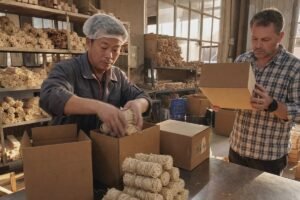
Because we run true one-stop OEM and ODM production, we also bring a private-label mockup showing a buyer's hypothetical brand on our pouch. Nothing accelerates a wholesale buyer outreach conversation like seeing their own shelf presence rendered in physical form. Consider preparing a Distributor Discovery Kit too: all colors, one mini display mockup, and pricing tiers in a single takeaway box.
How do I ensure my trade show samples match future mass-production quality?
When we calibrate a new color formulation in Ningbo, the batch record follows it from lab bench to sealed pouch. That traceability exists precisely because of this question — the one every experienced buyer eventually asks.
Pull trade show samples directly from a documented mass-production batch, not a hand-made lab run. Keep batch records, retain duplicate samples, apply batch-to-batch QC testing for color intensity and burn time, and confirm your supplier's ISO 9001 process controls in writing.

The biggest fear a purchasing manager carries is the golden sample problem: a perfect sample at the show, followed by inconsistent container loads six months later. I have heard this exact worry from buyers in the US, Poland, and Australia, almost word for word. Here is how to eliminate it.
A four-step consistency process
- Sample from production, not the lab. Every sample packet we bring to a show comes off the same line, same filling equipment, and same sealing process as commercial orders. If your samples are hand-mixed, your buyers are evaluating a product you cannot ship.
- Document the batch. Record raw material lot numbers, mixing parameters, and fill weights. High-purity Metallsalze 6 drive color performance, so raw material consistency is where color drift usually starts.
- Test every batch the same way. We burn-test each production batch for color intensity, Brenndauer, and residue before release. Retain sealed duplicates of the exact show batch so any future order can be compared against it.
- Put it in the contract. Ask your supplier to confirm in writing that mass-production goods will match the retained show sample, with tolerances defined. A factory with 17+ years of production depth will agree without hesitation. A trading company usually cannot.
Logistics is part of quality too
Consistency also covers how samples travel. Treat color-flame powders as potentially regulated goods: check Hazmat shipping requirements 7 before air freight, keep samples in original sealed packaging, and never pack them beside lighters, batteries, fuel, or aerosols. Good trade show booth logistics — climate-aware transport, crush-resistant cartons, samples kept away from hot booth lighting — protect both safety and the sample's appearance when the buyer picks it up.
Schlussfolgerung
Sell the spectacle, not the hazard. Sealed certified samples, six to ten variations, shelf-ready packaging, and production-batch traceability turn Magic Fire powder samples into signed orders.
Fußnoten
1. Fire safety official role responsible for venue compliance and safety enforcement. ↩︎
2. Manufacturing method used to ensure consistency between samples and final goods. ↩︎
3. U.S. government resource providing data and insights on the outdoor recreation economy. ↩︎
4. Global standard for retail product identification and inventory management. ↩︎
5. Leading trade association representing the interests of the outdoor recreation industry. ↩︎
6. Chemical compounds used to create specific color effects in pyrotechnic applications. ↩︎
7. Federal regulations governing the transport of hazardous materials in the United States. ↩︎


 English
  Spanish
  German
  French
  Arabic
  Portuguese
Diskutieren Sie mit