






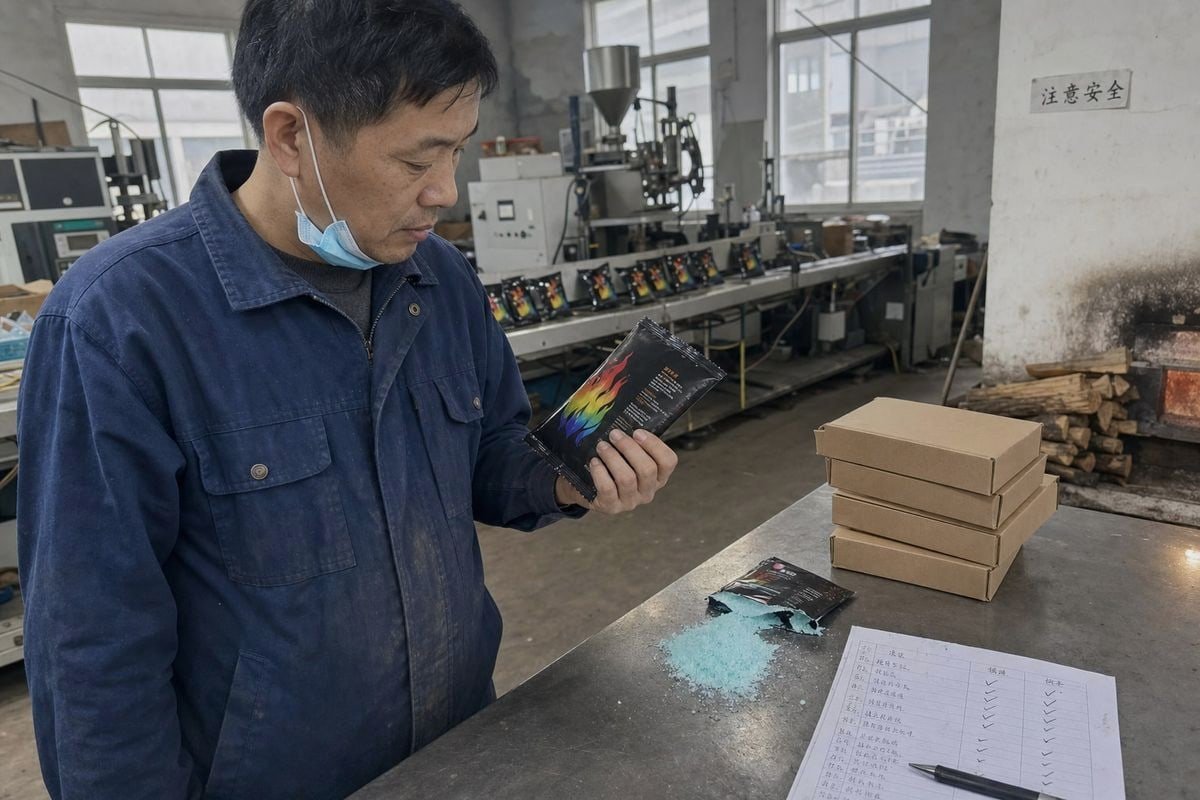
Falsches Lesen der Gebrauchsanweisungen und Dosierungsrichtlinien auf der Verpackung von Magic Fire Powder kann zu Rücksendungen, Beschwerden oder Schlimmerem führen GHS-Piktogramme 1. Ich habe Millionen dieser Etiketten gedruckt und weiß, wo Käufer ins Stolpern geraten.
Um die Verpackung von Magic Fire Powder zu interpretieren, lesen Sie die Dosierung als ungeöffnete Päckchen pro Feuer (normalerweise 1–3), befolgen Sie die Kernschritte – den Beutel nicht öffnen, ihn in ein heißes Holzfeuer werfen, niemals über farbigen Flammen kochen – und überprüfen Sie alle Warnungen anhand der Kennzeichnungsvorschriften Ihres Marktes.
Das ist die Kurzfassung. Unten werde ich jeden Teil des Etiketts aufschlüsseln, Ihnen zeigen, wie Sie die Genauigkeit überprüfen können, und erklären, wie Sie die Formulierungen für Ihre eigene Marke anpassen können.
Wie überprüfe ich, ob die Dosierungsanweisungen auf der Verpackung von Magic Fire Powder für meine Kunden korrekt und sicher sind?
Ein Händler in Polen fragte mich einmal, warum die Packung eines Lieferanten 45 Minuten Farbe angab, während unsere 10–15 Minuten angab Kennzeichnungsvorschriften 2. Die ehrliche Antwort lehrte ihn mehr als jedes Datenblatt.
Dosierungsgenauigkeit überprüfen, indem Sie Berichte über Brandtests und Videoaufzeichnungen vom Werk anfordern, Proben selbst in einem Standard-Holzfeuer testen und bestätigen, dass die angegebene Dauer den tatsächlichen Ergebnissen entspricht. Behandeln Sie Dauerangaben als Best-Case-Schätzungen und lehnen Sie Lieferanten ab, die keine Chargenprüfungen vorweisen können.

Das Wort "Dosierung" verwirrt viele Erstkäufer. Bei Farbfackelprodukten bedeutet Dosierung nicht eine präzise chemische Dosis, wie bei Medikamenten. Es bedeutet die Anzahl der ungeöffneten Beutel, die Sie in ein Feuer legen. In unserer Produktionsstätte in Ningbo kalibrieren wir jeden Beutel nach Gewicht, sodass eine Packung eine vorhersehbare Wirkung auf ein Lagerfeuer von Standardgröße erzielt. Aber das sichtbare Ergebnis hängt immer noch vom Feuer selbst ab.
Warum die Dauerangaben so stark variieren
Sie werden stark unterschiedliche Zahlen über Marken hinweg sehen: 5–10 Minuten, 20–30 Minuten, sogar 45 Minuten mit drei Beuteln. Das sind nicht gerade Lügen. Sie werden unter verschiedenen Bedingungen gemessen. Ein heißes Glutbett verlängert die Wirkung. Ein schwaches oder nasses Feuer beendet es frühzeitig. Wenn wir Brenntests durchführen, protokollieren wir die Feuergröße, den Brennstofftyp und den Umgebungswind und geben dann einen konservativen Bereich auf dem Etikett an. Ich würde lieber unterbieten, als Beschwerde-E-Mails von Ihren Kunden zu erhalten.
So überprüfen Sie die Dosierungsangaben eines Lieferanten
Hier ist die praktische Checkliste, die ich Käufern gebe, die unsere Fabrik besuchen:
| Verifizierungsschritt | Was Sie anfordern sollten | Rote Flagge |
|---|---|---|
| Brenntest-Dokumentation | Zeitgesteuertes Video eines einzelnen Beutels auf einem Standardfeuer | Nur Marketingmaterial, kein Timer |
| Chargengewichtskontrolle | QS-Aufzeichnungen, die die Füllgewichtstoleranz zeigen | "Jeder Beutel ist gleich" ohne Daten |
| Drittanbieter-Tests | SGS- oder Intertek-Berichte | Zertifikate, die nicht nachvollziehbar sind |
| Muster-zu-Masse-Abgleich | Eine schriftliche Garantie, dass Muster die Massenproduktion widerspiegeln | Muster, die außerhalb der Linie von Hand befüllt wurden |
| Dauer-Formulierungen | Konservativer Bereich als Schätzung angegeben | Absolute Garantien wie "hält 45 Minuten" |
Testen Sie auch die Platzierungsanleitung. Gute Anweisungen weisen die Benutzer an, mehrere Beutel über das Feuerbett zu verteilen, anstatt sie zu stapeln. Gestapelte Beutel verschwenden Material und verkürzen die Gesamtdauer der Show. Wenn das Etikett eines Lieferanten die Platzierung vollständig ignoriert, wurden seine Anweisungen wahrscheinlich von einem Verkaufsteam und nicht von einem Labor verfasst.
Was sollte ich prüfen, um sicherzustellen, dass die Nutzungsrichtlinien den Kennzeichnungs- und Sicherheitsvorschriften meines Landes entsprechen?
Compliance ist der Kompromiss, den ich bei jeder Eigenmarkenbestellung abwäge. Ein billigeres Etikett mit vagen Warnungen könnte Cents pro Einheit sparen Verbraucherschutz 3, kann aber einen ganzen Container am Zoll stranden lassen.
Stellen Sie sicher, dass das Etikett die erforderlichen Gefahrenhinweise, GHS-Piktogramme, wo zutreffend, Kindersicherheits- und Nicht-Lebensmittel-Warnungen, sprachspezifischen Text für Ihren Markt und nachverfolgbare Zertifizierungsreferenzen wie CE- oder SGS-Prüfberichte enthält. Bestätigen Sie die genaue Formulierung anhand Ihrer nationalen Regeln für chemische Kennzeichnung und Verbraucherprodukte.

Über 17 Jahre Export in die USA, nach Deutschland, Großbritannien, Frankreich Welthandelsorganisation 4, und darüber hinaus habe ich gelernt, dass das Kennzeichnungsrecht dort ist, wo gute Produkte sterben. Jeder Markt liest denselben Beutel anders. Was die Überprüfung eines US-Einzelhandelskunden besteht, kann die rechtliche Prüfung eines deutschen Importeurs nicht bestehen und umgekehrt. Daher bauen wir die Compliance-Überprüfung in unseren OEM-Prozess ein, bevor überhaupt Druckplatten hergestellt werden.
Die Kernelemente, auf die Regulierungsbehörden achten
Unabhängig vom Land konzentrieren sich die meisten Überprüfungen auf dieselben Kategorien:
| Kennzeichnungselement | Warum es wichtig ist | Typische Anforderung |
|---|---|---|
| Gefahren- und Warnhinweise | Schutz vor rechtlicher Haftung | "Nicht zum Kochen", "Von Kindern fernhalten", Belüftungshinweise |
| GHS-Piktogramme 5 | Standardisierte chemische Gefahrenkommunikation | Korrekte Symbole, die der tatsächlichen Klassifizierung entsprechen |
| Sprache | Gesetz zur Verbraucherverständigung | Lokale Sprache in den meisten EU-Märkten obligatorisch |
| Hersteller-/Importeurdetails | Rückverfolgbarkeit | Benannte verantwortliche Partei mit Adresse |
| Nettogewicht und Chargencode | Durchsetzung und Rückrufe | Gedruckte Chargen- oder Losnummer auf jeder Einheit |
| Zertifizierungsreferenzen | Akzeptanz im Einzelhandel | CE-Kennzeichnung 6 wo zutreffend, Prüfberichte liegen vor |
Eine praktische Routine zur Einhaltung von Vorschriften vor der Bestellung
Ich empfehle Käufern, diese Reihenfolge zu befolgen. Fordern Sie zuerst das Sicherheitsdatenblatt (Sicherheitsdatenblatt an 7) und die aktuellen Prüfberichte des Lieferanten an – wir halten SGS- und Intertek-Dokumentationen aus genau diesem Grund bereit. Zweitens senden Sie die Entwurfszeichnung des Etiketts an Ihren lokalen Compliance-Berater oder den Anwalt Ihres Importeurs. Drittens bestätigen Sie, dass die Anwendungsschritte auf dem Etikett mit dem geprüften Produkt übereinstimmen, da Aufsichtsbehörden Anweisungen als Sicherheitsansprüche behandeln. Viertens überprüfen Sie die Sprache für die Innenraumnutzung. Wenn ein Produkt drinnen belüftet werden muss, muss dies auf dem Etikett deutlich angegeben sein. Überprüfen Sie schließlich, ob Chargennummern auf jedem Beutel aufgedruckt werden, nicht nur auf der Außenverpackung. Einzelhandelsketten wie die großen US-Baumarktketten werden dies verlangen, ebenso wie die EU-Marktüberwachungsbehörden.
Ein weiterer Punkt aus Erfahrung: BSCI- und ISO 9001-Audits zertifizieren Ihr Etikett nicht, aber sie zeigen Ihnen, dass die Fabrik dokumentierte Prozesse dahinter hat. Eine Fabrik ohne Qualitätssystem hat selten auch Disziplin beim Etikett.
Wie kann ich Warnhinweise und Prüfzeichen auf der Verpackung interpretieren, bevor ich eine Bestellung aufgeben?
Während einer Qualitätskontrolle im letzten Jahr hat unser Team einen Korrekturabzug entdeckt, bei dem der gelbe Warnstreifen verkleinert worden war, um in ein Design zu passen. Wir haben ihn abgelehnt. Dieser Streifen ist keine Dekoration – er trägt die Warnungen, die den Endverbraucher und Ihre Marke schützen.
Lesen Sie Warnhinweise in drei Schichten: Verhaltenswarnungen (öffnen Sie die Packung nicht, kochen Sie nicht über farbigen Flammen), Umweltwarnungen (nur Holzfeuer, Belüftung bei Innengebrauch) und Handhabungswarnungen (Kontakt mit dem Inhalt vermeiden, wenn beschädigt). Überprüfen Sie dann jedes Zertifizierungszeichen anhand eines ausgestellten, nachvollziehbaren Testberichts.

Der Warntext auf der Farbflammenverpackung ist dicht, daher übersetze ich die wiederkehrenden Aussagen in das, was sie tatsächlich für Ihre Kunden bedeuten.
Entschlüsselung der Standardwarnungen
"Vor Gebrauch nicht öffnen" bedeutet, dass der Beutel Teil des Liefersystems ist. Er wird intakt ins Feuer gegeben, verbrennt und setzt das farbwechselnde Material in den Flammen frei. Das vorherige Öffnen reduziert die Wirkung und birgt ein vermeidbares Risiko des Hautkontakts. "Nicht zum Kochen" ist die wichtigste Zeile auf der Packung. Die farbigen Flammen sind nur ein visueller Effekt. Keine Marshmallows, keine Hot Dogs, kein Grillen, solange Farben sichtbar sind. "Nur für Holzfeuer" bedeutet, dass das Produkt eine anhaltende Festbrennstoffhitze benötigt – Lagerfeuer, Kamine, Feuerstellen, manchmal Grillkohle – keine Gasflammen oder Kerzen. "Innenraumnutzung belüften" signalisiert, dass geschlossene Kamine einen funktionierenden Schornstein und Luftzirkulation benötigen; ohne diese sollte die Innenraumnutzung gänzlich vermieden werden.
Kritische Prüfung von Zertifizierungszeichen
Ein Logo auf einer Schachtel beweist für sich allein nichts. Hier ist, wie ich Käufern sage, jedes Zeichen zu überprüfen:
| Zeichen oder Anspruch | Was es bedeuten sollte | Wie zu überprüfen |
|---|---|---|
| CE-Kennzeichnung | Produkt entspricht den geltenden EU-Anforderungen | Fordern Sie die Erklärung und die unterstützende Prüfdatei an |
| SGS / Intertek Referenz | Dieses Produkt wurde von einem unabhängigen Labor getestet | Fordern Sie die Berichtsnummer an und gleichen Sie sie mit dem Labor ab |
| ISO 9001 | Die Fabrik verfügt über ein zertifiziertes Qualitätssystem | Fordern Sie das Zertifikat mit gültigen Daten und Umfang an |
| BSCI | Geprüfte soziale Compliance | Fordern Sie die Audit-ID an |
| "Umweltfreundlich / ungiftig" Text | Formulierungsansprüche | Verlangen Sie das Sicherheitsdatenblatt und die Prüfdaten hinter dem Anspruch |
Wenn ein Lieferant bei einer dieser Anfragen zögert, gehen Sie weg. Wir übergeben unser vollständiges Dokumentenpaket vor der Musterung, da ernsthafte Käufer – die Einkaufsmanager, mit denen wir in den USA und Deutschland zusammenarbeiten – ohne diese nicht bestellen werden. Gefälschte und nachgeahmte Packungen sind in dieser Kategorie üblich, und veränderte Nutzungsansprüche auf Fälschungen sind ein echtes Sicherheitsproblem. Nachverfolgbare Unterlagen sind Ihr einziges zuverlässiges Filter.
Kann ich die Anweisungen zur Anwendung und die Formulierungen zur Dosierung für meine Private-Label-Verpackung anpassen?
Die häufigste Frage, die ich auf Messen höre, betrifft nicht den Preis. Es ist, ob eine Marke ihre eigenen Anweisungen in ihrer eigenen Sprache auf ihrer eigenen Verpackung anbringen kann. Die Antwort ist ja – im Rahmen der Sicherheitsgrenzen.
Ja. Im Rahmen eines OEM/ODM-Programms können Sie Anweisungsformulierungen, Sprache, Dosierungsdarstellung, Verpackungsformat, Layout von Warnhinweisen, Barcodes und Branding anpassen. Sicherheitskritische Aussagen – Verwendung in ungeöffneter Verpackung, kein Kochen, nur Holzfeuer, Belüftung – müssen jedoch beibehalten werden, und die endgültige Formulierung sollte die Compliance-Prüfung für Ihren Markt bestehen.

Unsere Fabrik in Liuyang produziert seit langem Farbflammenpackungen für Eigenmarken für Outdoor-Marken, Kaminhändler und Festival-Geschenkhändler in über 30 Ländern, daher kann ich Ihnen genau sagen, wo die Flexibilität bei der Anpassung endet und wo sie nicht sein darf.
Was Sie frei anpassen können
Sie kontrollieren die Stimme und das Format. Viele Marken schreiben unsere Basis-Anweisungen in freundlichere Texte um – nummerierte Schritte, Symbole, sogar einen QR-Code, der zu einem Demovideo verlinkt. Sie können auch das Verpackungsformat wählen: einzelne Folienbeutel, Kraft-Standbodenbeutel, Plastikgläser oder Klappdeckel-Verkaufsboxen mit einzelnen Beuteln. Sie können auch die angegebene Dosierungsdarstellung anpassen. Wenn Ihr Produkt in größeren Beuteln mit längerer Brenndauer versendet wird, sollte Ihr Etikett dies angeben; wir kalibrieren dann das Füllgewicht und führen Brenntests durch, damit der aufgedruckte Anspruch der Realität entspricht. Barcodes, Markenlogos, mehrsprachige Tafeln und marktspezifische Warnbänder sind Standardanfragen in unserem One-Stop-OEM-Prozess.
Was sich niemals ändern sollte
Einige Zeilen sind nicht verhandelbar, und ich weise zurück, wenn Kunden versuchen, sie abzuschwächen. Die Anweisung, den Beutel ungeöffnet zu halten, muss bestehen bleiben, da dies sowohl ein Leistungs- als auch ein Sicherheitspunkt ist. Die Warnung vor dem Kochen muss bestehen bleiben. Die Anweisung, nur für Holzfeuer, muss bestehen bleiben. Die Belüftungssprache für den Innenbereich muss bestehen bleiben. Und jeder Daueranspruch muss die getestete Leistung widerspiegeln, nicht den Marketing-Ehrgeiz. Meine Regel für Kunden ist einfach: Ihre Marke besitzt den Ton, das Design und das Kundenerlebnis – aber die Physik und die Sicherheitsfakten gehören zum getesteten Produkt. Wenn beide Seiten diese Grenze respektieren, wird die erste Probe, die wir Ihnen zusenden, mit den Massenproduktions-Einheiten in Ihrem Container übereinstimmen, jedes Mal.
Schlussfolgerung
Lesen Sie Magic Fire Powder-Etiketten als Packungen pro Feuer-Dosierung, nicht verhandelbare Sicherheitshinweise und überprüfbare Zertifizierungen. Testen Sie Behauptungen, prüfen Sie die Einhaltung, passen Sie sie klug an – und arbeiten Sie mit einer Fabrik zusammen, die alles dokumentiert.
Fußnoten
Die Hazard Communication Standard der OSHA definiert die GHS-Piktogrammanforderungen, auf die in der Kennzeichnungskonformität verwiesen wird. ↩︎
US-regulatorischer Verweis darauf, wie Produktkennzeichnung und Warnhinweise geregelt werden. ↩︎
US-Verbraucherschutzbehörde, die für Warnhinweise und Gefahrenanforderungen relevant ist. ↩︎
Relevant für die grenzüberschreitende Handelskonformität, die für den Export gekennzeichneter Produkte weltweit diskutiert wird. ↩︎
Erläutert standardisierte chemische Gefahrensymbole, auf die in der Tabelle zur Kennzeichnungskonformität verwiesen wird. ↩︎
Offizielle EU-Quelle, die die CE-Kennzeichnungsanforderungen erläutert, die in der Zertifizierungstabelle erwähnt werden. ↩︎
Hintergrund zu SDS-Dokumenten, die Käufern empfohlen werden, von Lieferanten anzufordern. ↩︎



 English
  Spanish
  German
  French
  Arabic
  Portuguese
Diskutieren Sie mit