






Designing a starter pack of fireplace colored pine cones sounds simple until your first checkout display flops CE-Kennzeichnung 1. On our production line, we have watched buyers learn this the hard way. A great product with weak packaging just sits there. Shoppers walk past it, confused about what it does. The fix is a deliberate design process, which I will walk you through below.
A starter pack of fireplace colored pine cones should contain 3–6 wax-coated color-flame cones, a printed instruction card, and clear safety labeling, packaged in a compact windowed pouch or box priced for impulse purchase, with a color-effect visual on the front and a small footprint for retail counter displays.
That is the short answer. Now let us break down each decision: product mix, sizing and pricing, packaging and display, and the compliance work that keeps your product on the shelf.
What Products Should I Include in a Fireplace Colored Pine Cone Starter Pack?
During a sampling round last year, a German distributor asked us to build three trial pack configurations. Our factory team tested each one, and the results shaped how I now advise every buyer.
A well-designed fireplace colored pine cone starter pack includes 3–6 color-flame cones, one instruction card, one visible warning label, and optionally a match or firestarter add-on. Single-color packs work for gifting; mixed-color packs work for family novelty positioning at checkout.

The core of the pack is the cone itself. In our range, each cone is dipped in wax so it works as a fire starter, and treated with chemical flame colorants so it produces the color effect. That dual function matters. A cone that only looks pretty is décor. A cone that lights the fire and turns the flames blue or green is a product people talk about.
Core Components to Include
Here is the component list we recommend to B2B buyers building a first SKU:
| Komponente | Zweck | Anmerkungen |
|---|---|---|
| 3–6 color-flame cones | The hero product | Wax-dipped for reliable ignition |
| Instruction card | Reduces buyer hesitation | Three steps maximum |
| Warning label | Compliance and trust | Wood-burning fires only |
| Color swatch panel | Communicates the effect | Print actual flame colors |
| Optional firestarter or matches | Raises perceived value | Good for premium bundles |
Single Color or Mixed Colors?
This is the first real trade-off you will weigh. Mixed packs photograph beautifully and read as "rainbow fire starters" at a glance. Single-color packs let you sell holiday-specific editions, like green for Christmas or purple for Halloween. One caution from our own testing: instructions should tell users to burn one color batch at a time, because mixing additives in one burn muddies the effect. Common colorants behave differently — copper compounds push blue-green, Strontiumchlorid 2 pushes red — so concentration and coverage matter. Because effects vary with moisture and burn conditions, we advise labeling the effect as a fun visual enhancement, never as a guaranteed uniform color. That honesty protects your returns rate.
How Do I Size and Price My Starter Pack for Impulse Checkout Purchases?
A US wholesaler once told me his checkout rule in one sentence: if a shopper has to think for more than five seconds, the sale is gone impulse purchase 3. We now design every trial pack around that rule.
Size the starter pack at 3–5 cones, small enough to hold in one hand, and target an impulse price point under roughly ten to fifteen dollars retail. This covers one or two fireside evenings, feels giftable, and keeps the decision fast at the register.

Impulse pricing is not guesswork. It follows a simple logic chain. First, the pack must be cheap enough that no one checks their budget. Second, it must feel substantial enough to be a real hearth accessory, not a trinket. Third, the unit economics must leave room for your margin and the retailer's margin. In our OEM work, we adjust cone size, cone count, and wax coating weight to hit a target landed cost, then work backward to the retail price.
A Simple Sizing Framework
- Define the retail price ceiling for your market's checkout zone.
- Subtract the retailer margin, typically 40–50% in gift retail.
- Subtract freight, duty, and your own margin.
- That remainder is your target factory cost — we then engineer the pack to it.
Pack Size Comparison
| Packungsformat | Cone Count | Bester Anwendungsfall | Impulse Fit |
|---|---|---|---|
| Mini pack | 3 | Trial purchase, stocking stuffer | Ausgezeichnet |
| Standard pack | 5–6 | One weekend of fires | Sehr gut |
| Gift bundle | 6–10 | Host gift, gift set packaging | Good, near checkout |
| Bulk refill bag | 15+ | Repeat buyers, hearth shops | Poor at checkout |
Notice the pattern. Bulk bags belong on the shelf, not the counter. The DIY crowd often ties 3 to 5 cones together as a bundle, and that instinct is right: it matches a single evening's use. Your starter pack should sit between boutique and bulk — small enough for impulse buy packaging, real enough to feel like a fireplace accessory. Also plan for MOQ flexibility. We often run smaller trial quantities for first-time buyers so they can test sell-through before committing to seasonal volume.
What Packaging and Display Design Will Attract Buyers at the Checkout Counter?
Packaging is where I have seen the biggest gap between samples and shelf reality. Our design team once reworked a buyer's kraft pouch three times before the flame effect finally read clearly under bright store lighting.
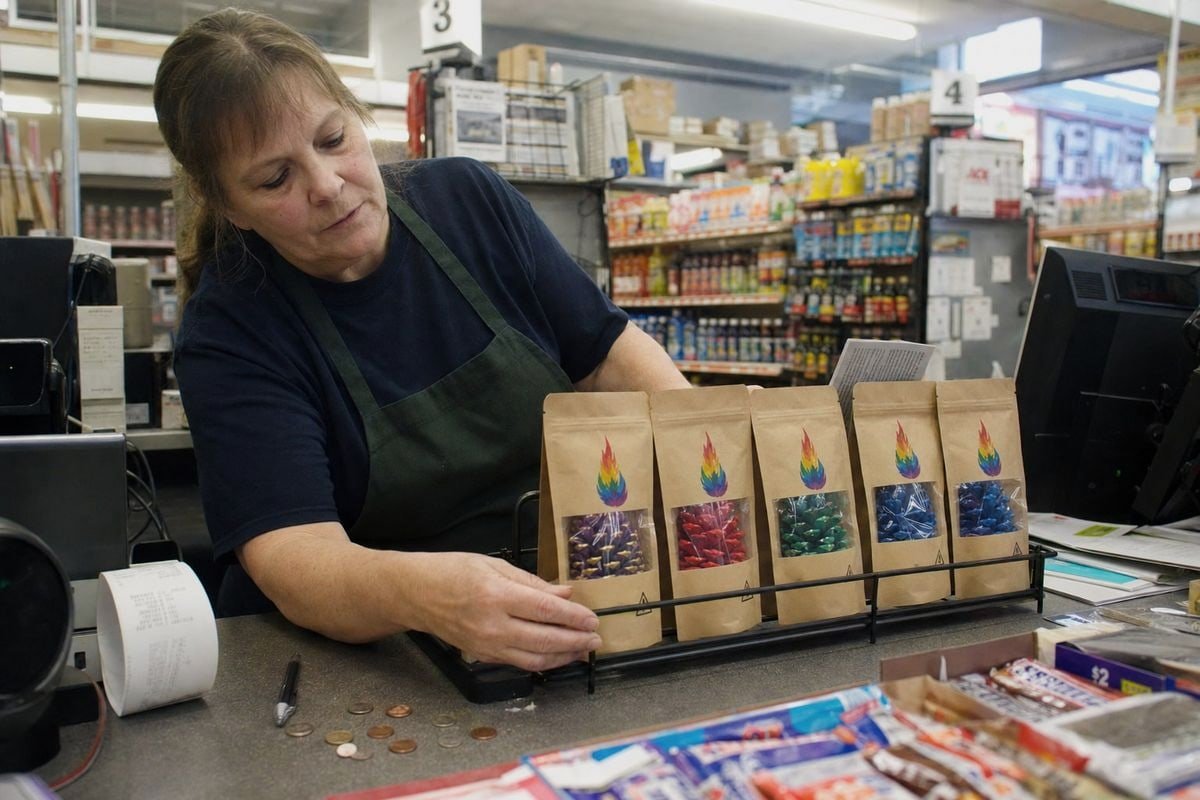
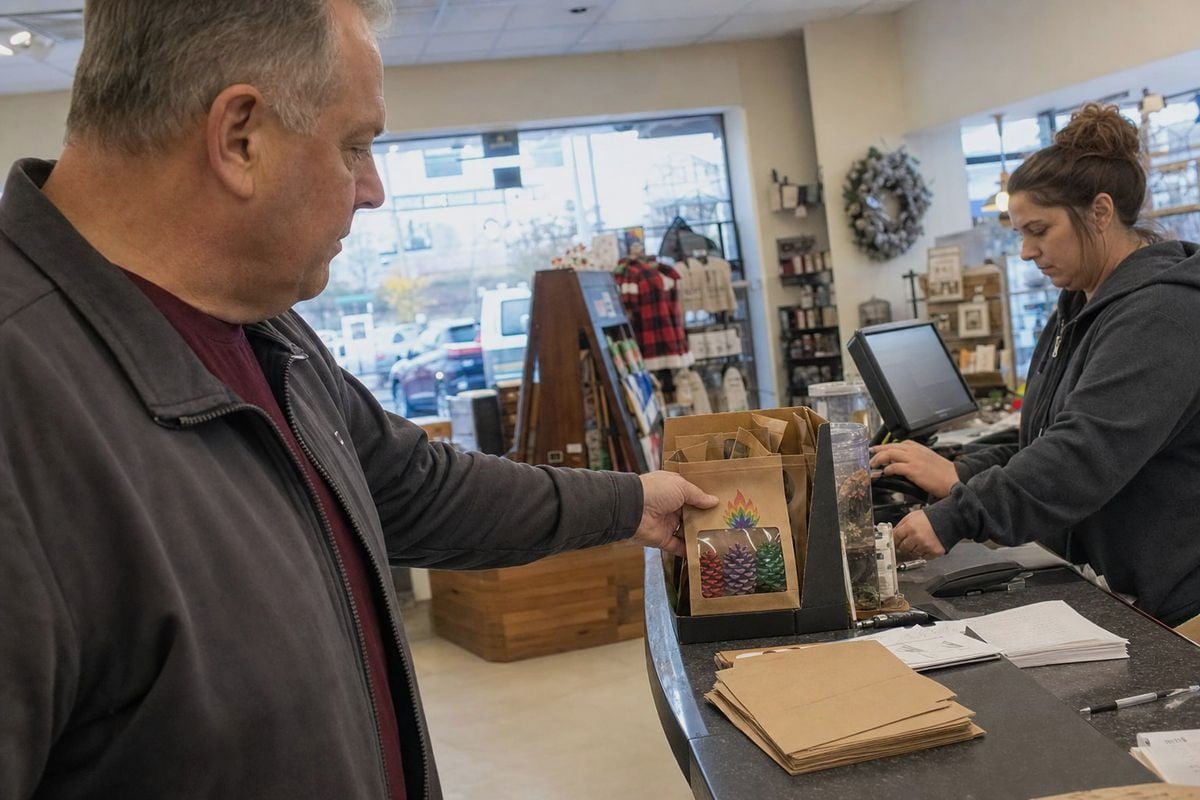
Use a compact kraft pouch or windowed box with a printed rainbow-flame visual, a clear product name, and a three-step instruction card. Display it in a countertop tray or tiered stand near candles and hearth accessories, with a flame-color swatch or QR video preview.

The core problem is this: a colored pine cone looks like an ordinary pine cone until it burns. Your packaging must sell an effect the shopper cannot see. That is why the strongest point-of-purchase 4 displays for this category lean on visuals, not text.
Packaging Elements That Convert
We have found three formats work well, and each suits a different retail channel:
| Format | Aesthetic | Bester Kanal |
|---|---|---|
| Kraft-Standbodenbeutel mit Fenster | Outdoorsy, eco-craft | Camping und Outdoor-Einzelhandel |
| Burlap-Kordelzugbeutel | Rustic, artisanal | Gift shops, farm stores |
| Windowed gift box | Premium, seasonal | Department and holiday retail |
A clear window or printed color gradient tells the story in one glance. Breathable materials like burlap and cotton mesh also prevent moisture buildup, which protects wax-coated cones in humid stockrooms. For premium lines, plantable seed-paper tags add an eco-friendly story that gift buyers respond to.
Display Tactics That Reduce Hesitation
Retail counter displays work best when they answer the shopper's silent question: does this actually work? Three proven tactics help. First, print a flame-color swatch panel on the tray. Second, add a QR code linking to a ten-second real-fireplace video. Third, consider a small glow-sample jar with battery LEDs to simulate the effect under store lights. For engaged retailers, a pick-and-mix bin where customers build a custom color palette raises both engagement and basket value. Place the display near matches, candles, and firewood tools — this is seasonal merchandising, so context sells the product. Our factory supplies custom display trays, barcodes, and private-label artwork as part of one-stop OEM packaging, so buyers do not need to coordinate a separate display vendor.
How Can I Ensure My Starter Pack Meets Compliance Standards for My Target Market?
The hardest lesson from 17 years of exporting fire products to 30-plus countries is that compliance failures kill programs faster than weak sales ever do. One rejected shipment can end a retail relationship.
Ensure compliance by using non-toxic, tested flame colorants, printing market-specific warning labels, and requiring supplier certifications such as CE marking plus SGS or Intertek test reports. State clearly that cones are for wood-burning fireplaces and fire pits only, never cooking or gas logs.
Compliance for color-flame products covers three layers: the chemistry, the labeling, and the supplier's paperwork. Skip any one layer and you carry the risk personally.
Layer One: The Chemistry
Not all flame colorants are equal Flammentest 5. Some DIY recipes reference compounds like Kupfersulfat 6, which raises handling and toxicity questions in consumer products. Our formulations use eco-friendly colorant systems with no harmful chemicals, validated by third-party testing. When you evaluate any supplier, ask exactly which chemical flame colorants they use and request the safety data. If they hesitate, walk away.
Layer Two: The Labeling
Your pack needs a high-visibility disclaimer stating the product is for wood-burning fires only — not for cooking, not for gas logs, and not for ventless fireplaces. This is not optional. Product listings in this category already carry ventless-appliance warnings, and retailers in the US and EU expect them. Add "keep away from children," ignition instructions, and a note that flame colors vary with burn conditions. We print market-specific warning labels, barcodes, and multilingual text as standard OEM work for buyers in the US, Germany, France, and beyond.
Layer Three: The Paperwork
Serious retail sourcing channels will ask for documentation before a purchase order. Here is the checklist we hand new buyers:
- Factory quality system certification, such as ISO 9001 7.
- Social compliance audit, such as BSCI, for larger retail programs.
- Product test reports from SGS or Intertek for your destination market.
- CE documentation where applicable for European distribution.
- Batch-level QC records, so mass production matches the approved sample.
That last point deserves emphasis. In our production lines, batch-to-batch consistency is a controlled process, because a starter pack that burns beautifully in the sample and poorly in the container load will destroy your reorder rate.
Schlussfolgerung
A winning starter pack of fireplace colored pine cones combines 3–6 tested cones, visual-first impulse packaging, smart counter placement, and full compliance documentation. Start with a small trial run, measure sell-through, then scale seasonally.
Fußnoten
1. Official EU source explaining CE marking requirements referenced for compliance certification. ↩︎
2. Background on the chemical compound used as a red flame colorant additive. ↩︎
3. Explains consumer psychology behind impulse buying, central to the checkout display strategy. ↩︎
4. Background concept on retail



 English
  Spanish
  German
  French
  Arabic
  Portuguese
Diskutieren Sie mit