






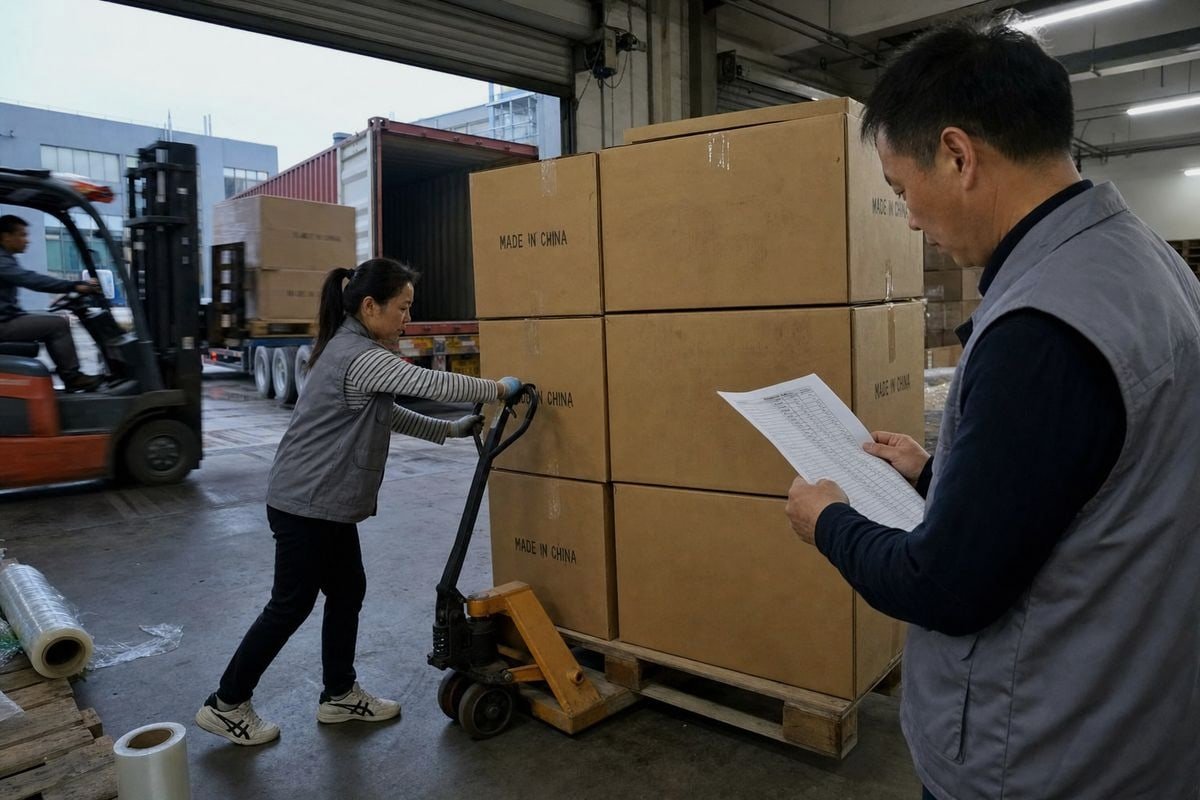
Country of origin labeling on fireplace pine cones trips up more importers than any duty question. I have watched shipments from our Ningbo lines get flagged over one missing sticker.
Fireplace pine cones imported into the U.S. must be marked with the English name of the country of origin, such as "Made in China," in a conspicuous, legible, and permanent way on the item or its retail container, following 19 CFR Part 134 marking rules.
The rule sounds simple. The details are not. Below, I break down exactly what CBP expects, where the label goes, and how to avoid a costly hold at the port.
What Are the U.S. Customs Requirements for Marking "Made in China" on Imported Pine Cones?
A buyer from Ohio once asked me why his sample bag said nothing about China. That question saved his first container, because we fixed the marking before production started.
U.S. Customs requires every foreign-origin article, including fireplace pine cones, to carry the English country name — for example, "Made in China" — under 19 CFR Part 134. The marking must be conspicuous and permanent, legible to a person of normal vision, and must reach the ultimate purchaser intact.
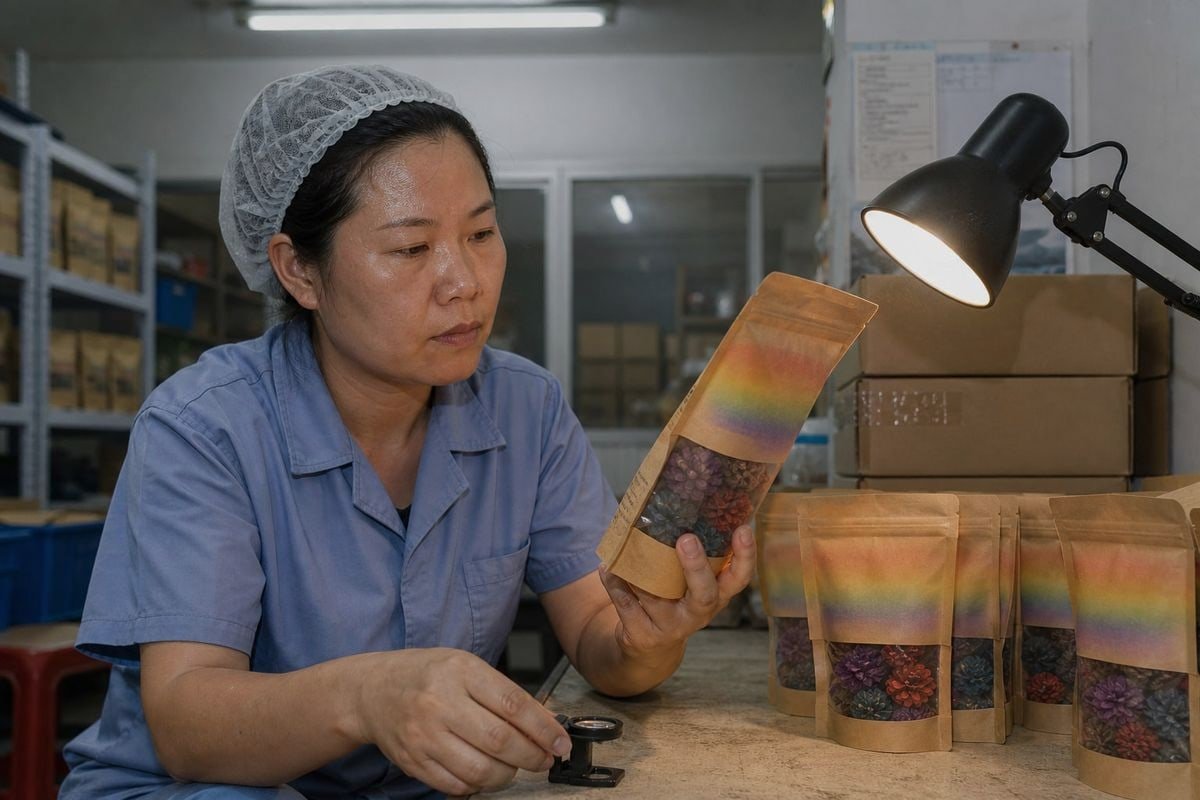
The legal foundation here is the marking of imported articles statute, implemented through 19 CFR Part 134 1. CBP applies it to almost everything that crosses the border, and decorative or color-flame pine cones are no exception. There is no special carve-out for botanical décor. Your pine cones fall under the ordinary framework for imported merchandise.
Who Is the "Ultimate Purchaser"?
CBP cares about one person: the ultimate purchaser 2. That is the last person in the U.S. who receives the product in its imported form. For retail fireplace pine cones, that is the shopper who picks the bag off the shelf. The origin marking must survive shipping, warehousing, and shelf placement so that shopper can read it without effort.
What "Conspicuous and Permanent" Means in Practice
CBP does not demand engraving on every cone. It demands a marking method appropriate to the product. For a kraft pouch or burlap sack, a printed line or a firmly adhered label works. For loose cones sold individually, the immediate container usually carries the marking instead.
| Anforderung | What CBP Expects | Practical Method for Pine Cones |
|---|---|---|
| English wording | Full country name, e.g., "Made in China" | Avoid abbreviations or Chinese-only text |
| Conspicuous | Visible with casual handling | Front or back panel, not under a fold |
| Legible | Readable by normal vision | Minimum practical font size, clear contrast |
| Permanent | Durable for the product's life cycle | Printed on packaging or a strong adhesive label |
There is one more wrinkle worth raising. Some buyers assume that because pine cones are grown in a forest, the harvest country always controls. Not true. If cones harvested in one country are dipped, waxed, or chemically treated in another, that processing can amount to substantial transformation 3, shifting the legal country of origin to the processing site. Since we harvest, treat, and pack in China, our cones are cleanly "Made in China" — but if your supply chain splits across countries, get a customs broker's opinion before you print packaging.
Where Exactly Should I Place the Country of Origin Label on My Retail Packaging?
Packaging placement is a trade-off we weigh on every private-label project: the label must satisfy CBP, yet not fight with the brand artwork our clients spent months designing.
Place "Made in China" on the outermost container that reaches the ultimate purchaser — the front or back panel of the retail bag, pouch, or box — in a spot visible without opening, unfolding, or removing anything. If individual cones are excepted from marking, the retail container must still be marked.
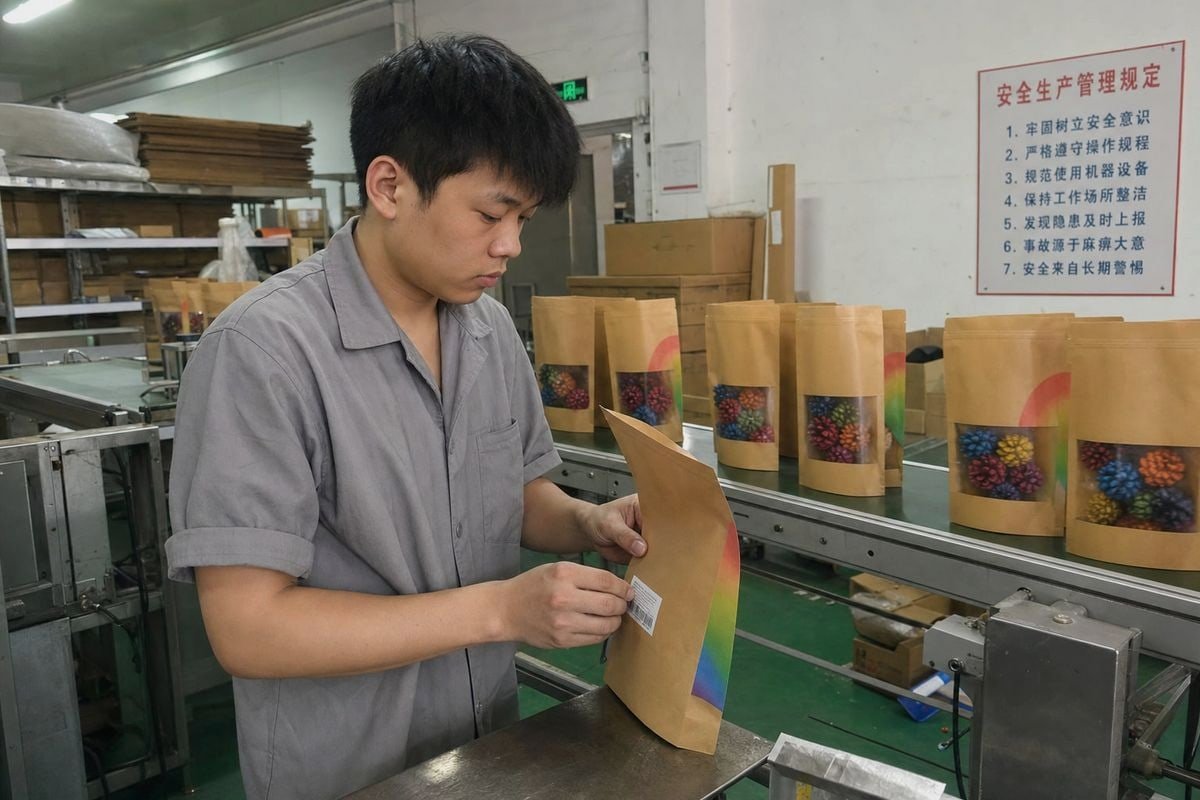
The core principle is simple: CBP inspects what the shopper sees. For fireplace pine cones, the compliance surface is almost always the retail package, not the cone itself. Loose natural cones are impractical to mark individually, so the immediate container carries the obligation. But placement still matters, and this is where importers stumble.
Placement by Packaging Format
We produce three common formats — hand-painted cone sets, burlap drawstring sacks, and stand-up resealable kraft pouches — and each has its own best-practice placement.
| Verpackungsformat | Recommended Label Position | Common Mistake to Avoid |
|---|---|---|
| Stehbeutel aus Kraftpapier mit Fenster | Back panel, near the barcode block | Hiding it inside the resealable flap |
| Burlap-Kordelzugbeutel | Sewn-in or adhered tag on the body | Printing only on a removable hang tag string |
| Gift box for painted cone sets | Bottom or back exterior panel | Marking only the inner tray, not the outer box |
| Master carton for e-commerce | Outer shipping carton plus retail unit | Marking the carton only and not the retail bag |
Three Rules That Keep You Safe
First, the marking must not be hidden by later attachments. A shrink band, a promotional sticker, or a folded header card that covers "Made in China" defeats the conspicuous requirement. Second, if your fireplace pine cones sell as part of a set with matches or firestarters from different countries, disclose the origin of each distinct component on the retail packaging. Third, for e-commerce shipments, CBP increasingly wants origin visible on the outermost shipping container too, since that speeds de minimis clearance 4. On our OEM lines, we place the origin statement in the artwork file at the design stage, right beside the barcode and warning text, so it can never be forgotten during a repack or artwork revision.
Can My Supplier Help Me Get Compliant Labeling and Documentation Before Shipping?
Over 17 years of exporting fire products to the U.S., Germany, and 30-plus other markets, we have learned that compliance work done before shipping costs a fraction of fixing it at the port.
Yes — a capable factory should print the origin marking into your packaging artwork, supply the commercial invoice with correct HTS code classification, arrange the USDA APHIS phytosanitary certificate, prepare Lacey Act declaration data, and provide test reports before the container ever leaves China.
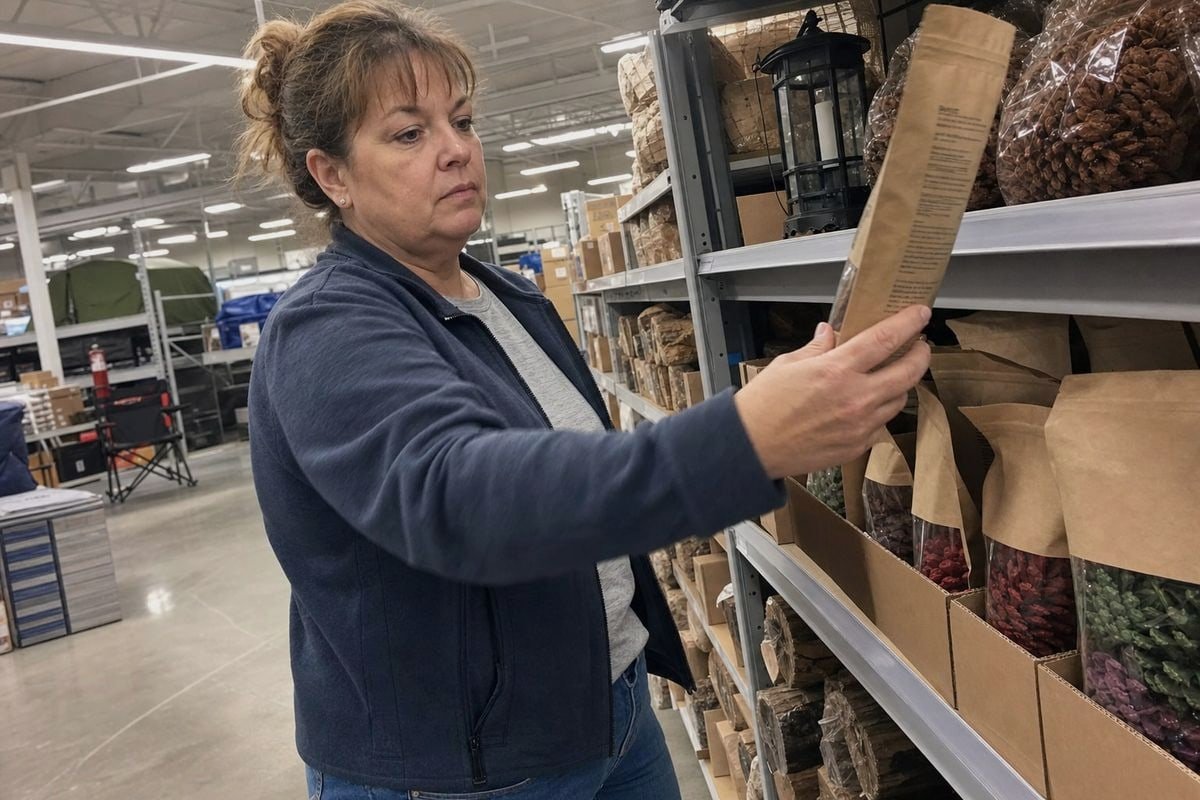
Documentation for plant-based fire products is heavier than most importers expect. Pine cones are botanical material, so they trigger agricultural controls on top of the standard customs paperwork. A supplier who only quotes a unit price and leaves the paperwork to you is transferring risk, not saving you money. Here is what we handle on a typical U.S.-bound order, and what you should demand from any factory.
The Pre-Shipment Compliance Checklist
- Artwork lock with origin marking. We add "Made in China" to your dieline next to the barcode and any Bundesgesetz über gefährliche Stoffe 5 cautionary text required for color-flame chemistry, then send a proof for sign-off.
- HTS code classification confirmed in writing. Natural dried cones typically classify under 0604.99.3000 (duty-free), while painted or frosted cones fall under 0604.99.6000 at 11%. That gap changes your landed cost, so classify before you price.
- Phytosanitary certificate. USDA APHIS expects proof the cones are free of invasive pests and wood-boring insects 6. We coordinate the Wärmebehandlung and inspection with Chinese plant quarantine authorities.
- Lacey Act declaration data. You file it as importer, but we supply the species name and harvest country so your broker can complete it accurately.
- Handelsrechnung und Packliste stating the country of origin consistently with the packaging — mismatches between documents and labels invite exams.
- Wood packaging compliance. Pallets and crates must meet ISPM 15 standards 7 with the HT stamp, or the whole shipment can be refused at the port.
- Drittanbieter-Testberichte. Our SGS and Intertek reports cover the color-flame formulation, which matters because very high chemical concentrations can push a product toward HTS Chapter 36 pyrotechnic classification. We formulate to stay clearly in the décor category.
One caution I give every new buyer: ask your supplier to show real certificates, not promises. Our ISO 9001, BSCI, and CE documentation exists because U.S. and EU retail channels treat it as a hard gate, and yours will too.
What Happens If My Fireplace Pine Cones Are Mislabeled or Missing Origin Marks at Customs?
The most expensive lesson I have seen a client learn involved a container held three weeks because a shrink sleeve covered the origin line on every pouch.
CBP can detain mislabeled fireplace pine cones, demand remarking under supervision, assess a marking duty of 10% of the goods' value, or order redelivery, re-export, or destruction. You also risk exam fees, storage charges, missed retail delivery windows, and increased scrutiny on future shipments.
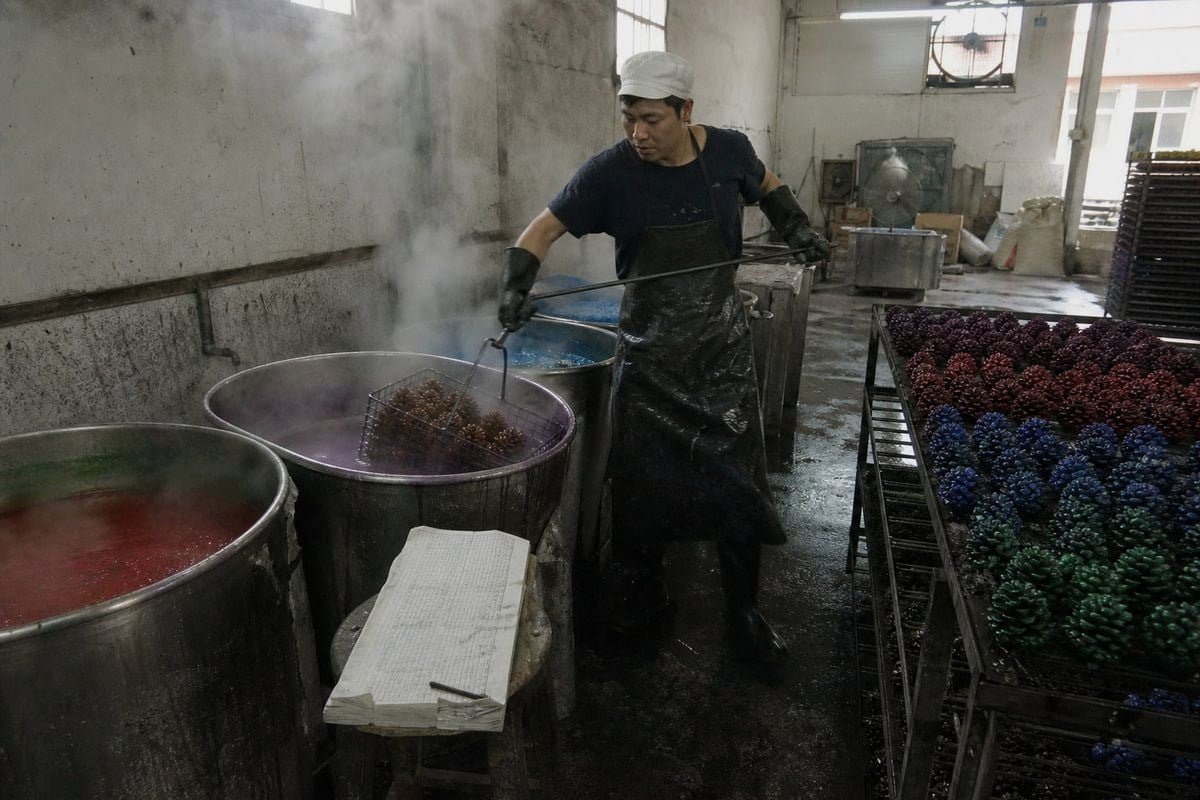
The consequences escalate depending on how the problem is found and how you respond. Understanding the ladder helps you decide how much prevention is worth. In my view, prevention wins every time, because the indirect costs — lost shelf dates, chargebacks from big-box retailers, damaged broker relationships — usually exceed the formal penalties.
Die Eskalationsleiter
| Phase | What CBP Does | Cost to You |
|---|---|---|
| Detention | Holds goods, issues a marking notice | Storage and demurrage fees start immediately |
| Remarking | Requires labels applied under CBP supervision | Labor, label printing, supervision costs, delays |
| Marking duty | Assesses 10% additional duty on unmarked goods | Direct hit to landed cost and margin |
| Redelivery or re-export | Orders goods returned or shipped out | Freight both ways, likely a lost season |
| Repeat offender status | Flags future entries for exams | Slower clearance on every shipment after |
Why Pine Cones Get Extra Attention
Remember that origin marking is only one trigger. Botanical products invite agricultural holds if the Pflanzengesundheitszeugnis is missing or the pallets fail ISPM 15 standards. Color-flame products invite chemical questions if hazard labeling is absent. When one deficiency appears, officers tend to look harder at everything else. A clean, consistent package — origin mark, hazard statements, matching commercial invoice — signals a professional importer and speeds you through. In our experience shipping to U.S. distributors for over a decade, containers with complete, consistent labeling rarely get pulled twice.
Schlussfolgerung
Mislabeled origin marks stall shipments and burn margins. Mark fireplace pine cones "Made in China" conspicuously on retail packaging, align every document, and partner with a factory that builds compliance in from day one.
Fußnoten
1. Official regulation text governing country of origin marking for imports. ↩︎
2. Legal definition clarifying who qualifies as the ultimate purchaser under CBP rules. ↩︎
3. Authoritative International Trade Administration guide on the substantial transformation principle for country of origin marking. ↩︎
4. CBP's own explanation of de minimis entry rules affecting e-commerce shipments. ↩︎
5. Official CPSC statute page for hazard labeling requirements mentioned in the checklist. ↩︎
6. USDA APHIS resource on pest controls relevant to phytosanitary certification for botanical imports. ↩︎
7. Explains the international wood packaging treatment standard referenced for pallets. ↩︎


 English
  Spanish
  German
  French
  Arabic
  Portuguese
Diskutieren Sie mit