






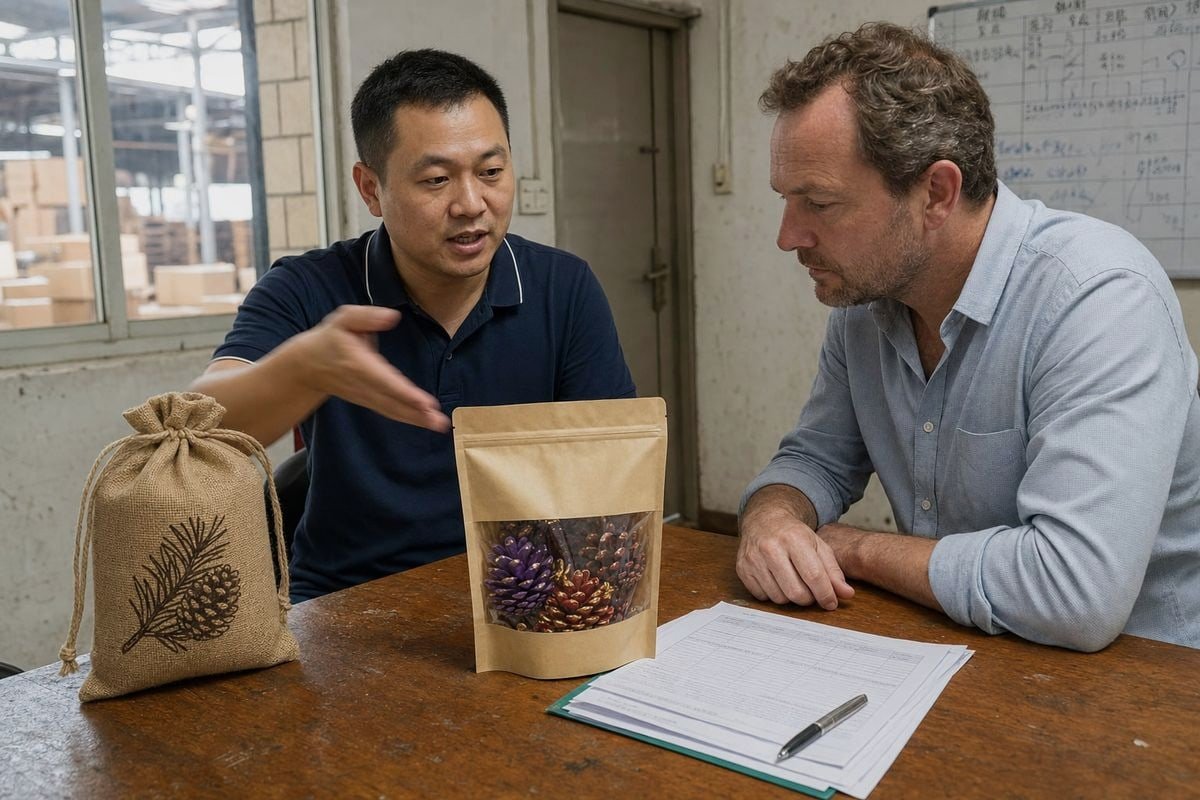
Choosing between branded vs private label colored pine cones can quietly drain your margins if you guess wrong HS-Code-Klassifizierung 1. On our color-flame pinecone lines, we see importers face this exact dilemma every season.
Compare branded vs private label colored pine cones on five factors: profit margin, certification burden, quality consistency, MOQ flexibility, and brand control. Branded goods launch faster with built-in trust; private label delivers higher long-term margins, exclusive packaging, and full ownership of your seasonal decor brand.
Both models can work. The right choice depends on your channel, your budget, and your growth plan. Let me walk you through each factor, starting with the one that stops shipments cold: certification.
What Certifications Should I Require Before Comparing Branded and Private Label Pine Cones?
A buyer from Germany once told me his previous supplier's shipment sat in customs for six weeks over missing test reports. In our export work across 30+ countries, paperwork failures kill deals faster than pricing does.
Require ISO 9001 for quality management, BSCI for social compliance, CE marking where applicable, and third-party test reports from SGS or Intertek before comparing any suppliers. For color-flame pine cones, also verify chemical safety documentation and phytosanitary or fumigation certificates depending on the destination country.
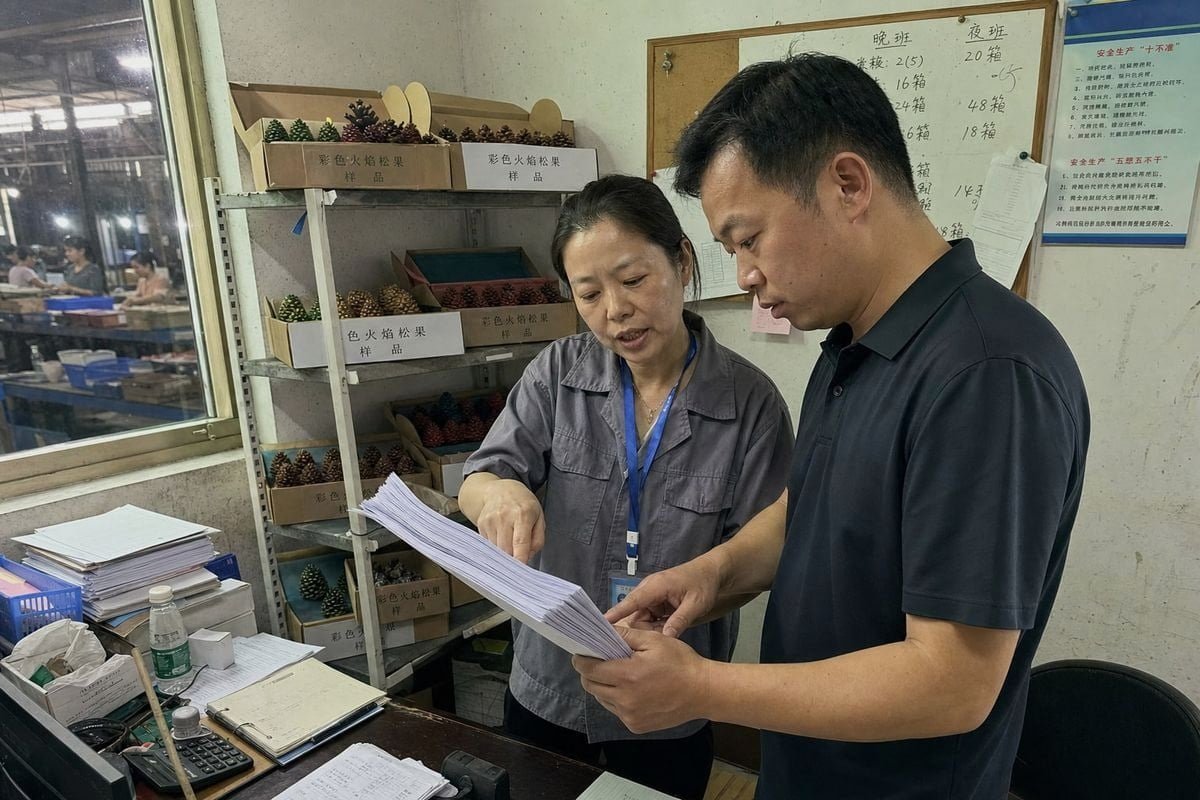
Certification is the first filter, not the last. Whether you buy branded or private label, the goods clear customs under your name as the importer. That means the liability sits with you, not the factory or the brand owner. I have seen buyers assume a branded product automatically carries full documentation. Sometimes it does. Sometimes the brand owner holds reports that they will not share with resellers, which leaves you exposed if a marketplace or retailer asks for proof.
Why Private Label Shifts the Compliance Burden to You
With branded goods, standardized QC protocols 2 and certifications are often built into production. With private label, you must independently confirm the factory holds valid certificates and arrange third-party inspections 3 yourself. This is not a reason to avoid private label. It is a reason to pick a factory that already treats compliance as a hard requirement. At our plant, we hand over ISO 9001, BSCI, CE, and SGS/Intertek reports at the quotation stage, because our US and EU buyers cannot move forward without them.
The Documentation Checklist I Recommend
| Dokument | Branded Sourcing | Private Label Sourcing |
|---|---|---|
| ISO 9001 Fabrikzertifikat | Usually held by brand owner | Must verify directly with factory |
| BSCI Sozialaudit | Often available on request | Request current audit report |
| SGS/Intertek-Testberichte | Tied to brand's SKUs | Must cover your custom specs |
| CE-Kennzeichnung (wo zutreffend) | Brand's responsibility | Your responsibility as brand owner |
| Phytosanitary/fumigation docs | Included per shipment | Confirm per shipment and origin |
| Country-of-origin labeling | Pre-printed by brand | You must specify correctly |
One more legal point. If you resell a branded product and alter its packaging, labels, or claims without authorization, you take on trademark liability 4. Private label removes that risk entirely because the mark is yours. But then accuracy becomes your job: your packaging claims, warning labels, and origin statements must be correct. We print warning labels and barcodes for private-label clients precisely because getting these wrong is expensive.
How Do Private Label Colored Pine Cones Affect My Profit Margins Compared to Branded Options?
The trade-off I discuss most with purchasing managers is simple: pay a brand premium now, or invest in packaging setup once. After 17+ years of quoting both ways, the math almost always favors private label past the first two seasons.
Private label colored pine cones typically deliver higher margins because you skip the brand owner's markup and control retail pricing. Expect higher upfront costs for packaging design and setup, but lower per-unit costs at scale and stronger pricing power once your own brand gains traction.
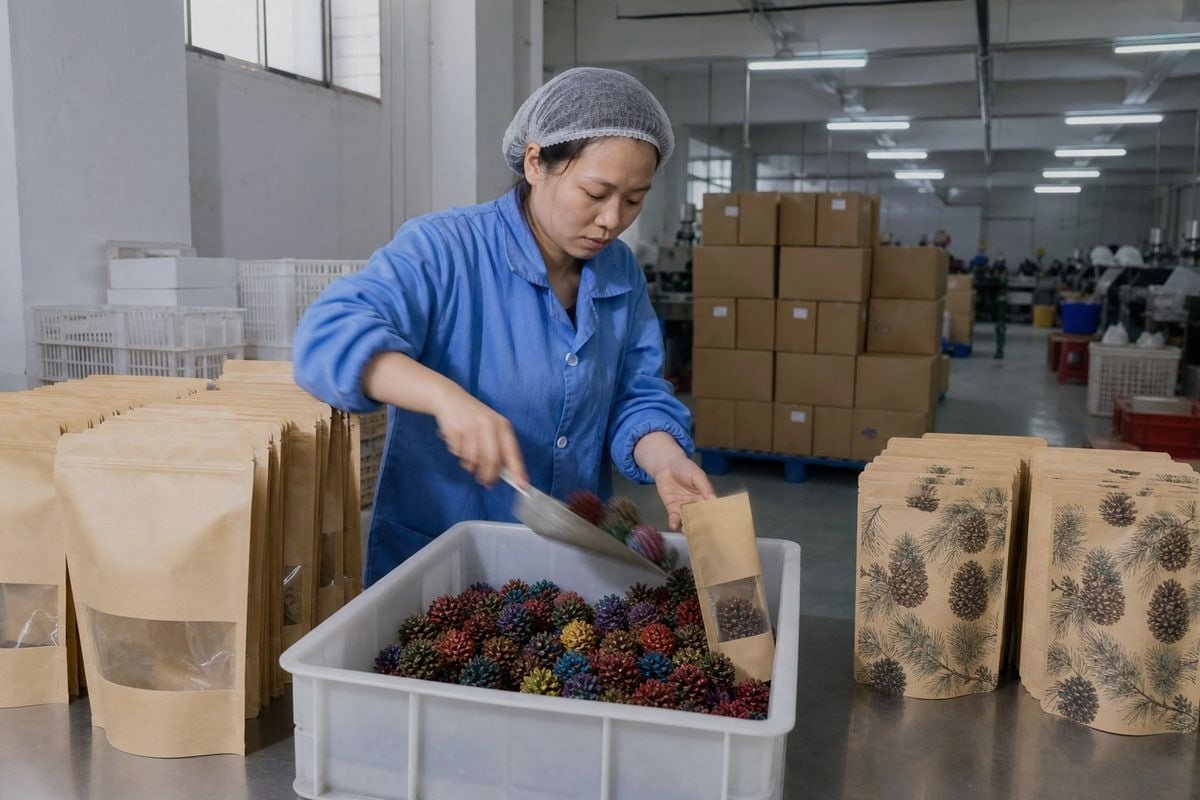
Let me break down where the money actually moves. When you resell a branded product, part of your landed cost is the brand premium. That premium buys you consumer trust and marketing collateral, which has real value in year one. But it compresses your margin permanently, and you cannot escape it by scaling volume. Worse, other resellers can source the same branded item and undercut you on price, because buyers compare identical listings instantly on marketplaces.
Private label flips the structure. Your setup costs are front-loaded: custom pouch printing, label artwork, branded master cartons, sometimes plate fees. But the pine cones themselves are a relatively low-technology natural product. The factory cost is similar to what the brand owner pays. Once your packaging is set up, every reorder captures the margin the brand owner used to take.
A Simplified Margin Comparison
| Kostenfaktor | Branded Resale | Wir arbeiten mit Importeuren, Großhändlern, Markeninhabern, großen Einzelhändlern, Distributoren von Outdoor-Produkten, Verkäufern von Kaminzubehör und Käufern von saisonalen Geschenken zusammen, die stabile Qualität, praktische Verpackungen und zuverlässige Exportkommunikation benötigen. |
|---|---|---|
| Per-unit product cost | Higher (includes brand markup) | Lower at scale |
| Packaging setup | Keine | One-time investment |
| Retail pricing control | Limited (MAP rules possible) | Volle Kontrolle |
| Price comparison risk | High (identical listings) | Low (unique SKU) |
| Margin trajectory | Flat or shrinking | Expanding with volume |
| Demand generation cost | Low (brand carries it) | You build reviews and visibility |
The Hidden Landed-Cost Angle
Do not forget HS-Code-Klassifizierung 5. Finished branded decorative products and bulk private-label pine cones can classify differently, and duty rates affect total landed cost in ways buyers often miss. We advise clients to run both scenarios past their customs broker before comparing quotes. A cheaper FOB-Preis 6 on branded goods can lose its advantage after duties and the brand premium stack up. In our experience, e-commerce sellers feel this most, because their real battleground is packaging design and search visibility, not legacy brand recognition. That is exactly where private label spends its money.
Can a Private Label Supplier Match the Quality Consistency of Established Branded Pine Cones?
Batch-to-batch color consistency is where I have watched importers get burned. One client came to us after a previous private-label supplier shipped a second run with visibly duller dye than the approved sample. His retail buyer rejected the whole container.
Yes, a private label supplier can match branded quality consistency, but only if the factory runs documented batch controls, dye stability testing, and pre-shipment inspections. Verify UV exposure, humidity resistance, and color-bleed performance across sample lots before committing, since no brand reputation covers you.
The honest answer is that the pine cone itself is often similar across suppliers. Differentiation comes from process discipline, not product engineering. Established brands earned their reputation through repeatable QC. A private-label factory either has that same discipline or it does not, and you need to test for it rather than assume.
Here is what actually varies between batches of colored pine cones: dye intensity, colorfastness 7, cone size grading, moisture content, odor, dusting, and breakage during transit. For our color-flame pinecones, we add another layer: the flame-color effect must perform identically from the first sample to the ten-thousandth unit, because a fireplace product that underperforms generates returns and reviews you cannot undo.
How to Test a Private Label Supplier Before Committing
- Order sample lots from two separate production runs, not one. Consistency between runs tells you more than one perfect sample.
- Run dye stability checks yourself: UV exposure, humidity resistance, and color bleed under moisture. Defects in decorative goods are visual, so visual testing matters most.
- Set photo standards in writing. Agree on reference images for acceptable color range, gold-tip coverage, and cone size before mass production.
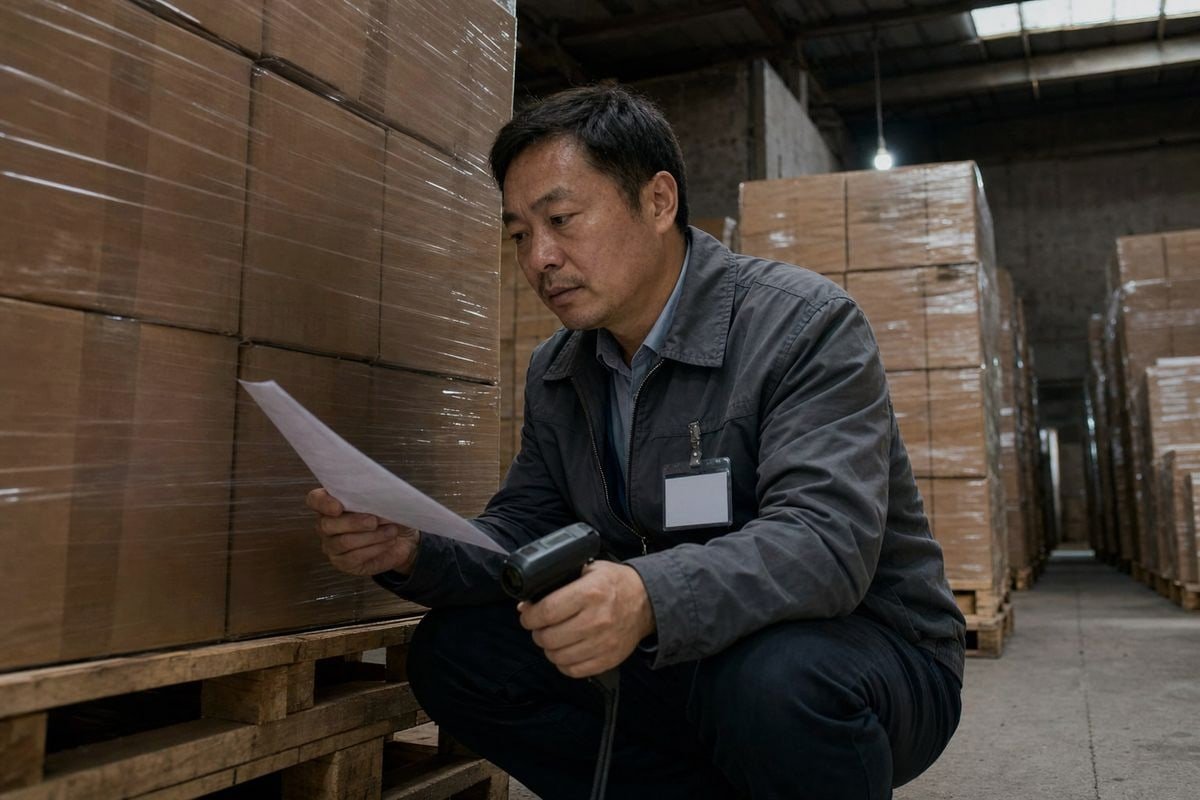
- Require pre-shipment inspection, either third-party or with documented factory photos against your standards.
- Test packaging abrasion. Painted cones rubbing inside a pouch or carton during a sea voyage can arrive scuffed.
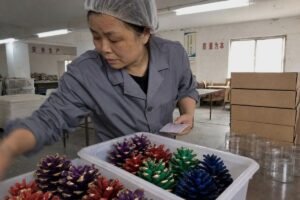
At our factory, the promise we make is specific: the first sample reliably reflects mass-production quality, because the sample runs on the same lines with the same batch controls. Ask any private-label candidate to make that same commitment in writing. If they hesitate, that hesitation is your answer. A factory with 17+ years of complete production lines behaves very differently from a trading company relaying your specs to an unknown workshop.
What MOQ and Customization Options Should I Expect When Switching to Private Label Pine Cones?
A first-time importer from the Netherlands recently asked me for 300 units to test her gift-shop channel before committing to a container. That conversation happens weekly, and it shapes how we structure trial MOQs.
Expect private label MOQs of roughly 500 to 2,000 units depending on packaging complexity, higher than branded small-batch options. In exchange, you gain full customization: dye colors, flame effects, pouch or jar packaging, label artwork, warning labels, barcodes, and branded master cartons.

Branded suppliers usually offer flexible small batches because the product and packaging already exist on the shelf. Private label carries higher MOQs because custom printing runs, label plates, and packaging setup need volume to make economic sense. That is the structural reality, but the gap is narrower than most buyers fear, especially with packaging formats that print in smaller runs.
What "Customization" Really Means for Pine Cones
Private label here does not mean re-engineering the product the way it would for electronics. It means controlling presentation and specification within the factory's process. From our own OEM/ODM work, the realistic menu looks like this:
| Anpassungsbereich | Typische Optionen | MOQ Impact |
|---|---|---|
| Color/finish | Dye colors, metallic tip accents, gloss level | Low — within existing process |
| Flammeneffekt | Color-flame formulation, burn time | Niedrig bis mittel |
| Verpackungsformat | Kraft pouch, burlap sack, plastic jar, resealable bag | Medium — drives print MOQ |
| Etiketten-Artwork | Full custom design, your logo and story | Low — digital printing helps |
| Konformitätsdruck | Warning labels, barcodes, origin marks | Low — but must be correct |
| Retail-ready extras | Display boxes, seasonal collection names | Medium to high |
A Practical Middle Path
You do not have to choose all-or-nothing on day one. A pattern that works well: start with a generic or lightly branded trial order to validate which colors, pack sizes, and channels sell in your market. Then commit to full private label once the data is in. We support this deliberately with lower trial MOQs and branded samples, because a buyer who validates demand first becomes a long-term reorder client, not a one-season gamble. Ask your supplier whether branding is included in samples and how packaging standards are held between the trial run and mass production. Those two questions separate real factories from middlemen.
Schlussfolgerung
Branded pine cones buy speed and trust; private label buys margin, exclusivity, and a brand you own. Verify certifications and batch consistency first, then choose the model matching your growth plan — we are ready to support either path.
Fußnoten
1. Background on the Harmonized System used to classify goods and determine duty rates. ↩︎
2. ISO 9001 defines the quality management protocols referenced for branded and private label factories. ↩︎
3. SGS is a leading provider of the third-party inspection services importers must arrange. ↩︎
4. Explains the legal exposure importers face when altering branded packaging without authorization. ↩︎
5. WTO is the authoritative body governing international trade classification and customs standards. ↩︎
6. ICC Incoterms rules define FOB pricing terms used in international trade agreements. ↩︎
7. Defines colorfastness testing relevant to verifying dye stability in colored pine cones. ↩︎


 English
  Spanish
  German
  French
  Arabic
  Portuguese
Diskutieren Sie mit