






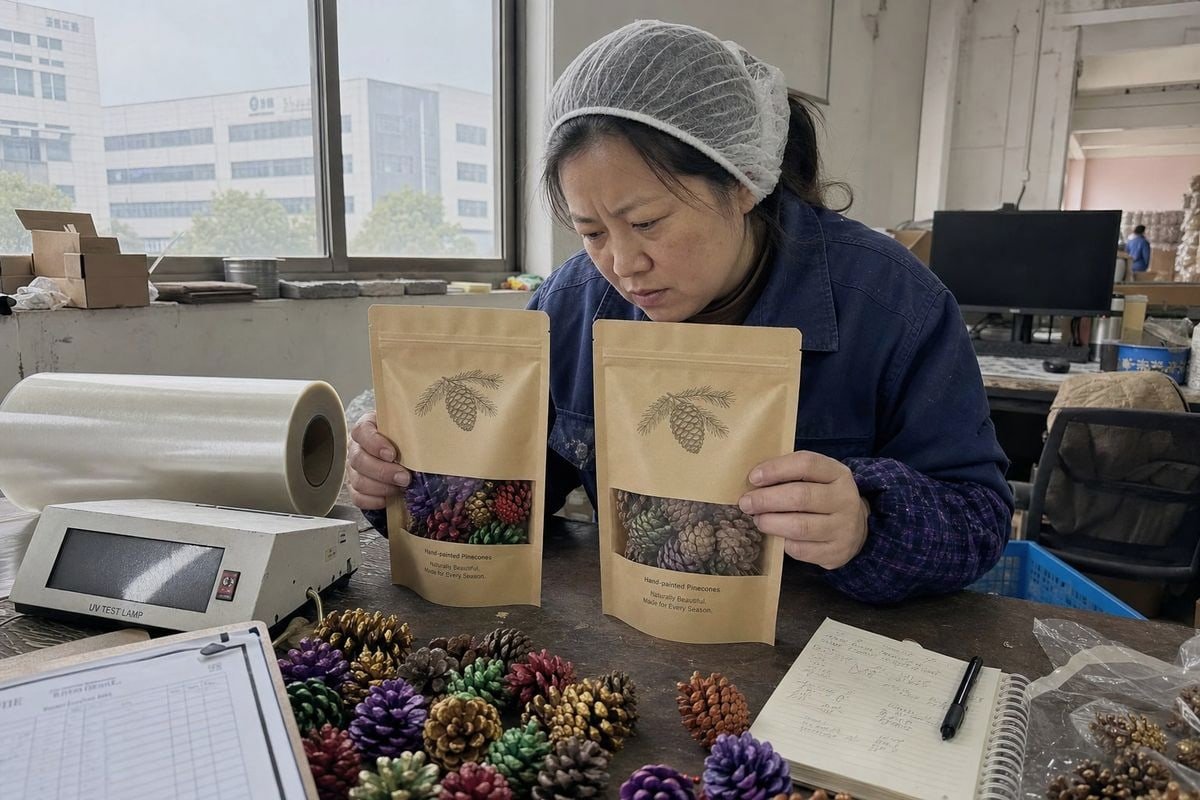
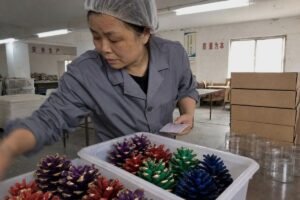
Fade-resistant packaging for colored pine cones became a priority at our factory after buyers reported washed-out shelf displays. Sunlight quietly destroys vibrant retail products, and dull packaging kills sell-through fast.
Choose fade-resistant packaging for colored pine cones by combining UV-blocking films or coatings, pigment-based UV-resistant inks, laminated moisture barriers, and heat-stable seals. Verify lightfastness ratings, request colorfastness testing reports, and run accelerated sun-exposure tests on samples before placing any bulk order.
That is the short answer. Below, I break down the certifications to check, the sample tests to run, the best materials, and how to get custom packaging without huge minimums.
What certifications should I verify to ensure the packaging materials won't degrade under UV exposure?
At our Ningbo production site, we keep a binder of packaging test reports on hand, because European buyers of our color-flame pinecones ask for documentation before they ask for pricing.
Verify ISO lightfastness ratings such as the Blue Wool Scale, ASTM G154 or ISO 4892 accelerated UV weathering reports, ink lightfastness certificates from the ink supplier, and third-party SGS or Intertek test documentation confirming the film or coating resists UV-driven pigment degradation.

In our experience exporting to 30+ countries, the certification conversation is where good suppliers separate from risky ones. A supplier who cannot show test data is asking you to gamble your shelf presence. Semi-outdoor displays get daylight, reflected light, and heat. That mix accelerates pigment degradation in both the printed graphics and the dyed cones inside.
Die wichtigsten Dokumente, die Sie anfordern sollten
Ask for these before you commit:
| Zertifizierung / Bericht | Was es beweist | Why It Matters for Semi-Outdoor Shelves |
|---|---|---|
| Blue Wool Scale (ISO 105-B02) | Ink and pigment lightfastness rating, graded 1–8 | Grade 6+ inks survive months of daylight; grade 3 inks fade in weeks |
| ASTM G154 / ISO 4892 | Accelerated UV weathering of the film or substrate | Simulates months of sun in days, exposing weak materials early |
| SGS / Intertek material report | Unabhängige Verifizierung von UV-stabilized plastic 1 claims | Stops suppliers from overstating additive content |
| MVTR test data | Moisture vapor transmission rate of the laminate | Humidity swings cause color bleed and packaging warp |
| Seal integrity / heat aging data | Adhesives and closures survive warm display conditions | Heat buildup weakens seals long before graphics fade |
Watch for vague language
Phrases like "sun safe" or "outdoor grade" mean nothing without a standard behind them. When we source films for our own kraft pouches and jar labels, we ask which UV absorbers or HALS stabilizers 2 are compounded into the plastic. A real answer includes additive types and loading levels. A vague answer is a red flag. Our ISO 9001 system requires us to keep this data traceable batch to batch, and I recommend you demand the same discipline from any packaging partner.
How do I test sample packaging for fade resistance before committing to a bulk order?
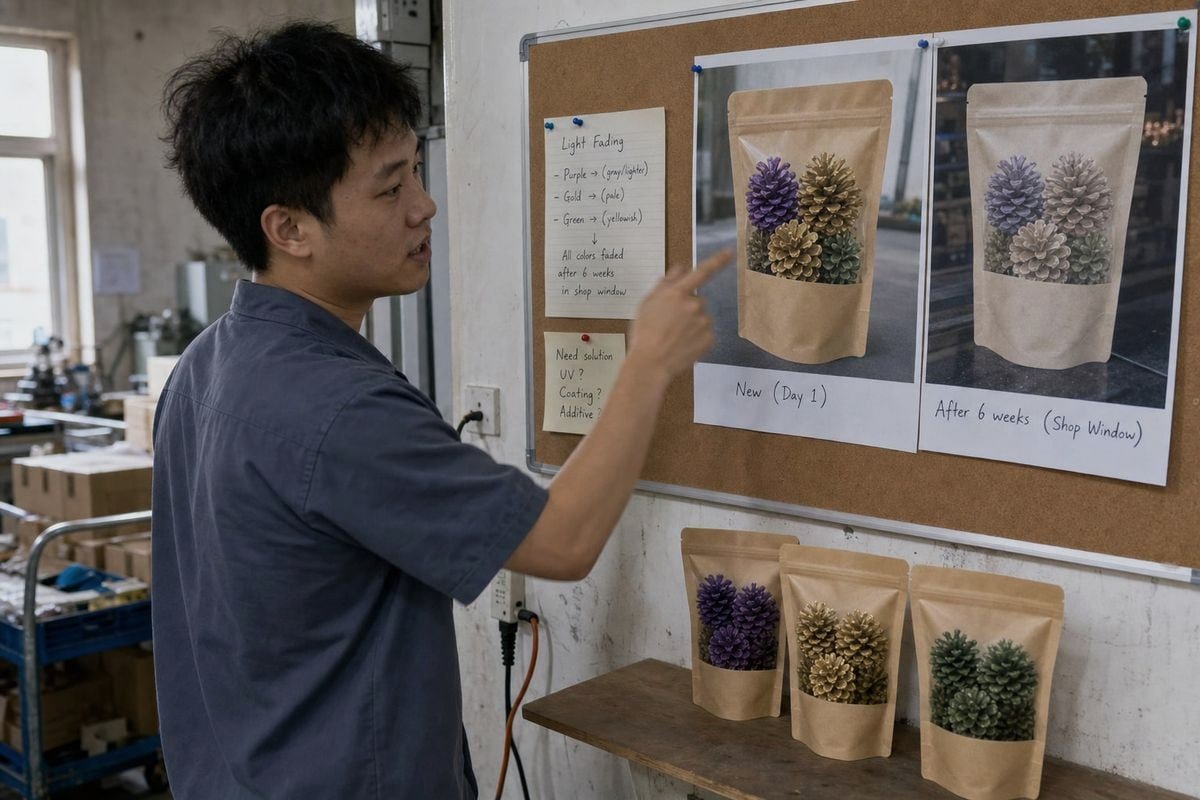
A German distributor once returned our early pouch samples with photos taped to them — one fresh, one after six weeks in his shop window. That side-by-side test changed how we validate packaging.
Test samples by splitting them into a control set kept in darkness and an exposure set placed in real or simulated sunlight for 4–8 weeks. Compare color shift with a spectrophotometer or reference swatches, and check seals, laminates, and window films for yellowing or warping.
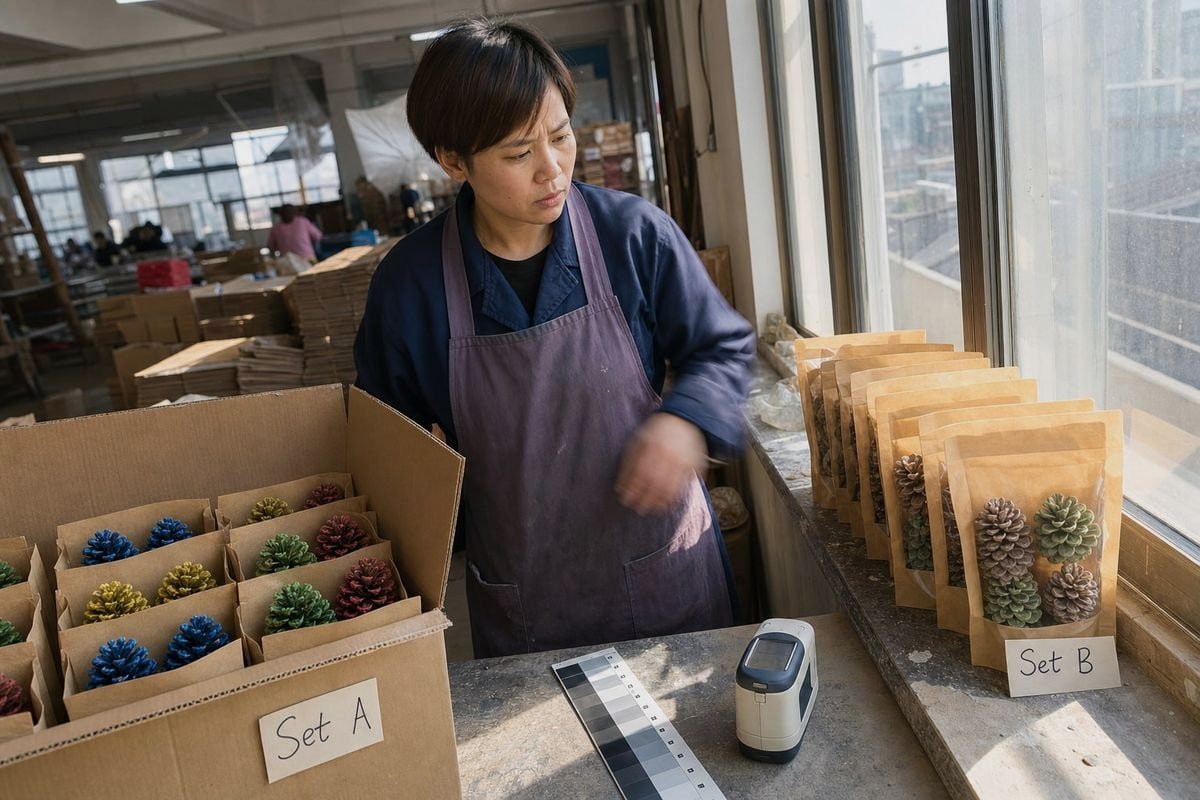
When we develop new display packaging for our Magic Fire packets and color-flame pinecones, we never trust a datasheet alone. Visible fading often appears only after cumulative exposure, so a quick glance at a fresh sample tells you almost nothing. You need a structured colorfastness testing routine, and it is simpler than most buyers expect.
A practical six-step sample test
- Order duplicate samples. Get at least six identical units so you can run controls and exposure sets side by side.
- Create a control. Seal two samples in an opaque box in a stable indoor room. These are your baseline.
- Simulate the real shelf. Place two samples in a south-facing window or under a UV lamp that mimics your semi-outdoor environment, including heat.
- Add humidity stress. Put the last two samples through daily humidity swings — a bathroom shelf works — to check the moisture vapor transmission rate performance and seal behavior.
- Photograph weekly under identical lighting. Use the same camera settings and a gray card so color shifts are comparable.
- Compare at week 4 and week 8. Look for graphic fading, clear-window yellowing, laminate lifting, seal softening, and any color transfer from the cones onto the inner film.
What failure looks like
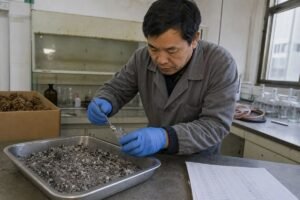
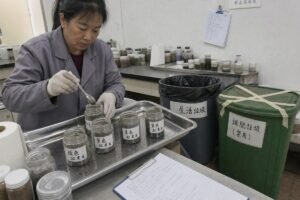
Fading rarely announces itself evenly. Reds and purples usually go first because those pigments are the least lightfast. Check the rainbow gradient areas and saturated brand colors before anything else. Also open the exposed pouches. If the painted cones inside show dulling or the glossy lacquered finish has hazed, the package is letting UV and moisture through even if the graphics still look fine. In our QC lab, we treat any visible shift at week 4 as a fail, because retail exposure runs far longer than eight weeks.
Which packaging materials and printing methods hold up best on semi-outdoor retail displays?
The trade-off we weigh most often in our packaging line is visibility versus protection. Buyers want customers to see the vibrant purple and gold cones, but every square inch of clear film is a square inch of UV entry.
Opaque laminated cartons or foil-lined pouches offer the best protection, followed by UV-filtering PET windows with pigment-based UV-resistant inks. Pair any format with a matte UV-blocking coating or laminate, and avoid untreated clear film, dye-based inks, and unlaminated paper.
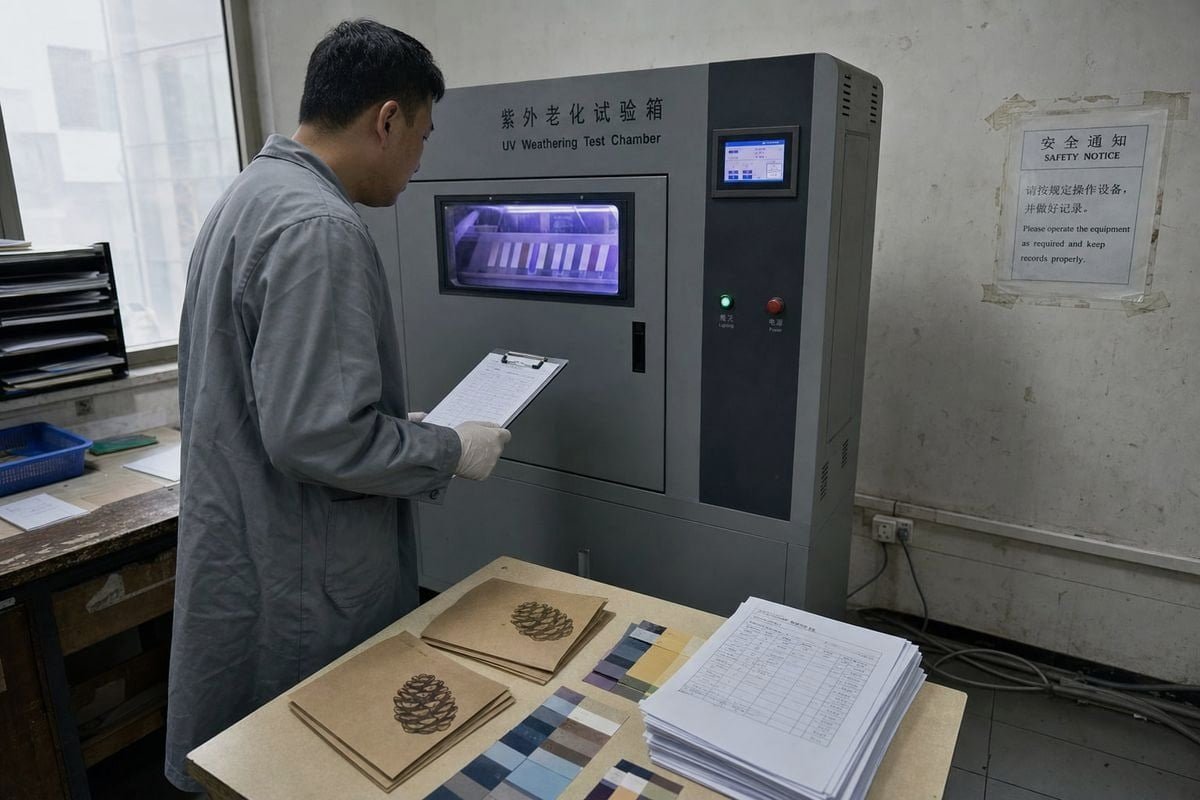
Having run these decisions through 17+ years of fire-product packaging, I frame it as a simple rule: design the package as a light barrier first and a display tool second. Here is how the main options compare for a semi-outdoor shelf.
| Verpackungsformat | UV Protection | Product Visibility | Moisture Resistance | Bester Anwendungsfall |
|---|---|---|---|---|
| Opaque laminated carton | Ausgezeichnet | None (use printed imagery) | Gut | Direct or near-direct sun exposure |
| Foil-lined stand-up pouch | Ausgezeichnet | None or small window | Ausgezeichnet | Bulk refill bags, harsh conditions |
| Kraft pouch with UV-filtering PET window | Gut | Moderat | Gut | Balanced retail display, moderate light |
| Clear UV-stabilized plastic clamshell | Moderat | Ausgezeichnet | Moderat | Shaded shelves, short seasonal runs |
| Standard clear film or shrink wrap | Schlecht | Ausgezeichnet | Poor–Moderate | Indoor, brief exposure only |
Substrate choices: polypropylene vs PET
For windows and clear panels, the polypropylene vs PET 3 question comes up constantly. PET holds UV-filtering additives well, resists yellowing longer, and keeps clarity through heat cycles. Polypropylene is cheaper and seals easily, but standard grades embrittle and haze faster under sunlight unless they are properly UV-stabilized plastic grades. For semi-outdoor shelves, we default to UV-filtering PET windows inside a laminated kraft or opaque body — the format you see on our own campfire pinecone pouches.
Inks and coatings
Pigment-based inks 4 beat dye-based inks decisively on lightfastness. On top of the print, a matte laminate or UV-blocking coating slows degradation of both graphics and the product finish behind a window. Opaque protective films on the back and sides of the package cut cumulative exposure further, since reflected light attacks all faces of a package, not just the front. Finally, structural tricks help: a cantilevered header card acts as a built-in sun visor against high-angle overhead light, and a resealable zipper with a hermetic heat seal keeps humidity from cycling the cone scales open and closed, which cracks paint over time. Humidity-resistant packaging with a desiccant insert adds cheap insurance in coastal or covered-patio retail settings.
Can I get custom fade-resistant packaging designed for my brand without a huge minimum order quantity?
A UK camping brand approached us last year wanting private-label pinecone pouches but feared a 50,000-unit commitment. We started them at a trial-size run, and that order grew into a standing seasonal program.
Yes. Factories with in-house OEM/ODM capability can deliver custom fade-resistant packaging at trial-friendly minimums by using digital printing, stock pouch structures with custom labels, or shared film runs. Expect lower MOQs for labels and digital print, higher MOQs for custom rotogravure film.
Our one-stop OEM/ODM 5 setup exists precisely because buyers at established importers want to test a market before committing container volumes. The key is understanding which customization routes carry which minimums, and structuring your first order around the low-MOQ routes without sacrificing shelf-life stability.
MOQ-friendly customization routes
| Customization Route | Typical MOQ Level | Fade Resistance Potential | Am besten für |
|---|---|---|---|
| Custom label on stock UV-stabilized pouch | Niedrig | High (laminated pigment-ink labels) | First trial orders, market tests |
| Digitally printed laminated pouch | Niedrig–Mittel | High with UV overlaminate | Small brands, seasonal SKUs |
| Custom-printed carton or header card | Mittel | High (opaque board blocks UV fully) | Display-ready retail programs |
| Rotogravure custom film with UV additives | Hoch | Höchste | Established SKUs at volume |
How to negotiate the trial order
Be direct about your exposure conditions. Tell the factory the packaging will sit on semi-outdoor shelves, and ask them to specify the UV-blocking coatings, laminate structure, and ink lightfastness rating 6 in writing on the quotation. At our factory, we bundle the full private-label package — custom pouches or boxes, warning labels, barcodes, and display packaging — because compliance-minded buyers in the US and EU need shelf-ready goods, not just printed film. Also ask whether the first sample truly reflects mass production. Our strict Chargen-zu-Chargen-Qualitätskontrolle 7 exists so that the pouch you approve is the pouch that ships, and that consistency matters more for fade resistance than almost anything else. A beautiful sample printed on different film than the production run is a fade complaint waiting to happen. Finally, plan reorders into the discussion. Suppliers offer better MOQ flexibility when they see a path to repeat seasonal volume, and colored pine cones are a naturally recurring holiday and camping-season product.
Schlussfolgerung
Faded packaging quietly kills semi-outdoor sales. Verify certifications, test samples under real light, choose UV-blocking laminates and pigment inks, and start with low-MOQ custom runs from a compliant factory.
Fußnoten
1. Authoritative Wikipedia entry explaining UV degradation and stabilization in polymers. ↩︎
2. Background on UV stabilizer additives referenced when discussing plastic film compounding. ↩︎
3. Explains PET substrate properties relevant to the packaging material comparison discussed. ↩︎
4. Background on pigment chemistry supporting the lightfastness comparison claim. ↩︎
5. Comprehensive overview of manufacturing models including OEM and ODM. ↩︎
6. ASTM International sets accelerated weathering standards like G154 for lightfastness testing. ↩︎
7. ISO 9001 governs the quality management systems ensuring manufacturing consistency described. ↩︎
 English
  Spanish
  German
  French
  Arabic
  Portuguese
Diskutieren Sie mit