






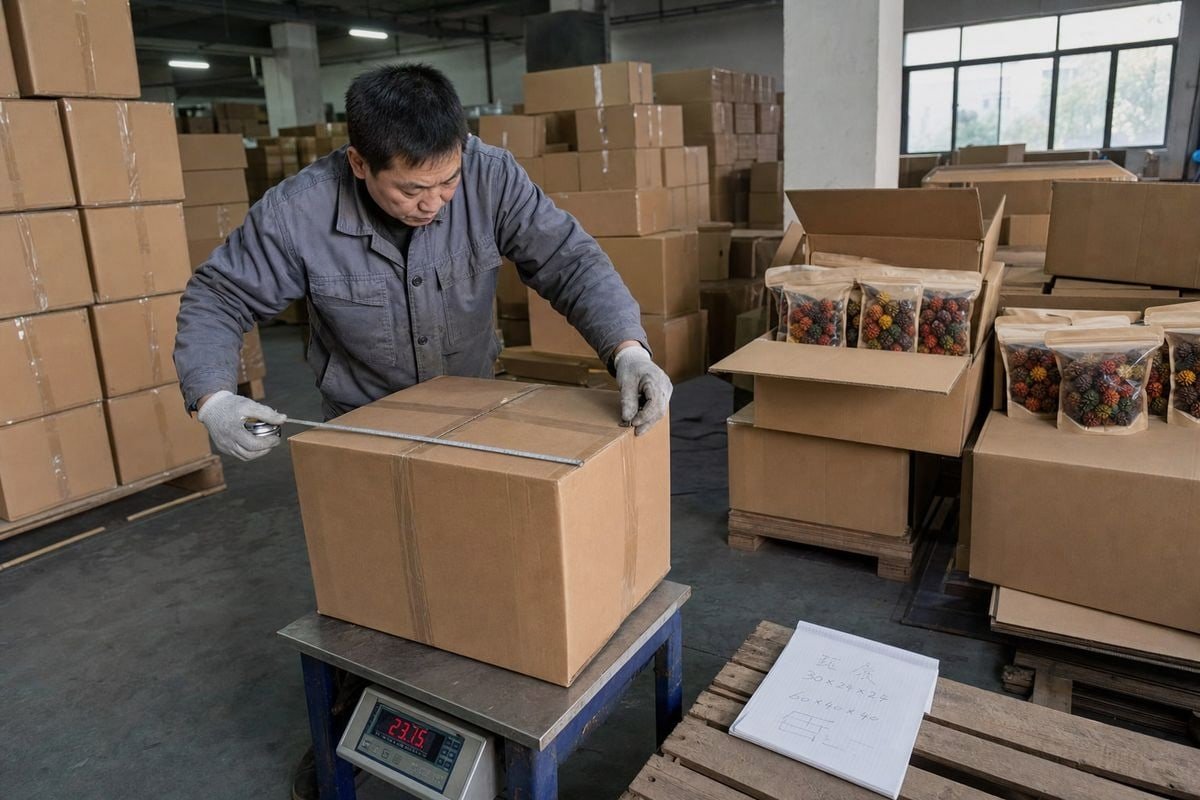
Volumetric cost for bulky pine cones surprises many first-time importers phytosanitary or treatment certificate 1. Our export team ships color-flame pinecones weekly, and I've watched buyers get quotes triple their expectations. Here's why — and how to fix it.
To calculate volumetric cost for bulky pine cones from China, multiply carton length × width × height in centimeters, then divide by the carrier's divisor (6000 for air freight, 5000 for express). Carriers bill whichever is higher: this volumetric weight or the actual scale weight.
That single formula drives most of your freight bill. But the divisor changes by carrier and mode, and packaging choices can double or halve your cost. Let me walk you through the details, step by step, based on the shipments we handle from our Ningbo production base every month.
What documents do I need to verify volumetric weight before I confirm my order?
A German distributor once asked me to re-send our packing list three times before booking. He was right to push. Our shipping documents are what protect buyers from surprise volumetric charges.
Before confirming an order, request a detailed packing list with outer carton dimensions and gross weight, a proforma invoice stating carton count, the carrier's quoted volumetric divisor in writing, and a phytosanitary or treatment certificate for natural pine cone products.

The packing list is your most important tool. It must show the outer carton dimensions — not the inner box or product size — because carriers scan the widest external points, including any bulges. When we prepare packing lists at our factory in Ningbo, we measure each master carton after sealing, because a slightly bulging lid can add two centimeters and shift the chargeable weight upward. Automated laser scanners at sorting hubs will catch that bulge even if a tape measure misses it.
Die Kern-Dokumenten-Checkliste
| Dokument | Was zu überprüfen ist | Warum es wichtig ist |
|---|---|---|
| Packliste | Outer carton dimensions (L×W×H in cm), gross weight per carton, carton count | This is the raw data for the dimensional weight formula |
| Proforma invoice | Total shipment value, Incoterms 2, carton totals | Determines import duties and taxes at destination |
| Freight quote | The volumetric divisor stated in writing (5000, 6000, or CBM-based) | Divisors are not universal; unverified quotes hide costs |
| Phytosanitary / treatment certificate | Heat treatment or fumigation for natural cones | A fixed per-shipment fee; missing it can block customs clearance |
| Test reports (SGS/Intertek) | Product compliance for retail markets | Required by most US and EU retail buyers |
One point buyers often miss: natural pine cones need a phytosanitary certificate or proof of treatment. This is a fixed per-shipment cost, so it barely matters on a full container but stings on a small trial order. In our experience exporting to 30+ countries, we prepare these documents alongside SGS-Prüfberichten 3 as a standard package, because compliance paperwork delayed at origin means demurrage charges at destination.
Also ask your supplier whether the freight quote calculates volumetric weight per carton with rounding, or on the aggregated shipment volume. The two methods can produce different billed totals on the same goods.
How can I reduce shipping costs when importing bulky pine cones from China?
Years ago, we switched one client from loose-filled cartons to a nested packing pattern. Their billed weight dropped noticeably on the very next shipment. Packaging optimization is where cost control actually starts.
Reduce costs by shrinking carton size, using interlocking packing patterns that nest pine cone tips together, consolidating orders into fewer dense cartons, and matching the transport mode to your volume. Cutting a few centimeters per dimension lowers volumetric weight significantly.

Pine cones are the textbook example of bulky-but-light cargo. A carton full of cones may weigh 8 kg but occupy the space of a 20 kg shipment. Carriers sell space, not just weight, so your real enemy is empty air inside the box.
Start With the Carton, Not the Freight Quote
Volume grows fast as dimensions grow. Trimming a 60 × 40 × 50 cm carton down to 55 × 38 × 45 cm cuts the cube from 120,000 cm³ to about 94,000 cm³ — roughly a 22% reduction in volumetric weight before you touch anything else. When we run cartonization trials on our production line, we test three or four carton sizes against real packed cones before locking in export packaging.
Practical Cost-Reduction Checklist
- Nest the cones. Interlocking packing — tapered ends nested together — can reduce total carton volume by up to 20% versus loose filling.
- Right-size the carton. Eliminate void fill wherever the product allows; every empty centimeter is billed space.
- Consolidate orders. One denser shipment beats three airy ones, and consolidation spreads fixed fees like phytosanitary certificates across more units.
- Confirm the divisor before booking. A freight forwarder China buyers trust should state whether the quote uses 5000, 6000, or CBM pricing.
- Watch shipping carrier surcharges. Fuel, remote-area, and oversize surcharges apply on top of chargeable weight; oversize triggers are dimension-based, so compact cartons dodge them too.
- Ship dry cones. Green or high-sap cones retain moisture and add actual weight; properly dried cones keep both weights low.
One more forward-looking note: void space rules such as the EU's Verpackungs- und Verpackungsabfallverordnung 4 may soon penalize shipments with excessive empty air. Buyers selling into Europe should treat dense packing as a compliance issue, not just a cost tactic. We already design our color-flame pinecone packaging — kraft pouches, jars, and display boxes — with this trend in mind for our EU distributors.
Should I choose sea freight or air freight for large, lightweight pine cone shipments?
There is a real trade-off we weigh with every buyer: speed against space cost. For pine cones, the air freight vs sea freight decision hinges almost entirely on how the billing math treats volume.
Choose sea freight (LCL) for large pine cone orders because it bills by cubic meter at a 1:1000 weight-to-volume ratio, which favors light, bulky cargo. Use air freight only for urgent, small shipments where the higher volumetric divisor of 6000 still applies.
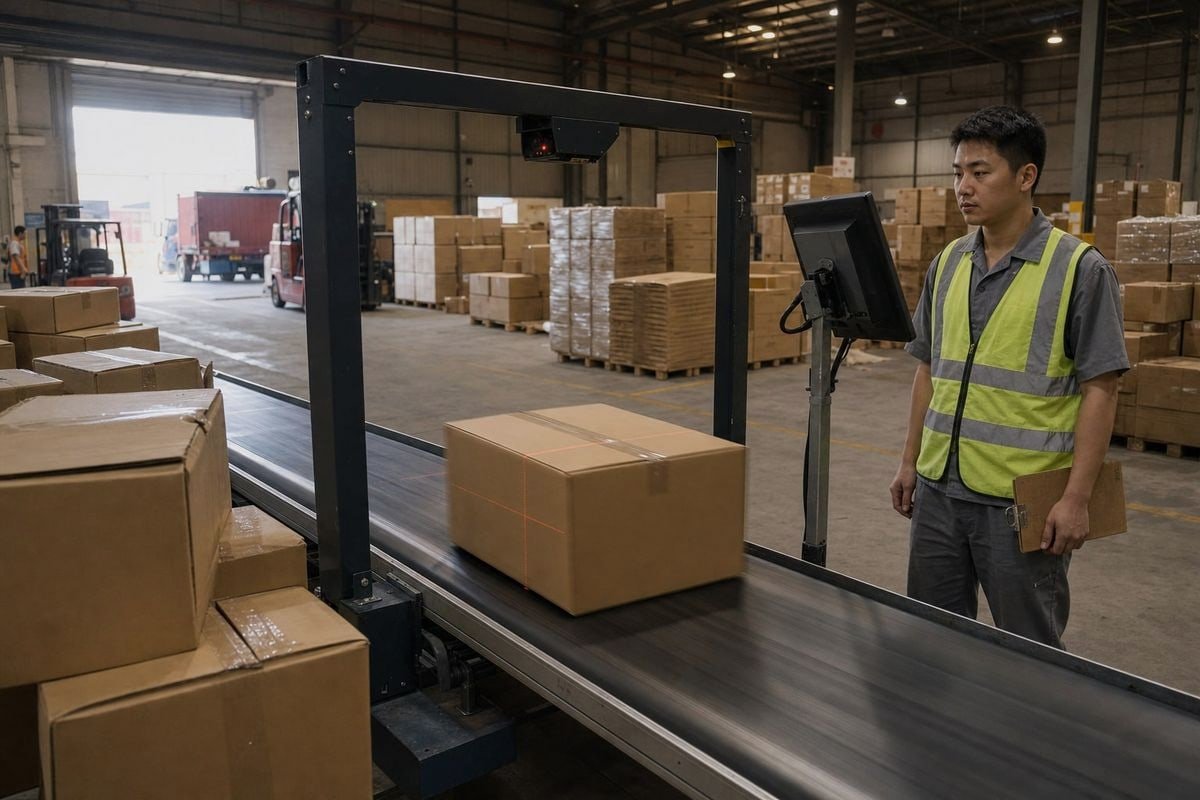
Here is the core difference. Air and express networks have limited space, so they punish bulk. Ocean freight sells space by the cubic meter 5, so bulk is simply what you pay for — at a far lower rate. Run the same carton through each billing method and the gap becomes obvious.
Same Carton, Three Billing Methods
Take a standard export carton of decorative pine cones: 60 × 40 × 50 cm, actual weight 8 kg.
| Verkehrsträger | Divisor / Rule | Calculation | Billed Weight |
|---|---|---|---|
| Expresskurier | 5000 | 120,000 ÷ 5000 | 24 kg |
| Luftfracht | 6000 | 120,000 ÷ 6000 | 20 kg |
| Sea freight (LCL 6) | CBM, 1:1000 ratio | 0.12 CBM × 1000 | 120 kg equivalent, but at a much lower per-unit rate |
The express shipment bills at 24 kg — three times the actual weight. Air freight bills at 20 kg. LCL shipping uses a CBM calculation instead of a volumetric divisor: 0.12 cubic meters billed at the forwarder's per-CBM rate, which for bulky-light cargo usually works out far cheaper per unit than air.
Our Rule of Thumb From 17 Years of Exporting
When our clients order trial quantities — a few cartons of samples or a small seasonal top-up — express or air makes sense because speed matters and the absolute cost stays manageable. Once an order reaches roughly one cubic meter or more, LCL almost always wins on angekommene Kosten. For our large US and German fireplace distributors, full-season orders go by sea, and we plan production lead times backward from their retail dates so ocean transit never threatens shelf timing. Slow but cheap only works if your factory ships on schedule — which is exactly why lead-time reliability matters as much as the freight rate itself.
How do I compare volumetric cost quotes from different Chinese manufacturers?
A UK buyer once forwarded me two competing quotes and asked why they differed by 30% on identical goods. The answer sat in the fine print: different divisors and different rounding rules.
Compare quotes by requesting each supplier's carton dimensions, packing density per carton, stated volumetric divisor, and rounding method. Then recalculate the chargeable weight yourself using one consistent formula, so you compare true landed cost rather than headline freight rates.

Two suppliers can quote the same product and reach very different freight numbers. The divisor is not universal. Common air and express services use 6000 or 5000, and some China-linked domestic services use 12000, 6000, or even 3000 depending on the service line and route. If one quote assumes 6000 and another assumes 5000, the second bills 20% more weight on identical cartons — before any price difference in the goods themselves.
A Five-Point Quote Comparison Framework
| Comparison Point | Was Sie fragen sollten | Rote Flagge |
|---|---|---|
| Kartonabmessungen | Exact outer L×W×H per master carton | Vague or "approximate" dimensions |
| Units per carton | Packing density and nesting method | Fewer units per carton means more billed cubes per product |
| Divisor used | 5000, 6000, or CBM-based, in writing | No divisor stated on the quote |
| Rounding rule | Per-carton rounding vs whole-shipment aggregation | Per-piece rounding can inflate totals on multi-carton orders |
| Included fees | Documentation, phytosanitary, shipping carrier surcharges | "Freight only" quotes that exclude fixed fees |
Normalize Before You Compare
The only fair comparison is one you calculate yourself. Take each supplier's carton dimensions, apply the same dimensional weight formula and the same divisor, multiply by carton count, and add the fixed costs — certificates, documentation, and estimated Zölle und Steuern 7 at your end. Now the quotes are on equal footing.
When we prepare quotations for OEM color-flame pinecone orders, we include the carton spec sheet and packing density by default. In my experience, suppliers who volunteer this data usually run tighter production and QC processes too; suppliers who dodge dimension questions often ship in whatever cartons are on hand, and your freight bill absorbs the sloppiness. A quote's transparency is a preview of the supplier's discipline.
Schlussfolgerung
Bulky pine cones get billed by space, not weight. Verify documents, confirm the divisor, optimize packaging density, and match the mode to volume — that's how importers control landed cost.
Fußnoten
1. International standard body governing phytosanitary certification for plant-based exports like pine cones. ↩︎
2. Incoterms are referenced as a key proforma invoice term buyers must verify. ↩︎
3. Official SGS site, the testing and certification body referenced for compliance documentation. ↩︎
4. Official EU source explaining the packaging waste regulation mentioned regarding void space rules. ↩︎
5. Defines the volumetric unit used for LCL freight billing calculations described in the article. ↩︎
6. Wikipedia background on the LCL sea freight shipping method discussed extensively in the article. ↩︎
7. WTO resource on tariffs relevant to import duties mentioned in landed cost calculations. ↩︎



 English
  Spanish
  German
  French
  Arabic
  Portuguese
Diskutieren Sie mit