






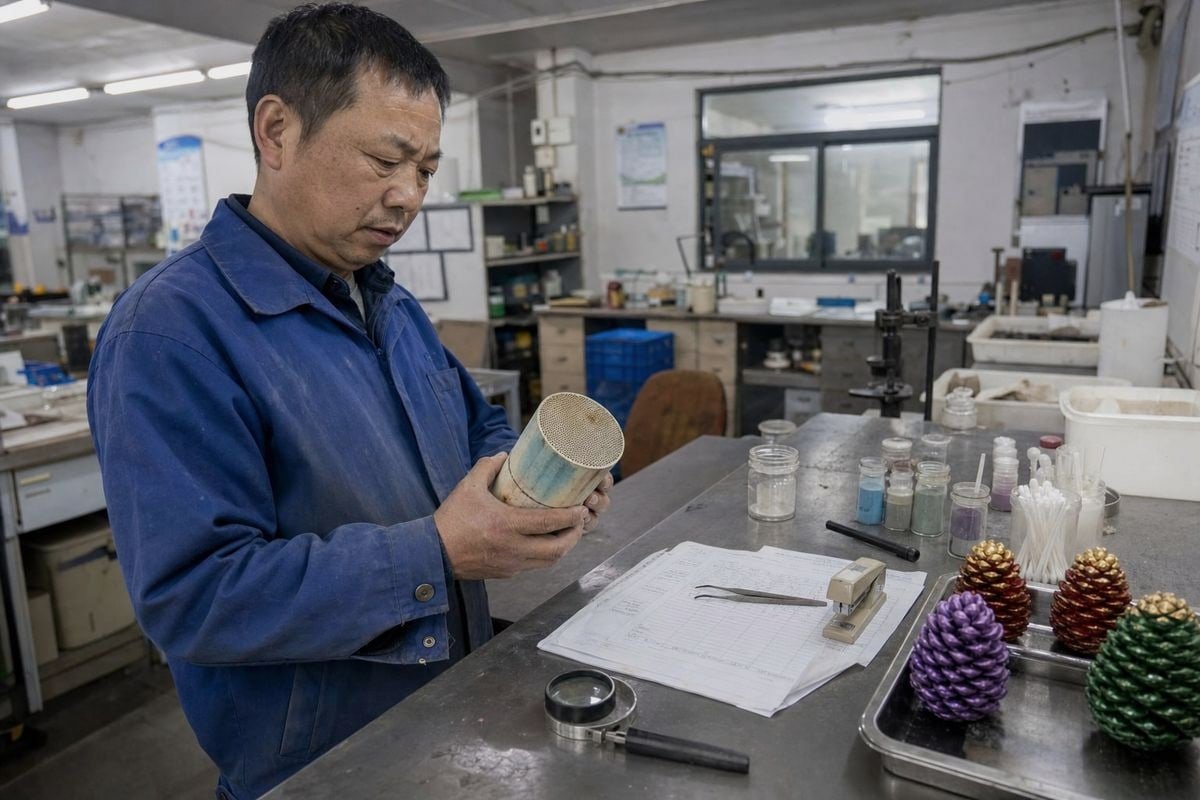
Farbige Kamin-Kiefernkegel sehen magisch aus, aber in unserer Produktionslinie hören wir immer wieder eine besorgte Frage: ruinieren sie leise einen teuren katalytischen Brennstoff?
Ja, gefärbte Kamin-Kiefernkegel können den katalytischen Verbrenner eines Ofens beschädigen. Die meisten Farbstoffe basieren auf Metallsalzen wie Kupfersulfat, die eine Katalysatorvergiftung, Maskierung und Beschädigung der Washcoat-Schicht verursachen. Sofern der Hersteller des Ofens oder Verbrenners diese nicht ausdrücklich genehmigt, sollten sie nur in nicht-katalytischen Feuern verwendet werden.
Diese kurze Antwort verbirgt viele Details. Unten gehe ich auf die Chemie, das Risiko und darauf ein, wie Käufer [die Sicherheit vor der Bestellung überprüfen können](https://sunrichfire.com/how-confirm-fireplace-colored-pine-cones-safe-wood-burning-stoves/).
Welche Chemikalien in gefärbten Kamin-Kiefernkegeln könnten meinen katalytischen Verbrennungskammer beeinträchtigen?
Während einer Überprüfung der Formulierung in unserem Werk in Ningbo vor einigen Jahren haben wir jeden in der Branche verwendeten Farbstoff kartiert ISO 9001 Qualitätsmanagementsystem-Zertifizierung 1. Was wir gefunden haben, erklärt genau, warum katalytische Öfen so anfällig sind.
Farbige Kiefernzapfen enthalten typischerweise Metallsalze – Kupfersulfat für Blaugrün, Strontiumchlorid für Rot, Kalium für Lila und Lithiumverbindungen für Rosa. Beim Verbrennen verdampfen diese Salze und lagern sich auf dem Verbrennungsofen ab, vergiften chemisch die Edelmetallbeschichtung und blockieren die aktiven Zentren des Katalysators.

Lassen Sie mich aufschlüsseln, was tatsächlich im Feuerraum passiert Schwermetall-Screening-Ergebnisse 2. Ein katalytischer Brennstoff ist ein keramisches Waben-Substrat 3 mit einer dünnen Aluminiumoxid-Waschschicht beschichtet. Diese Waschschicht trägt Platin oder Palladium 4 – die Edelmetallbeschichtung 5 die Rauch bei niedrigen Temperaturen wieder verbrennt. Es ist eine Präzisionsoberfläche. Alles, was sie beschichtet, mit ihr reagiert oder mit ihr verschmilzt, reduziert ihre Leistung.
Chemische Kamin-Farbstoffe sind per Design Materialien, die in Flammen verdampfen. So färben sie das Feuer. Das Problem ist, dass diese Dämpfe nicht verschwinden. Sie reisen mit dem Abgasstrom, kühlen leicht ab und kondensieren auf der ersten leicht kühlen Oberfläche, auf die sie treffen. In einem katalytischen Ofen ist diese Oberfläche oft der Brennstoff selbst.
Die gängigen Farbstoffchemikalien und ihre Risiken
| Flammenfarbe | Typische Chemikalie | Risiko für Katalysator |
|---|---|---|
| Blau / Grün | Kupfersulfat, Kupferchlorid | Starke Katalysatorvergiftung; Schwermetallablagerungen |
| Rot | Strontiumchlorid | Chloridangriff auf die Waschschicht; Maskierungsfilm |
| Lila | Kaliumverbindungen | Alkalische Maskierung von aktiven Zentren |
| Rosa | Lithiumverbindungen | Oberflächenkontamination, reduzierte Zündung |
| Weiß / Hell | Magnesiumsalze | Aschemaskierung, Rückstandsaufbau |
Warum "ein bisschen" immer noch wichtig ist
Die Exposition ist kumulativ. Ein Kegel wird nichts sichtbar zerstören. Aber jede Verbrennung fügt eine weitere molekulare Schicht von Schwermetallablagerungen hinzu. Über eine Saison verliert der Brennstoff seine Fähigkeit, die Zündtemperatur zu erreichen. Dann strömt Rauch unverbrennt hindurch, und Kreatinbildung beschleunigt sich im Schornstein. Einige Chemiequellen warnen auch vor Permanganaten, Nitraten und Chloraten in Flammenprodukten, da sie schädliche Nebenprodukte erzeugen. In unseren eigenen umweltfreundlichen Formulierungen schließen wir diese ausdrücklich aus – aber viele billige Dekorationskegel auf dem Markt tun dies nicht.
Sollte ich die Verwendung von farbigen Kiefernzapfen in einem Holzofen mit einem Katalysator vermeiden?
Einer unserer deutschen Distributoren bat uns einst, eine Warnung für katalytische Öfen auf seine Eigenmarkenverpackung zu setzen. Diese Anfrage lehrte unser Team eine bleibende Lektion: Ehrliche Kennzeichnung schützt alle nachgelagerten Akteure.
Ja, Sie sollten Farbfackeln-Kiefernzapfen in jedem Holzofen mit einem Katalysator vermeiden, es sei denn, der Ofenhersteller genehmigt sie ausdrücklich. Die Handbücher für Verbrennungsapparate verlangen nur abgelagertes, unbehandeltes Holz. Chemisch behandelte Zapfen fallen in die verbotene Kategorie neben bemaltem Holz, farbigem Papier und behandeltem Bauholz.
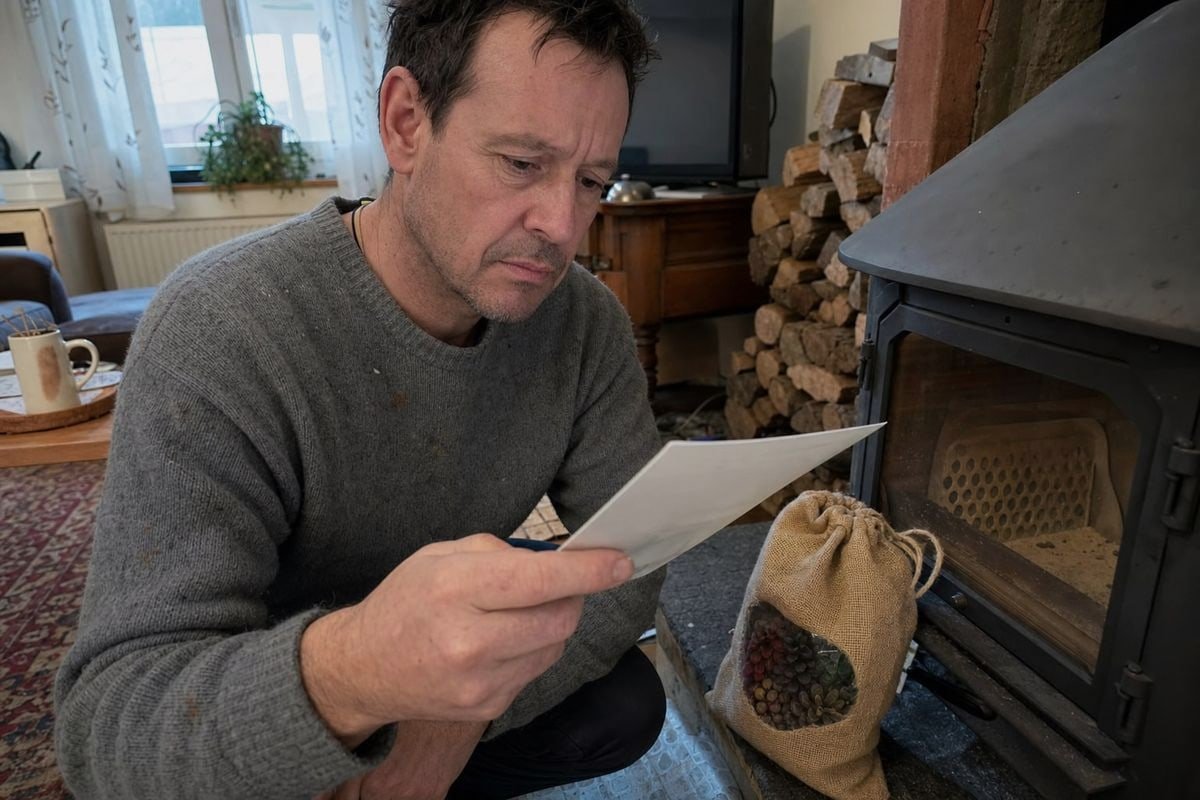
Hier ist die entscheidende Nuance, die die meisten Käufer übersehen: "sicher in einem offenen Kamin" bedeutet nicht "sicher in einem katalytischen Ofen". Offene Kamine leiten alles direkt in den Schornstein. Im Abgasweg befindet sich kein empfindlicher Katalysator. Katalytische Öfen sind anders. Sie zwingen Rauch durch einen Wabenkatalysator, so dass jede Chemikalie im Brennstoff diese empfindliche Oberfläche berührt.
Einige Hobbyforen behandeln Kiefernkegel als harmlose Anzündhölzer. Für einfache, unbehandelte Kegel in offenen Feuern ist diese Ansicht vernünftig. Aber farbige, chemisch behandelte Kegel sind eine völlig andere Produktkategorie. Dieser Unterschied ist das ganze Problem.
Offener Kamin vs. katalytischer Ofen: die Risikolücke
| Faktor | Offener Kamin | Katalytischer Holzofen |
|---|---|---|
| Katalysator vorhanden | Nein | Ja – keramisches Waben-Substrat |
| Empfindlichkeit gegenüber Metallsalzen | Niedrig | Sehr hoch |
| Hersteller-Brennstoffregeln | Lose | Streng: nur getrocknetes, unbehandeltes Holz |
| Garantieauswirkungen | Minimal | Das Verbrennen von behandeltem Material führt oft zum Erlöschen der Garantie |
| Hauptanliegen | Rückstände, Rauch, Haustiere | Catalyst poisoning, creosote buildup |
The bypass damper is not a loophole
Some users assume they can open the bypass damper, enjoy the colored flames, then close it afterward. In practice, heavy metal vapors linger in the firebox and settle on the catalyst once the bypass closes for the secondary burn. The damage still happens — just more slowly.
There is also a warranty dimension. Most EPA-zertifizierte Holzöfen 6 carry manuals that explicitly prohibit chemically treated fuel. Burning color-enhanced cones can void the warranty on both the stove and the combustor. And you cannot simply "burn off" the residue. An extremely hot fire risks thermal sintering 7, where the precious metal particles fuse together and permanently lose surface area. Chemical damage is typically irreversible, unlike ordinary fly ash that can be brushed away during routine wood stove maintenance.
Wie kann ich überprüfen, ob die Kiefernzapfen eines Lieferanten für katalytische Öfen sicher sind, bevor ich eine Großbestellung aufgeben?
Buyer audits are something we genuinely welcome. When a US fireplace distributor visited our Liuyang headquarters last year, we walked him through raw material records batch by batch — and that transparency closed the deal.
Überprüfen Sie die Sicherheit, indem Sie die vollständige Offenlegung der Inhaltsstoffe, SGS- oder Intertek-Testberichte, Ergebnisse der Schwermetallprüfung und die Erklärung des Lieferanten zur bestimmungsgemäßen Verwendung anfordern. Testen Sie dann selbst Brandproben. Wenn der Lieferant die Farbstoffchemie nicht dokumentieren kann, gehen Sie davon aus, dass das Produkt für katalytische Öfen unsicher ist.

In our seventeen-plus years of exporting fire products to more than thirty countries, we have learned that verification is a process, not a single document. Here is the sequence I recommend to any purchasing manager evaluating a colored pine cone supplier.
Ein schrittweiser Verifizierungsprozess
- Request the full chemical composition. A serious factory will disclose its colorant system under NDA. Vague answers like "natural minerals" are a red flag.
- Ask specifically about copper sulfate, chlorates, nitrates, and permanganates. These are the compounds most associated with catalyst damage and harmful byproducts.
- Demand third-party lab reports. SGS or Intertek burn-residue and heavy metal screening reports tell you what actually leaves the flame, not just what goes in.
- Check the intended-use statement. Reputable suppliers state clearly whether the product is for open fireplaces, campfires, and fire pits — or claims broader compatibility. Be skeptical of any cone marketed as universally safe.
- Run a sample burn test. Order a small trial quantity. We support flexible MOQs for exactly this reason. Burn the cones and inspect ash and residue color. Bright blue-green residue signals copper compounds.
- Audit the factory, not the trader. Trading companies often cannot answer chemistry questions. A real factory with complete production lines can show you the raw material intake records and batch QC logs.
One honest note from our side: even our own eco-friendly color-flame pinecones are positioned for campfires, open fireplaces, and fire pits. We advise all our B2B partners to label them accordingly rather than imply catalytic-stove compatibility. That candor protects your brand and your customers' stoves.
Welche Zertifizierungen sollte ich anfordern, um zu bestätigen, dass diese Tannenzapfen meinen Kundenöfen nicht beschädigen?
Compliance paperwork is where deals live or die in our world. Our export team spends nearly as much time preparing certification files as our factory spends producing the goods themselves — and buyers in the US and EU expect nothing less.
Fordern Sie eine ISO 9001-Qualitätssystemzertifizierung, BSCI-Sozialaudits, CE-Konformität, wo zutreffend, und SGS- oder Intertek-Chemikalienprüfberichte für Schwermetalle und Verbrennungsrückstände an. Erforderlich sind auch eine schriftliche Zusammensetzungserklärung und konforme Warnhinweise, die zugelassene Gerätetypen angeben.

Let me be direct about what each document actually proves, because buyers sometimes treat certifications as interchangeable. They are not. Each one answers a different question, and together they build a defensible compliance file for your market.
Certification checklist and what each one confirms
| Dokument | Was es beweist | Why It Matters for Catalytic Stove Safety |
|---|---|---|
| ISO 9001 | Konsistentes Qualitätsmanagementsystem | Batch-to-batch consistency means the tested sample matches mass production |
| SGS / Intertek Prüfbericht | Independent chemical and heavy metal analysis | Confirms absence or levels of copper, strontium, chlorates in residues |
| BSCI-Audit | Ethische, geprüfte Fabrikbetriebe | Verifies you are dealing with a real factory, not an untraceable trader |
| CE-Konformität | EU market compliance where applicable | Required for many European retail channels |
| Zusammensetzungserklärung | Written statement of colorant chemistry | Your legal basis if a customer claims stove damage |
| Überprüfung des Warnhinweises | Correct intended-use and safety text | Protects against liability from misuse in catalytic appliances |
Certification cannot make chemistry disappear
Here is the honest caveat I give every buyer: no certificate can make a metal-salt colorant safe for a catalytic combustor. Certifications confirm what a product contains and how consistently it is made. They do not change the physics of catalyst poisoning. That is why the smartest importers pair the compliance file with clear labeling — approved for open fireplaces, campfires, and fire pits — and let the paperwork prove the product does exactly what the label says.
At our factory, every private-label order ships with custom warning labels, barcodes, and market-specific compliance text built into the packaging. First samples reflect mass-production quality because the same QC gates apply to both. For a purchasing manager, that documentation trail is what turns a novelty décor item into a shelf-ready, defensible retail product.
Schlussfolgerung
Colored fireplace pine cones risk irreversible catalyst poisoning in catalytic stoves. Verify chemistry, demand certifications, label honestly, and reserve colored flames for open fires. Choose documented, compliant suppliers.
Fußnoten
1. Stable Wikipedia entry for the ISO 9001 quality management standard. ↩︎
2. Information on heavy metal screening and testing for product safety. ↩︎
3. Authoritative Wikipedia reference for catalytic converter substrate design and materials. ↩︎
4. Scientific overview of platinum and palladium as catalytic metals. ↩︎
5. Technical explanation of noble metals used in catalytic converters. ↩︎
6. EPA guidelines on wood stove certification and fuel safety. ↩︎
7. Explanation of thermal sintering and its effect on material surfaces. ↩︎


 English
  Spanish
  German
  French
  Arabic
  Portuguese
Diskutieren Sie mit