






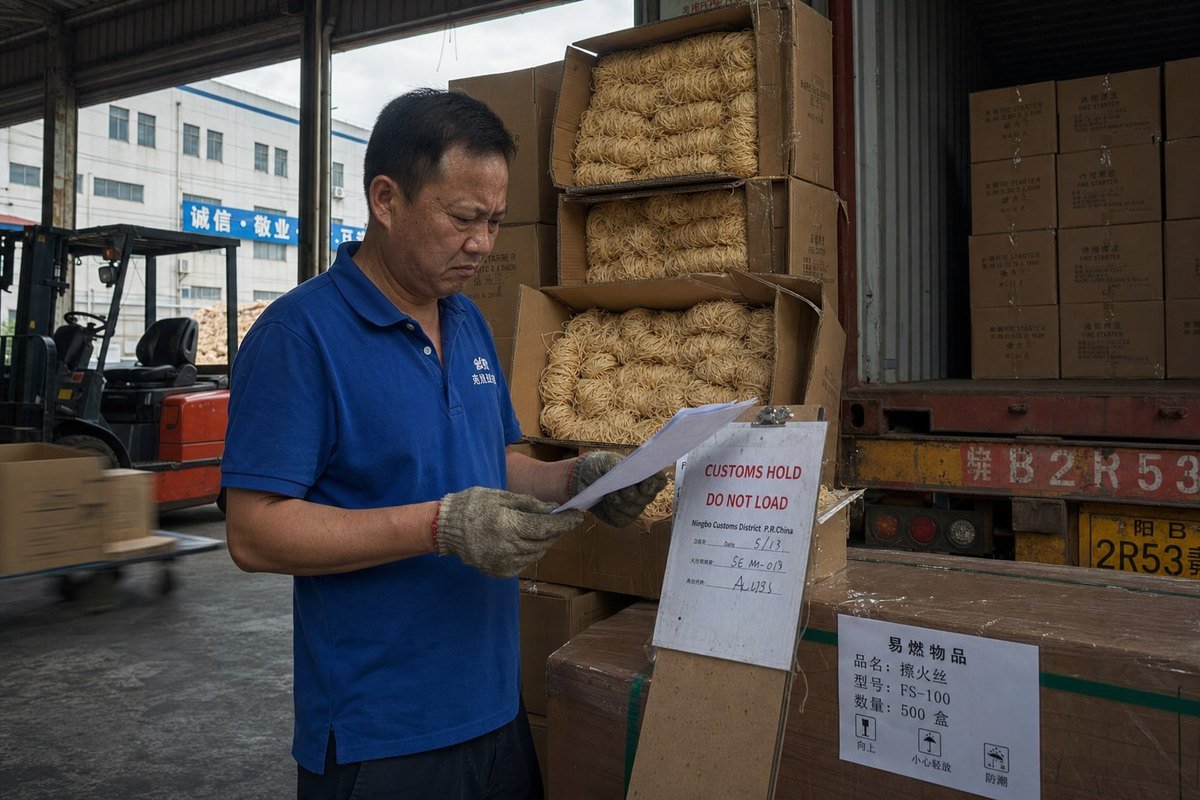
A vague wood fire starters contract nearly cost one of our buyers a full container إدارة جودة ISO 9001 1. The purchase order just said "fire starters" — no spec, no test method, no acceptance rule. When customs asked for documentation, everything stalled. On our production line, we have learned that ignition products need contracts as precise as the wax coating on each wood wool roll. The good news: a handful of well-drafted clauses prevents almost every dispute we have ever seen.
A wood fire starters contract should specify the exact product specification, moisture content limits, certifications and test reports, quality assurance protocols, MOQ and lead times, payment terms, packaging and labeling compliance, private label ownership, title and risk transfer, and remedies for nonconforming goods.
Let me break these terms down into four practical areas. Each one maps to a real risk: quality, supply reliability, payment, and liability. Here is what to put in writing before you sign.
What Certifications and Test Reports Should I Require Before Signing a Wood Fire Starters Contract?
During a factory audit a few years back, a German BSCI social compliance audit 2 distributor asked us for every test report we held — before discussing price at all. That order of priorities was exactly right, and it shaped how we advise every new buyer today.
Require ISO 9001 quality management certification, a BSCI social compliance audit, CE marking where applicable, third-party lab reports from SGS or Intertek, a Material Safety Data Sheet, and documentation covering flammability safety standards. Name each document in the contract and make delivery of copies a condition of payment.

Certifications are not decoration on a supplier's website. They are your legal shield if a product is challenged at customs, questioned by a retailer, or involved in a safety complaint. In our seventeen-plus years exporting fire-starting goods to more than thirty countries, we have never seen a serious importer treat compliance as optional. Your contract should treat it the same way.
The Documents to Name Explicitly
Do not write "supplier shall provide relevant certifications." That phrase means nothing in a dispute. Instead, list each document by name and issuing body. Here is the checklist we hand to new buyers:
| وثيقة | ما يثبته | Why the Contract Needs It |
|---|---|---|
| شهادة ISO 9001 | Quality management system is in place | Supports batch consistency claims |
| تقرير تدقيق BSCI | ظروف العمل اللائق والمصنع الأخلاقية | Required by many EU/US retail chains |
| وثائق CE | المطابقة لسوق الاتحاد الأوروبي | الوصول القانوني إلى السوق في أوروبا |
| تقرير اختبار SGS / Intertek | اختبار المنتج المستقل | Third-party proof, not self-declaration |
| صحيفة بيانات سلامة المواد | التخليص الجمركي والشحن | Customs clearance and retailer onboarding |
| Flammability and ignition test data | Product performs and burns safely | Defends against safety complaints |
If your positioning includes sustainability claims, add FSC certification standards 3 for the wood source. Retailers increasingly ask for chain-of-custody proof, and a sustainability claim without documentation is a liability, not an asset.
Make Documentation a Contract Condition
Tie document delivery to a milestone. For example: final payment is due only after the supplier delivers current copies of all listed certificates and batch-specific test reports. Also add a clause requiring the supplier to notify you if any certification lapses or is suspended during the contract term. A certificate that expired six months ago protects nobody.
أخيرًا،, verify independently. Ask the lab to confirm the report number. A real factory will welcome that check; a trading company reselling someone else's paperwork usually will not.
How Do I Define Quality Control and Batch Consistency Standards in My Contract?
There is a trade-off we weigh on every production run: wax coverage versus fiber exposure. Too much paraffin and the roll lights slowly; too little and it burns out fast. That tolerance only stays consistent because it is written down — and your contract should write it down too.
Define quality by measurable numbers: moisture content limits below a stated percentage, wax weight range per piece, dimensions with tolerances, minimum burn time, time-to-flame benchmark, prohibited materials such as treated wood, and an inspection window with AQL sampling rules for every batch.
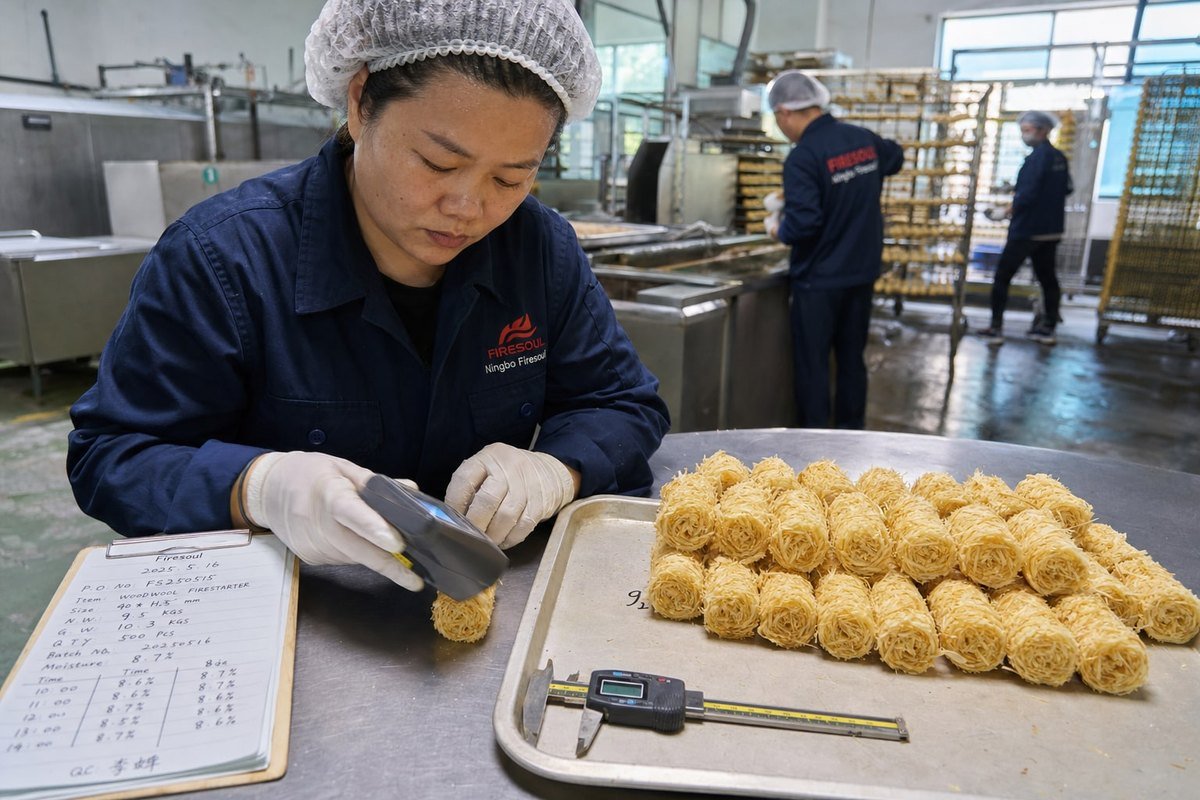
Subjective words cause disputes. "Good quality" and "premium grade" mean different things to a buyer in Rotterdam and a factory in Ningbo. Numbers do not. When we set up quality assurance protocols with a new private-label client, we replace every adjective with a measurable value, and I recommend you do the same in your contract.
Turn the Specification into Numbers
Wood fuel contracts routinely specify moisture and particle size for pellets and woodchip. Apply the same logic to fire starters. A workable specification table looks like this:
| المعلمة | Contract Standard | طريقة التحقق |
|---|---|---|
| محتوى الرطوبة | Below a stated maximum (e.g., under 20%) | Pin-type moisture meter, sampled per batch |
| Wax coating weight | Defined grams per piece, ± tolerance | وزن الوحدات التي تم أخذ عينات منها |
| أبعاد | Length and diameter with ± tolerance | Caliper measurement |
| وقت الاحتراق | Minimum minutes per piece | اختبار الاحتراق المتحكم فيه |
| Time-to-flame | Ignites within stated seconds from a single match | Controlled ignition test |
| مادة خام | Untreated wood wool and food-grade or specified wax only | Supplier declaration plus lab testing |
| Prohibited inputs | No treated wood, no chemical accelerants, no undisclosed binders | MSDS review and spot testing |
Require full disclosure of any additives or binders. Buyers selling into indoor fireplace channels need this for air-quality and safety compliance, and an incomplete ingredient list can block a retail listing.
Define How Batches Are Checked and Rejected
A spec without a verification procedure is a wish. Your contract should state three things clearly. First, the sampling plan — for example, AQL-based random sampling from each production batch, with the buyer entitled to فحص طرف ثالث قبل الشحن 4 at the factory. Second, the inspection window — how many days you have after delivery to test goods and report defects in writing. Third, the remedy ladder — replacement, rework, credit, or refund, in that order, with the supplier bearing freight on confirmed nonconforming goods.
Also add a golden-sample clause. The approved pre-production sample becomes the contractual reference standard, and mass production must match it. On our lines, batch-to-batch consistency is exactly what strict process control exists to deliver — but the contract is what makes that promise enforceable.
What MOQ, Lead Time, and Payment Terms Should I Negotiate for Trial Orders?
A UK camping brand once told me they walked away from two suppliers before us — not over price, but because neither would offer a realistic minimum order quantity for a first test run. That conversation taught me how much trial-order flexibility matters to serious buyers.
Negotiate a reduced trial MOQ (often one pallet to a partial container), a written production lead time of roughly 25–40 days plus transit, a 30% deposit with 70% due after inspection or against shipping documents, and pre-agreed wholesale pricing tiers for repeat volume.

A trial order has one job: to prove that mass production matches the sample and that logistics work end to end. Structure the commercial terms so the test is affordable for you and worthwhile for the factory.
Set the MOQ Realistically
Factories set MOQs around كفاءة الإنتاج 5 — wax melting runs, packaging setup, and pallet configuration. A fair contract acknowledges this while protecting your cash. In our experience supplying importers across the US and Europe, a workable structure looks like this:
| مرحلة الطلب | الحجم النموذجي | الغرض |
|---|---|---|
| طلب عينة | A few cartons, often courier-shipped | Confirm spec, packaging, and burn performance |
| طلب تجريبي | One pallet up to a partial container (LCL) | Test mass-production consistency and logistics |
| أول طلب مجمع | Full 20ft or 40ft container | Activate standard pricing |
| Ongoing bulk supply agreement | Scheduled containers per quarter or season | Lock in wholesale pricing tiers and capacity |
Write into the contract that trial pricing converts to tiered bulk pricing at defined volumes. This prevents an unpleasant surprise when you scale.
Pin Down Lead Times and Payment Mechanics
Logistics and lead times deserve their own clause, not a verbal estimate. Specify production lead time in calendar days from deposit receipt, the delivery Incoterm 6 (FOB, CIF, or DDP), the loading port, and what happens if the supplier is late — for example, a small credit per week of delay, or a right to cancel after a defined grace period. Fire starters are seasonal goods; a shipment that misses the autumn retail window loses most of its value, so timing remedies matter more here than in many categories.
On payment, the market standard is a 30% deposit and 70% balance. The key negotiation point is the trigger for the balance. Tie it to a passed pre-shipment inspection or to presentation of shipping documents — never to a bare calendar date. That single detail keeps leverage on quality where it belongs: with you, until the goods are verified.
How Can I Protect My Private Label Rights and Packaging Requirements in the Agreement?
One of the most detailed briefs we ever executed came from a US fireplace distributor: custom retail boxes, a countertop display design, region-specific warning labels, and barcodes for their retail chain — all under their own brand. The contract behind it was just as detailed as the artwork.
Include a clause stating you own all trademarks, artwork, and designs; prohibit the supplier from selling your branded product to third parties; attach approved packaging artwork as a contract exhibit; and require packaging and labeling compliance with your destination market's warning and barcode rules.

Private-label supply is where a generic purchase contract fails hardest. You are not just buying wax-dipped wood rolls; you are buying goods that carry your brand reputation on the shelf. The agreement must protect that brand as carefully as it protects the product.
Lock Down Intellectual Property and Exclusivity
Your private label specifications — logos, artwork files, box dieline, color codes, and copy — should be listed as your exclusive اختيار المصنعين الأصليين للمعدات يعني أنه يجب عليك تشغيل مصنعك الخاص أو معدات الإنتاج الخاصة بك 7 in the contract. Add three protections. First, the supplier may use your artwork only to fulfill your orders. Second, the supplier may not sell your branded or near-identical trade-dress product to any other buyer. Third, all tooling or printing plates paid for by you belong to you, and molds or dielines are returned or destroyed on termination. If your volumes justify it, negotiate territorial exclusivity for the product format in your market — factories offering true one-stop OEM/ODM services expect this conversation and can accommodate it.
Specify Packaging as Precisely as the Product
Treat packaging as a second product specification. The contract exhibit should cover: exact box dimensions and material grade, print quality standards against approved proofs, warning label text and placement for safety warning labels 8 your jurisdiction, barcode format and verified scannability, inner-carton and master-carton counts, and palletization standards. Because wood wool absorbs moisture, also specify moisture-barrier requirements — poly liners or sealed inner bags — plus storage-condition warranties before shipment. Kiln-dried performance is lost if the goods re-absorb humidity in a warehouse.
Close the section with liability and indemnification clauses. The supplier should indemnify you for defects arising from manufacturing; you typically carry responsibility for artwork content you supplied. Clear allocation here prevents finger-pointing if a labeling issue ever reaches a regulator or retailer.
خاتمة
Vague contracts create expensive disputes; ignition products punish ambiguity harder than most goods. Specify certifications, measurable quality standards, realistic trial terms, and private-label protections — then sign with confidence.
ملاحظات ختامية
1. Stable, authoritative Wikipedia reference for ISO 9001 quality management standards. ↩︎
2. Updated live URL for the amfori BSCI social audit program. ↩︎
3. Official standards for verifying wood comes from responsibly managed forests. ↩︎
4. Professional inspection services to verify product quality before leaving the factory. ↩︎
5. Overview of manufacturing methods designed to optimize production efficiency and output consistency. ↩︎
6. Official rules for the interpretation of international commercial trade terms. ↩︎
7. Global authority on the protection of trademarks and brand assets. ↩︎
8. Authoritative reference for international safety lab



 English
  Spanish
  German
  French
  Arabic
  Portuguese
انضم إلى المحادثة