







Scheduling ordering, production, and arrival for Magic Fire Powder is where I see buyers stumble every spring أكواز زخرفية مقابل أكواز وظيفية - قرر أولاً 1. Miss the window, and our production line simply cannot rescue a Memorial Day launch.
To schedule Magic Fire Powder for peak BBQ season, work backwards from your first big weekend: place orders 90–120 days ahead, allow 30–45 days for production and sea freight, and target warehouse arrival by early April with a 15% safety stock buffer.
That is the short answer. Below, I break the timeline into four practical questions. Each one covers a stage of the schedule, from the first purchase order to mid-season replenishment.
How far in advance should I place my order to avoid missing peak BBQ season demand?
Last February, a US distributor emailed our sales team asking for a full container by May 1st. We made it work, but only barely. His story shaped how I now advise every buyer on seasonal demand planning.
Place your first seasonal order 90–120 days before your first high-demand weekend. For a US Memorial Day kickoff, that means confirming your purchase order in late January or February, so production, shipping transit times, and customs clearance all finish before early April.

The logic is simple: peak BBQ season in the US runs roughly from Memorial Day through Labor Day, with extra spikes on July 4th and holiday campground weekends. Your shelves need to be full before the season starts, not during it. That is why I always tell buyers to plan backwards from the first big weekend, not forwards from when they feel ready to order.
Build the timeline backwards
Here is the backward schedule we recommend to our importers and wholesale procurement partners:
| معلم | Target Date (US Market) | لماذا هو مهم |
|---|---|---|
| First peak weekend | Late May (Memorial Day) | Demand spikes; stockouts here cost the whole season |
| Warehouse arrival | أوائل أبريل | Leaves time for testing, merchandising, influencer seeding 2 |
| Departure from China | Late February – early March | شحن بحري 3 plus customs takes 4–6 weeks to the US |
| Production start | Early February | Manufacturing cycle time is typically 2–3 weeks |
| تأكيد أمر الشراء | Late January | Locks in a production slot before the spring rush |
| Artwork and labels finalized | Q1, ideally January | Private-label packaging must be approved before mass production |
Use data, not guesswork
Do not guess your volume. Analyze last year's sales and build a seasonal index from historical data. Layer in event bookings, your promotional calendar, and even 30-day long-range weather forecasts. Some of our sharpest buyers trigger small secondary "mini-runs" when an unseasonably dry, warm spring window appears. Lead time forecasting only works when the demand side of the equation is honest.
One more point. Short-form video drives real impulse demand for color-changing fire additives. If you plan an influencer seeding push, product must land about four weeks before retail launch. That pulls your arrival target even earlier.
What lead times can I expect for production and international shipping of Magic Fire Powder?
During a batch inspection at our Ningbo facility last season, our QC team rejected a run of sachets over a seal-integrity issue. We reran it within days, but it reminded me why honest lead times always include a QC margin.
Expect 30–45 days total: roughly 15–20 days for mixing, sachet filling, sealing, and packaging, plus 25–35 days for sea freight to the US or Europe. Air freight cuts transit to 5–10 days but multiplies your cost significantly.
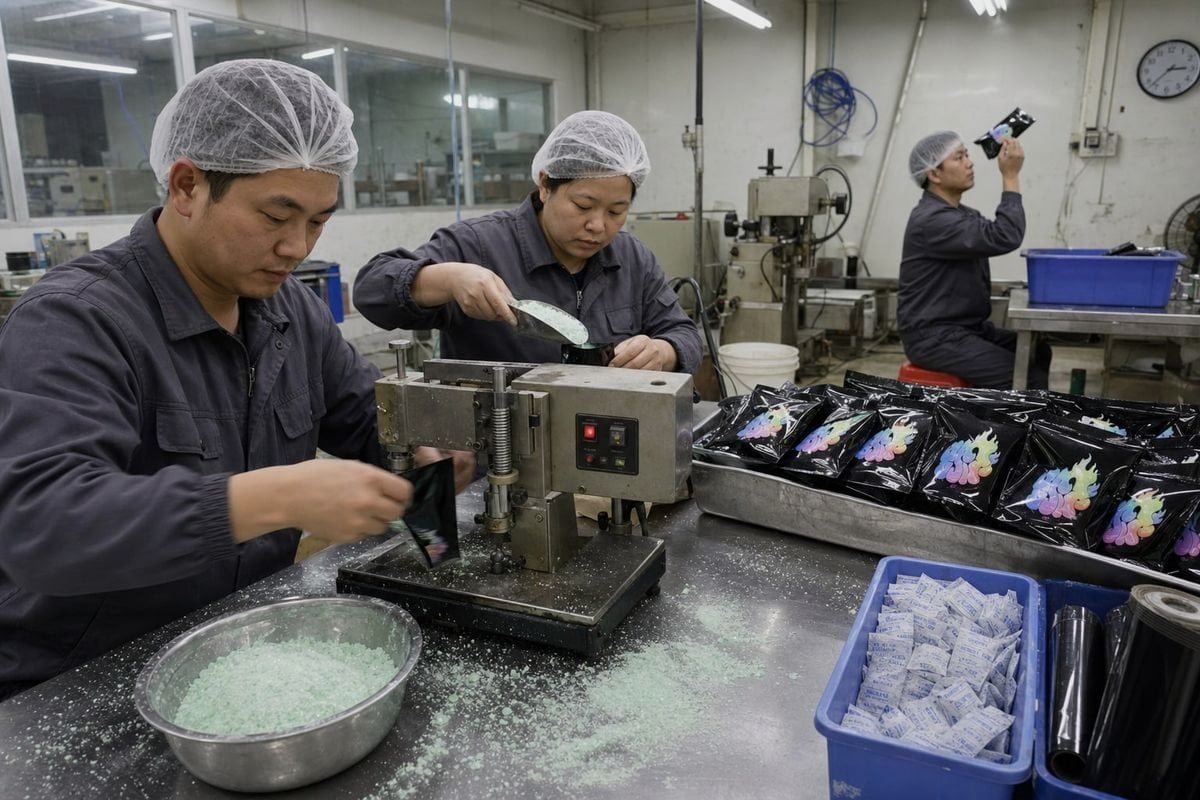
Manufacturing cycle time for color-flame packets is fairly predictable when the supplier runs its own production lines. After 17+ years making these products, we can quote firm dates because we control mixing, filling, and packing in-house. Trading companies often cannot, and that uncertainty compounds every downstream date in your schedule.
What happens during production
The production stage covers more than filling powder into pouches. It includes:
- Confirming the formula, burn duration, and pack weight against your approved sample.
- Printing and inspecting packaging — plastic bags, kraft bags, jars, or display boxes with your private label.
- Filling and heat-sealing sachets with sealed inner liners and desiccants, because the powder must stay dry and unopened until it hits the fire.
- Batch QC: seal integrity checks, weight tolerance checks, and burn tests so mass production matches the first sample.
- Carton packing with barcodes, warning labels, and صحائف بيانات السلامة 4 prepared for customs.
Typical transit windows
| المسار | الشحن البحري | الشحن الجوي | مصادر الأكواز الخام |
|---|---|---|---|
| China → US West Coast | 18-25 يومًا | 5–8 days | Fastest sea option; port congestion varies |
| China → US East Coast | 30-38 يومًا | 6–9 days | Add inland rail or truck time |
| China → Europe (DE, UK, NL) | 28–35 days | 5–8 days | Popular for our fireplace distributors |
| China → Australia | 14–22 days | 4–7 days | Shorter route, seasonal capacity swings |
One caution from experience exporting to 30+ countries: fire-adjacent goods get reviewed more carefully than ordinary novelties. Complete documentation — علامة CE 5, SGS or Intertek test reports, and correct safety data sheets — keeps your shipment moving. Missing paperwork is the most avoidable delay in this category.
How can I plan my reorder timeline if my first shipment sells out faster than expected?
There is a trade-off I weigh with every buyer: order big once and tie up cash, or order lean and risk a mid-season stockout. Neither extreme wins. A structured replenishment trigger beats both.
Set a reorder trigger at 40–50% remaining inventory, calculated from your weekly sell-through rate. Reorder immediately when triggered, and use air freight for urgent restocks if sea freight cannot arrive before your projected stockout date.

جيد إدارة المخزون 6 during peak season is a rhythm, not a one-time decision. The mistake I see most often is buying only enough for the launch weekend and treating replenishment as a problem for later. By the time "later" arrives, every supplier's production calendar is packed and shipping transit times have stretched with summer congestion.
A simple replenishment process
Here is the process our repeat distributors follow for retail stock replenishment:
- Track weekly sell-through from the moment product hits shelves. Even a simple spreadsheet works.
- Calculate weeks of cover: current stock divided by weekly sales rate.
- Trigger the reorder when weeks of cover drops below your total resupply lead time plus two weeks of buffer.
- Choose the shipping mode based on urgency. This is the bimodal shipping strategy: sea freight for planned bulk stock, air freight for high-demand emergency restocks.
- Pre-book a second production slot in your original PO. Reserving capacity in advance is far easier than begging for a slot in June.
Why pre-booking matters
When we sign a seasonal contract, we can hold a tentative second production window for the buyer. If sell-through is strong, they confirm it and jump the queue. If demand is soft, they release it with reasonable notice. That flexibility costs little upfront and saves the season when a viral video suddenly doubles demand for color-changing fire additives.
Also keep formats in mind. If your sachets sell out but jars linger, a reorder can rebalance the mix. Flexible MOQs on repeat orders make that adjustment practical rather than painful.
What factors could delay my shipment, and how do I build buffer time into my schedule?
Early in our export history, a container sat in customs for extra days because a colorant classification query 7 needed clarification. We cleared it, but I never again quoted a schedule without a regulatory buffer built in.
Build buffers for four risks: customs inspection of chemical-based products (add 10 days), peak-season carrier congestion (add 7–14 days), raw material or production slips (add 5–7 days), and demand surprises (hold 15% safety stock). Target arrival 2–4 weeks before first use.

Logistics and distribution for fire-adjacent products carry more friction than ordinary consumer goods. Carriers handle them cautiously. Customs officers ask more questions. Marketplaces review listings more slowly. None of this is a crisis if your schedule expects it. All of it is a crisis if your first event is tomorrow.
The main delay risks and their buffers
| Delay Factor | التأثير النموذجي | Recommended Buffer |
|---|---|---|
| Customs inspection of flame colorants | 3-10 أيام | 10-day regulatory buffer; pre-file test reports and safety data sheets |
| Peak-season port congestion | 5-14 يومًا | Ship in late February–March, before summer volume peaks |
| Raw material shortages | 3-7 أيام | Confirm PO early so the factory reserves materials |
| Carrier weather disruptions | 2–7 days | Avoid cutting arrival closer than 2 weeks to launch |
| Rework after QC rejection | 3-5 أيام | Choose suppliers with strict batch-to-batch quality control |
| Demand spikes mid-season | متغير | Hold a 15% safety stock buffer across the season |
Buffer stacking, done sensibly
Do not simply add every buffer end to end, or your schedule becomes uselessly long. Instead, stack the two largest independent risks — usually customs and congestion — and treat the rest as absorbed inside your 2–4 week pre-season arrival window. That window is not idle time. Use it for burn testing samples, staging displays away from food-prep areas, printing shelf signage, and seeding product with content creators.
One operational note on receiving: store the packets dry, sealed, and away from heat sources, and rotate stock by lot date so older inventory sells first. And remind retail customers of the core usage rule — these packets are for visual effect after cooking, never during it. Managing that expectation protects both safety and reviews.
خاتمة
Plan backwards from your first big weekend: order 90–120 days out, allow 30–45 days for production and transit, land stock by early April, and pre-book replenishment. Early scheduling wins the season.
ملاحظات ختامية
1. Updated working URL for SGS global testing services, replacing the broken service-group link. ↩︎
2. Overview of marketing strategies involving product placement with social media creators to drive consumer demand. ↩︎
3. Provides technical and historical background on the global maritime transport system for commercial goods. ↩︎
4. Authoritative OSHA landing page for Hazard Communication and Safety Data Sheet (SDS) standards. ↩︎
5. Official European Commission guide on the health, safety, and environmental protection standards for products. ↩︎
6. Detailed explanation of the systems and processes used to track and control business stock. ↩︎
7. Explains the international Harmonized System used by customs authorities to classify chemical products and determine duties. ↩︎



 English
  Spanish
  German
  French
  Arabic
  Portuguese
انضم إلى المحادثة