






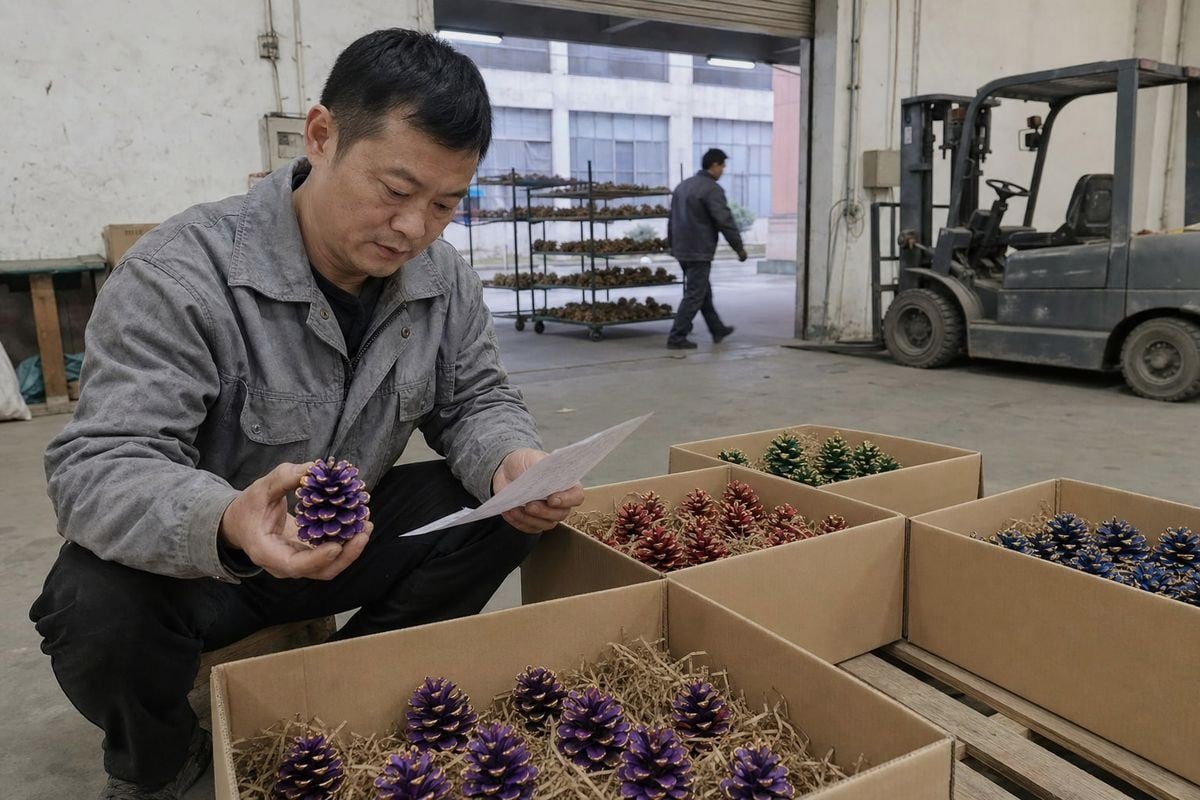
Buyers often ask me how one-time inspection differs from on-site supervision for pine cone orders chain-of-custody documentation 1. A wrong choice here can mean moldy cartons, missed seasons, and angry retail customers.
A one-time inspection is a single quality check of the finished pine cone lot, usually before shipment. On-site supervision is continuous monitoring of sorting, drying, coating, and packing during production. Inspection detects defects at the end; supervision prevents defects throughout the process.
Both methods have a place. The right choice depends on your order size, your supplier relationship, and the risk you need to control. Let me walk you through each option in practical terms.
What certifications should I request during a one-time inspection for pine cone orders?
A German distributor once rejected a competitor's shipment at customs over missing test reports. That incident shaped how our factory prepares documentation for every فحص ما قبل الشحن 2 we host.
During a one-time inspection for pine cone orders, request ISO 9001 factory certification, BSCI social compliance audits, CE marking where applicable, and third-party test reports from SGS or Intertek. Also ask for moisture content records, pest treatment documentation, and packaging safety verification.
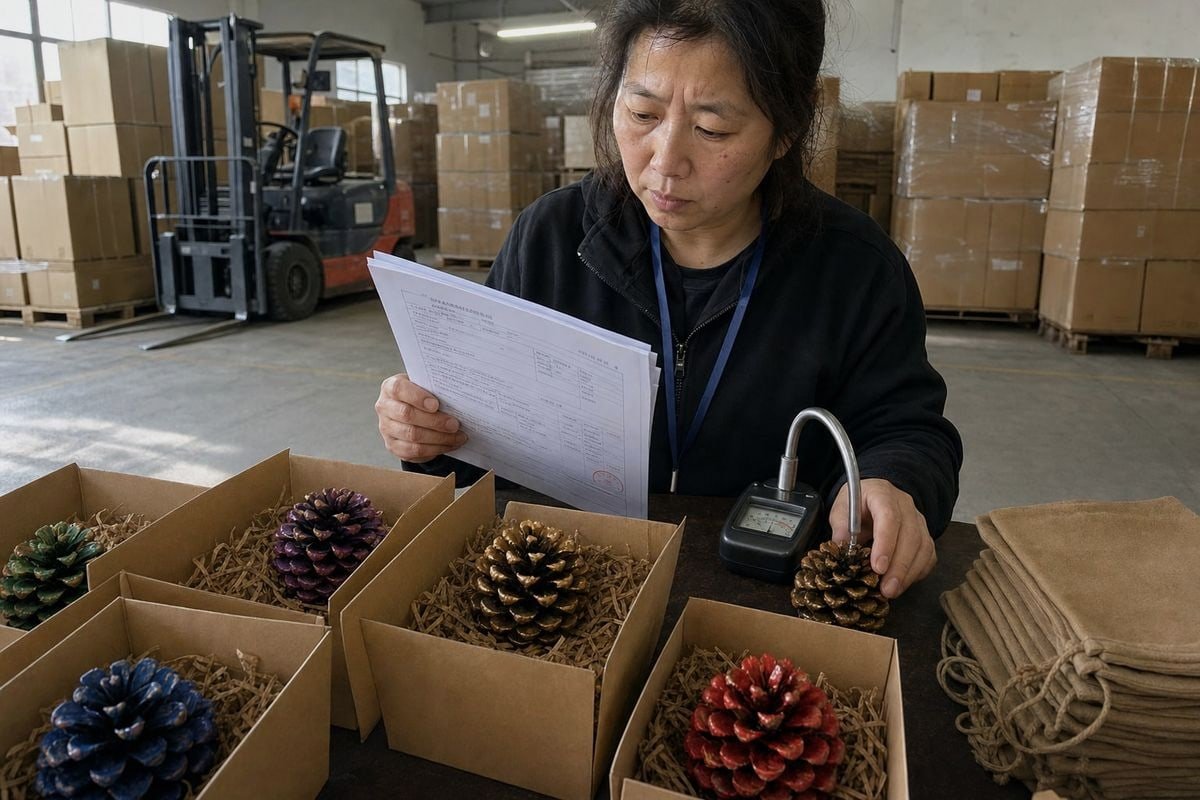
The certification package matters more for pine cones than many buyers realize. Pine cones are a natural product. They cross borders under agricultural and consumer-product scrutiny at the same time. When our color-flame pine cones ship to the US or the EU, the inspection visit is the moment when paperwork and physical product get verified together.
Here is what I recommend you check, in order of priority.
Core factory and product certifications
| شهادة | ما تثبته | لماذا هو مهم لمخاريط الصنوبر |
|---|---|---|
| ISO 9001 | المصنع يدير نظام جودة موثق | Consistent grading and batch control for a variable natural product |
| BSCI | Social compliance and ethical labor | Required by most large EU and US retail channels |
| علامة CE 3 | المنتج يلبي توجيهات السلامة الأوروبية | Essential for color-flame pine cones sold as consumer fire products |
| تقارير SGS / Intertek | اختبار طرف ثالث مستقل | Confirms no harmful chemicals in coatings or colorants |
Order-specific documents to verify on the day
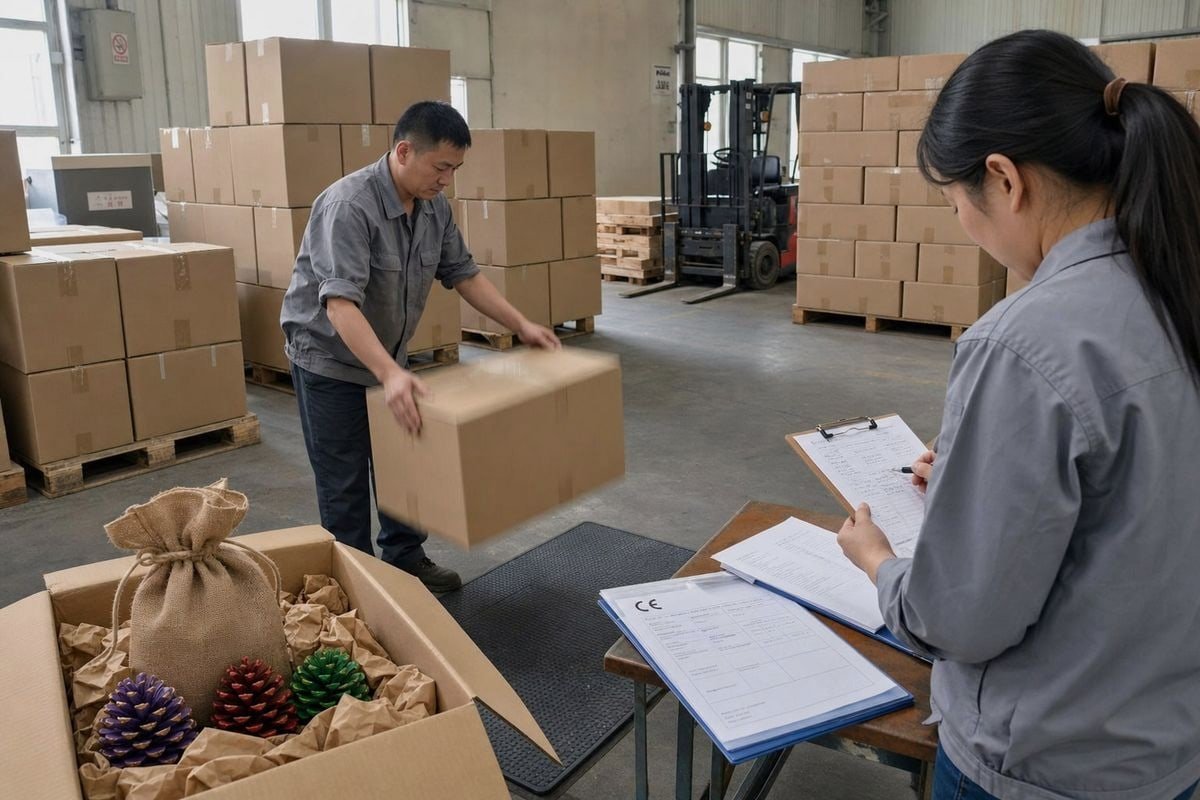
Beyond standing certifications, ask the inspector to confirm lot-specific records. These include moisture content readings 4, because hidden moisture causes mold in transit. They include pest and fumigation treatment records 5, because many destination countries require them for botanical goods. They include colorant and coating safety data if you are buying painted decorative cones or color-flame cones. And they include carton drop-test 6 or packing verification, because pine cones are brittle and crush easily.
In our experience exporting to 30+ countries, the buyers who send a detailed document checklist before the inspection date get a far smoother clearance. The ones who only check quantity and appearance often discover paperwork gaps after the container has already sailed. That is an expensive way to learn.
How does on-site supervision improve quality control for large-volume orders?
Several seasons ago, our QC team caught a drying-room humidity drift mid-production on a large color-flame pine cone run. Fixing it that afternoon saved the entire batch from mold risk.
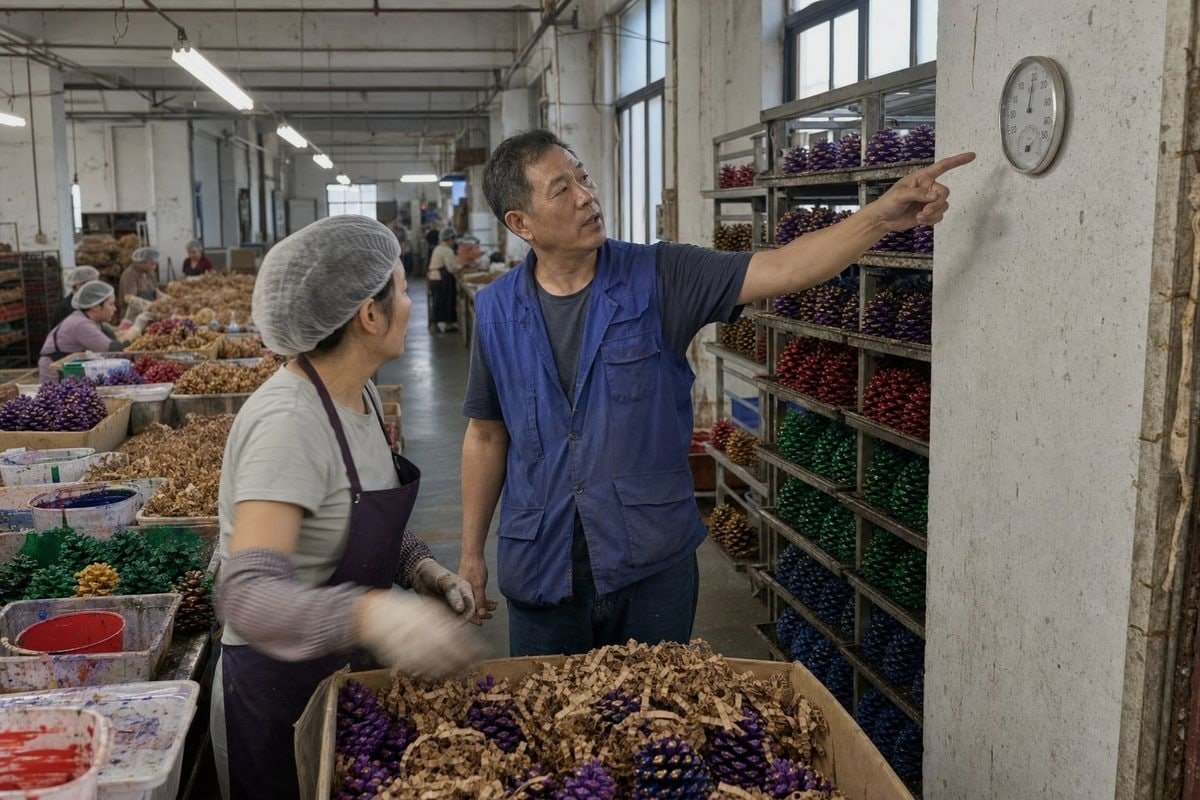
On-site supervision improves quality control for large-volume pine cone orders by catching problems in real time. Supervisors monitor raw material selection, sorting standards, drying conditions, coating consistency, and packing methods, correcting issues before they spread across thousands of cartons instead of discovering them at shipment.
The math on large orders is simple and unforgiving. If a process error affects 2% of a 500-unit order, you can sort it out by hand. If the same error runs unchecked through a 50,000-unit seasonal order, you have a container-sized problem. Supervision exists to stop the error at unit 500, not at unit 50,000.
Where supervision adds value across the process
Pine cones pass through several stages before they reach a carton. Each stage carries its own failure mode:
- استلام المواد الخام. Supervisors reject undersized, cracked, or sap-heavy cones before they enter production.
- Sorting and grading. Continuous checks keep size and shape consistent across the whole run, not just the first pallet.
- Drying and curing. Real-time humidity and temperature monitoring prevents the hidden moisture that causes mold weeks later at sea.
- Coating or treatment. For color-flame or painted cones, supervisors verify wax coverage, colorant dosage, and drying time on every shift.
- Packing. Correct carton fill and cushioning reduce crushing and breakage during transit.
The documentation advantage
There is a second benefit many buyers overlook. On-site supervision creates a continuous record: intake logs, drying charts, batch samples, and packing photos. If a dispute ever arises, that chain-of-custody documentation 7 gives you far stronger standing than a single inspection report. Some of our long-term partners also request periodic photo or video updates during production, which works well as a lower-cost middle ground when travel is not practical. Because our first sample is produced on the same lines as mass production, supervision mostly confirms consistency rather than firefighting surprises — but for a new supplier relationship, you should never assume that.
When should I choose one-time inspection versus ongoing on-site supervision for my order?
The trade-off I discuss most often with purchasing managers is not price versus quality. It is which risk they can afford to carry: a bad final batch, or the process failures that create one.
Choose a one-time inspection for small, simple orders from proven suppliers with stable processes. Choose on-site supervision for first orders with new suppliers, large seasonal volumes, or custom-processed pine cones like color-flame or painted products, where process errors are costly and hard to reverse.
The honest answer is that this is a risk-matching exercise, not a ranking. Here is the decision framework I share with buyers, based on the order scenarios we see most often.
Match the method to your order scenario
| Order scenario | Recommended approach | لماذا |
|---|---|---|
| Small decorative order, trusted supplier | One-time inspection | Low risk, low cost, sufficient final gate |
| الطلب الأول مع مورد جديد | On-site supervision plus final check | Process is unvalidated; early errors are likely |
| Large seasonal retail order | Supervision during production, inspection before loading | Defects at scale are unaffordable; missed seasons are worse |
| Custom color-flame or painted cones | إشراف في الموقع | Extra process steps multiply inconsistency and contamination risk |
| Repeat order, established relationship | One-time inspection, spot supervision occasionally | Trust is earned, but verification keeps it honest |
The hybrid model most experienced buyers use
Some buyers object that supervision is overkill once a supplier has proven itself. I understand the instinct, and cost pressure is real. But the strongest current trend in sourcing is a hybrid model, and for good reason. Supervision reduces defects during production. A final inspection catches whatever still slips through. One checks how the pine cones were handled; the other checks what is actually in the cartons. They answer different questions, so they are not substitutes.
Others argue the opposite: that a single inspection is always too weak. That is also wrong. For a stable, standardized order from a supplier with a documented quality system and batch-to-batch controls, a final inspection is a perfectly rational, cost-efficient gate. The mistake is applying one blanket rule to every order. Match the control to the risk, and revisit the choice as your volumes and product complexity grow.
What costs and lead times should I expect for each inspection option?
A UK buyer once told me he skipped supervision on a large custom order to save a few hundred dollars, then spent thousands on rework and air freight. That conversation stayed with me.
A one-time inspection typically costs a few hundred dollars for one to two days on site, adding minimal lead time. On-site supervision costs several times more, covering days or weeks of monitoring, but it reduces rework delays and shipment rejections that often cost far more.
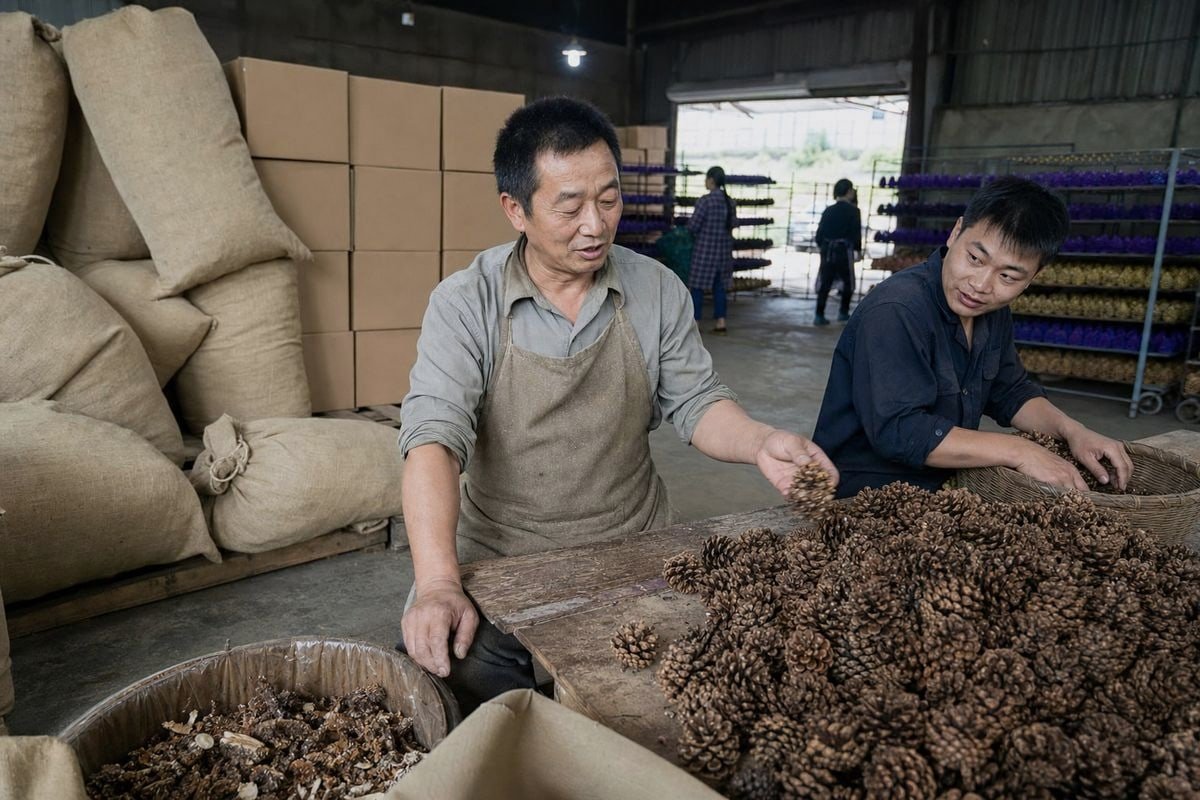
Cost comparisons only make sense when you count the full picture: the fee itself, the schedule impact, and the cost of failure each option leaves uncovered. Let me break that down honestly.
Direct costs and schedule impact compared
| عامل | One-time inspection | إشراف في الموقع |
|---|---|---|
| المدة النموذجية | 1–2 days, near end of production | Days to weeks, across production stages |
| Relative cost | Lower — a single visit fee | Higher — repeated or continuous presence |
| Scheduling | Easy; booked near ship date | Requires coordination from production start |
| Lead time impact | Minimal if goods pass; days of delay if they fail | Slight ongoing overhead, but fewer end-stage surprises |
| Failure cost exposure | High — defects found late may mean full rework or rejection | Low — issues fixed early, before they scale |
The hidden cost most buyers miss
The dangerous number is not the inspection fee. It is the cost of a failed final inspection on a seasonal product. Pine cone orders are usually tied to autumn and holiday retail windows. If a pre-shipment inspection fails in October, there may be no time to re-dry, re-sort, and re-pack before your shelf date. Air freight to recover the schedule can erase your entire margin. In that light, supervision on a large or custom order is not an expense; it is insurance against a missed season.
Remote video supervision is also changing this equation. Buyers can now monitor key stages — drying rooms, coating lines, packing — through scheduled video sessions without flying anyone in. We support this for overseas partners who want process visibility without travel budgets. It sits between the two traditional options in both cost and depth, and for many mid-sized orders it hits the right balance.
نصيحتي العملية: budget for a final inspection on every order as a baseline. Add supervision, physical or remote, whenever the order is large, custom-processed, or with a supplier you have not yet validated.
خاتمة
One-time inspection checks the result; on-site supervision protects the process. Match the method to your order risk, and combine both for large or custom pine cone orders.
ملاحظات ختامية
1. Explains the documentation concept underpinning traceability claims during production supervision. ↩︎
2. Background
 English
  Spanish
  German
  French
  Arabic
  Portuguese
انضم إلى المحادثة