







Juggling packaging needs for multiple Magic Fire powder brands 1 nearly broke one of our earliest clients. Three brands, three vendors, three sets of specs — and constant mix-ups. Our Liuyang factory rebuilt that workflow into a single controlled system, and this article explains how.
One supplier can meet different packaging needs for multiple Magic Fire powder brands by offering flexible formats — foil sachets, kraft pouches, jars, and display boxes — while running separate artwork files, batch codes, compliance labels, and quality checks for each private-label SKU under one coordinated production system.
The idea sounds simple. The execution is not. Below, I break down how custom formats, private-label separation, compliance labeling, and multi-brand quality control actually work in practice.
How can I request custom packaging formats like bags, pouches, or jars for my Magic Fire powder brand?
A German distributor once asked us for the same rainbow flame powder in three formats: single-use foil sachets for retail, kraft stand-up pouches for camping stores, and jars for fireplace shops. We said yes — with a process.
Request custom packaging by sending your supplier the target format, fill weight, artwork files, and market destination. A capable manufacturer will confirm feasibility, provide a dieline template, produce pre-production samples, and lock a written packaging specification before any mass production begins.
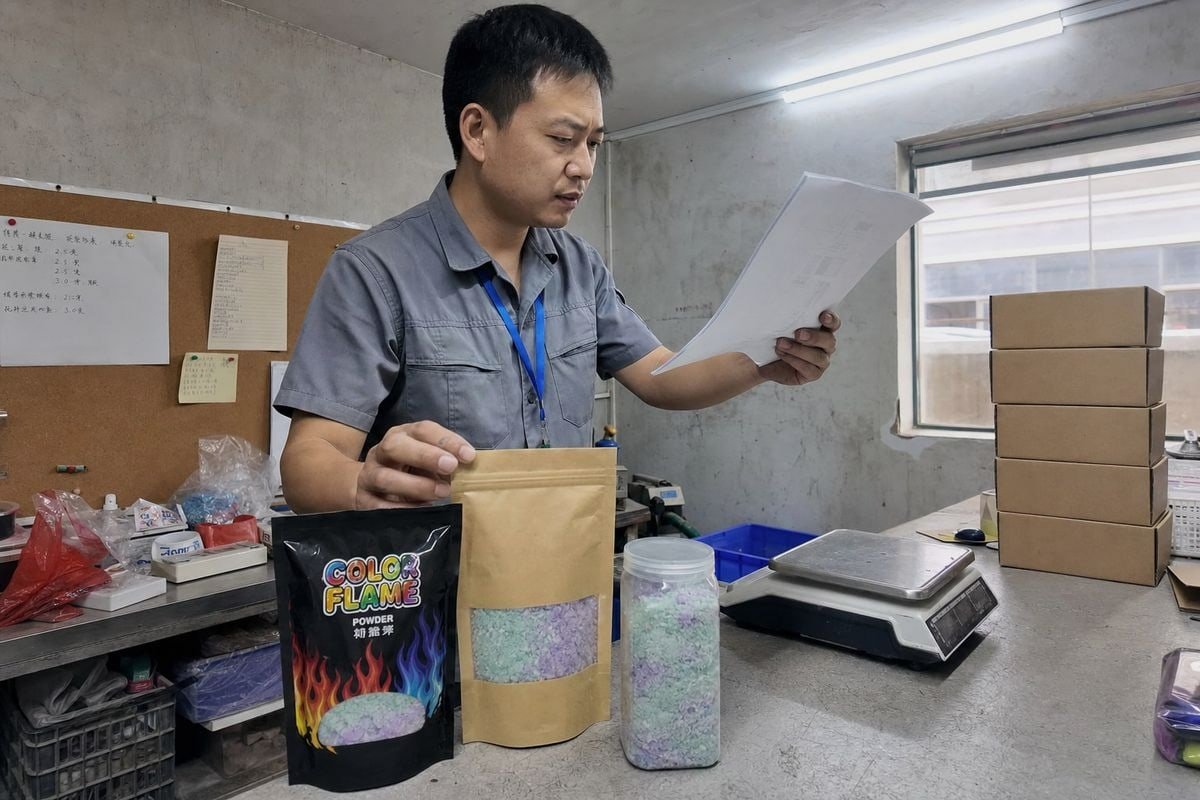
The format decision should start with your channel, not with your logo. In our OEM production capacity planning, we always ask buyers where the product will sit: a camping-store shelf, an e-commerce parcel, or a supermarket clip strip. Each answer points to a different pack. A glossy heat-sealed foil sachet with moisture-proof barrier film 2 protects the crystalline powder from clumping and works well as a low-cost impulse item. A kraft stand-up pouch with a resealable zip suits multi-use bulk refills. A plastic jar reads as premium and stores well beside a fireplace.
The request process, step by step
- Tell us the format, fill weight 3 per unit, and units per case.
- Receive our dieline template and material options for that format.
- Send print-ready artwork; we handle custom sachet printing in-house or through vetted partners.
- Approve digital proofs, then physical pre-production samples.
- Sign off a packaging specification sheet that governs mass production.
Matching format to channel
| تنسيق | متاجر الهدايا، مراكز الحدائق، عروض العطلات | Typical fill | Key benefit |
|---|---|---|---|
| Foil sachet | Retail impulse, gift sets | 15–25 g single use | Low cost, strong barrier |
| Kraft zip pouch | متاجر التخييم والمتاجر الخارجية | Multi-use refill | Resealable, natural look |
| جرة بلاستيكية | Fireplace and BBQ retail | Bulk scoops | Premium feel, durable |
| Display box + sachets | Supermarkets, counters | 10–50 sachets | Shelf-ready presentation |
Digital printing has also lowered the barrier for smaller brands. It lets us run high-quality custom artwork at a modest minimum order quantity (MOQ), so a trial order no longer demands the volumes that traditional plate printing once did.
Can my supplier handle multiple private-label designs without mixing up production batches?
Early in our export years, we learned this lesson the hard way: two brands, similar black pouches, one rushed changeover. Since then, our factory treats every private-label SKU as its own controlled project.
Yes — a disciplined supplier prevents mix-ups by assigning each brand a unique SKU code, separate artwork version files, distinct lot numbers, physical line clearance between runs, and labeled staging areas, so two private-label designs never share a filling line at the same time.

Private label manufacturing for several competing brands is normal in contract packaging services. The risk is not that a supplier serves your competitor. The risk is weak version control. When we run three brands of campfire colorant wholesale orders in one week, the system — not memory — keeps them apart.
The controls that actually matter
First, documentation. Every brand gets a locked specification: artwork file version, barcode, fill weight, case mark, and pallet label. Any change requires a new version number and a fresh sign-off. Second, physical separation. Between brand runs, the line is cleared, checked, and photographed. Leftover pouches from the previous run are counted back into locked storage. Third, traceability. Each batch carries a lot code that links the powder blend, the packaging lot, and the production date. If a question ever arises, we can trace one sachet back to its raw material within hours.
What to ask your supplier before onboarding
- Do you assign unique internal codes per brand SKU, not just per product?
- How do you perform line clearance between brand changeovers?
- Can you show a sample batch record with lot traceability?
- Who approves artwork revisions, and how are old files retired?
A supplier who answers these quickly, in writing, in clear English, is running a real system. A supplier who hesitates is running on luck.
What compliance labels and warning information do I need on different Magic Fire powder packaging types?
Compliance is the first question our US and EU buyers raise — usually before price. After 17+ years exporting fire-themed products to 30+ countries, we treat label review as a formal step, never an afterthought.
Magic Fire powder packaging needs GHS-aligned hazard warnings, keep-away-from-children notices, clear usage instructions, a batch or lot code, importer details, and country-specific marks such as CE where applicable — all backed by an SDS, with wording adapted to each destination market's language and regulations.

Different pack types carry the same core obligations but different space constraints. A small foil sachet has limited print area, so warnings must be concise and icon-driven. A jar or display box has room for full instructions, multilingual text, and a demonstration photo. Either way, صحيفة بيانات السلامة (SDS) 4 compliance sits behind the label: your freight forwarder, your retailer, and sometimes your customs broker will all ask for it. We prepare SDS documentation and third-party test reports through SGS and Intertek so our buyers can hand over a complete file, not a promise.
Core label elements by packaging type
| عنصر | Foil sachet | Kraft pouch | Jar | صندوق عرض |
|---|---|---|---|---|
| Product name and brand | نعم | نعم | نعم | نعم |
| Warning icons and caution text | Condensed | كامل | كامل | كامل |
| تعليمات الاستخدام | Short version | كامل | كامل | Full + photo |
| Lot/batch code | Printed or stamped | Printed | On base or lid | On flap |
| Barcode (EAN/UPC) | Optional | نعم | نعم | نعم |
| Importer/distributor address | If space allows | نعم | نعم | نعم |
Market-specific notes we flag for buyers
The US market expects clear English cautionary statements 5 and child-safety wording. Germany, France, and the Netherlands typically require local-language warnings alongside English. Retail sourcing channels often add their own label audits on top of legal minimums. Some brands now add a QR code linking to safety tutorials and usage videos — it saves label space and turns the pack into a digital touchpoint. Because our products use eco-friendly formulations with no harmful chemicals, the compliance file is straightforward, but it still must exist for every brand and every market separately.
How do I ensure consistent quality across custom packaging runs when ordering for several brands at once?
The trade-off we weigh on every multi-brand order is speed versus verification. Batching several brands on one line saves time, but only strict checkpoints make the first sample match the ten-thousandth unit.
Ensure consistency by locking a golden sample per brand, requiring in-line checks for fill weight, seal integrity, and print quality, reviewing batch QC records, and confirming your supplier holds ISO 9001 with batch-to-batch controls that apply identically to every brand's run.

Consistency across brands starts before production. Each brand's approved pre-production sample becomes the golden sample — the physical reference every future run is measured against. On our lines in Ningbo, operators check fill weight at set intervals, pull sachets for seal-strength tests 6, and compare print color against the approved proof. The powder itself is verified for particle consistency and blend uniformity before it ever reaches the filler, because inconsistent granules cause inconsistent flame color, and that failure lands on your brand, not ours.
A practical QC framework for multi-brand orders
| نقطة فحص | What is verified | Who confirms it |
|---|---|---|
| ما قبل الإنتاج | Golden sample, artwork proof, spec sheet | Buyer sign-off |
| Powder release | Blend uniformity, moisture level | Factory lab |
| In-line filling | Fill weight tolerance, seal integrity | Line QC |
| Post-run | Print color match, lot code accuracy | QC supervisor |
| قبل الشحن | Case marks, pallet labels, random unit audit | Buyer or third party |
Why one supplier can help rather than hurt
Some buyers worry that consolidating brands with one factory creates concentration risk. That objection is fair — and the answer is to verify supply chain scalability before you commit, not to fragment your orders by default. A factory with complete production lines, ISO 9001 7 and BSCI audits, and 17+ years of export history can absorb seasonal peaks and multiple SKUs without cutting corners. Splitting the same volume across three unaudited vendors usually multiplies your quality variance instead of reducing it. Flexible packaging solutions only stay consistent when one accountable system runs them all.
خاتمة
Serving multiple Magic Fire powder brands from one supplier works when formats stay flexible but systems stay strict. Choose a certified partner who coordinates variation — never one who forces every brand into one box.
ملاحظات ختامية
1. Authoritative Wikipedia entry explaining the pyrotechnic chemistry behind color-changing fire powders. ↩︎
2. Defines technical properties of barrier layers used to protect sensitive powders from humidity. ↩︎
3. Explains the concept of net weight, which is the basis for fill weight specifications in packaging. ↩︎
4. Standardized document required for communicating hazard information for chemical products. ↩︎
5. Authoritative .edu source for federal labeling requirements and cautionary statement prominence. ↩︎
6. FDA database entry for the ASTM F88 seal-strength testing standard, ensuring high authority and stability. ↩︎
7. Authoritative Wikipedia overview of ISO 9001 quality management standards. ↩︎



 English
  Spanish
  German
  French
  Arabic
  Portuguese
انضم إلى المحادثة