







Usage instructions for indoor vs outdoor fireplace pine cones are where many private-label programs fail compliance review 1. On our production line, we have seen one vague label sink an entire retail launch.
Usage instructions for indoor vs outdoor fireplace pine cones should be split into two clearly labeled sections: indoors, specify one cone per fire, a closed spark screen, and chimney maintenance; outdoors, allow two to three cones, stress ventilation, fire containment, and never leaving flames unattended.
Getting this right protects your customers and your brand. Below, I walk through the exact warnings, burn data, compliance details, and multilingual options you need on your packaging.
What safety warnings should I include for indoor vs outdoor use on my pine cone packaging?
A German distributor once returned a full sample batch to us — not because of the product, but because the warning panel treated indoor and outdoor use as identical. That lesson shaped every label we print now.
Indoor warnings must state: use only one dry cone per fire, keep a fine-mesh spark screen closed, never use cones as primary fuel, and maintain the chimney to prevent creosote buildup. Outdoor warnings must state: contain the fire, add cones sparingly, ensure ventilation, and fully extinguish before leaving.

The core problem is that the same pine cone carries a very different risk profile depending on where it burns. Indoors, the enclosed space, the chimney, and the proximity of furniture and pets raise the stakes. Outdoors, wind and open ground change the hazards entirely. Your packaging should never force the customer to guess which rules apply.
Why the two settings need separate warning blocks
Pine cones are fire starters and natural kindling, not fuel. They ignite fast, burn hot, and can crackle as resin pockets pop. Indoors, those pops throw sparks toward carpets and pets, which is why we always specify a fine-mesh spark screen on our indoor-facing labels. Heavy or repeated use also accelerates تراكم الكريوزوت 2 in flues, so a chimney safety reminder belongs on every indoor panel. Outdoors, sparks matter less, but containment and airflow and ventilation matter more.
إليك warning structure we recommend to our OEM buyers:
| Warning element | Indoor panel | Outdoor panel |
|---|---|---|
| Quantity limit | One cone per fire, maximum | Two to three cones, never a handful |
| Containment | Closed spark screen or stove door | Fire pit ring, screen, or stone surround |
| Supervision | Never leave an open hearth unattended | Extinguish fully before leaving the site |
| Maintenance | Annual chimney sweep; watch creosote | Clear dry debris within 3 m of the pit |
| Fuel role | Fire starter only, not primary fuel | Kindling aid only, not primary fuel |
Special-case warnings worth adding
We also advise buyers to include a pet-safety line if cones are scented: certain essential oil infusion additives 3 such as tea tree, peppermint, or eucalyptus become respiratory irritants for pets when burned, so they should never appear in indoor-rated cones. For premium wood stove markets like Germany, add a wood stove compatibility note: high-resin cones can foul catalytic converters in high-efficiency stoves, so buyers there expect a "not for catalytic stoves" caution or a low-resin certification.
How can I clearly label burn time and flame color differences for each pine cone variant?
When we were developing our color-flame pinecone line in Ningbo, our QC team burned hundreds of cones across three winters just to standardize the burn-time figures we could honestly print on a label.
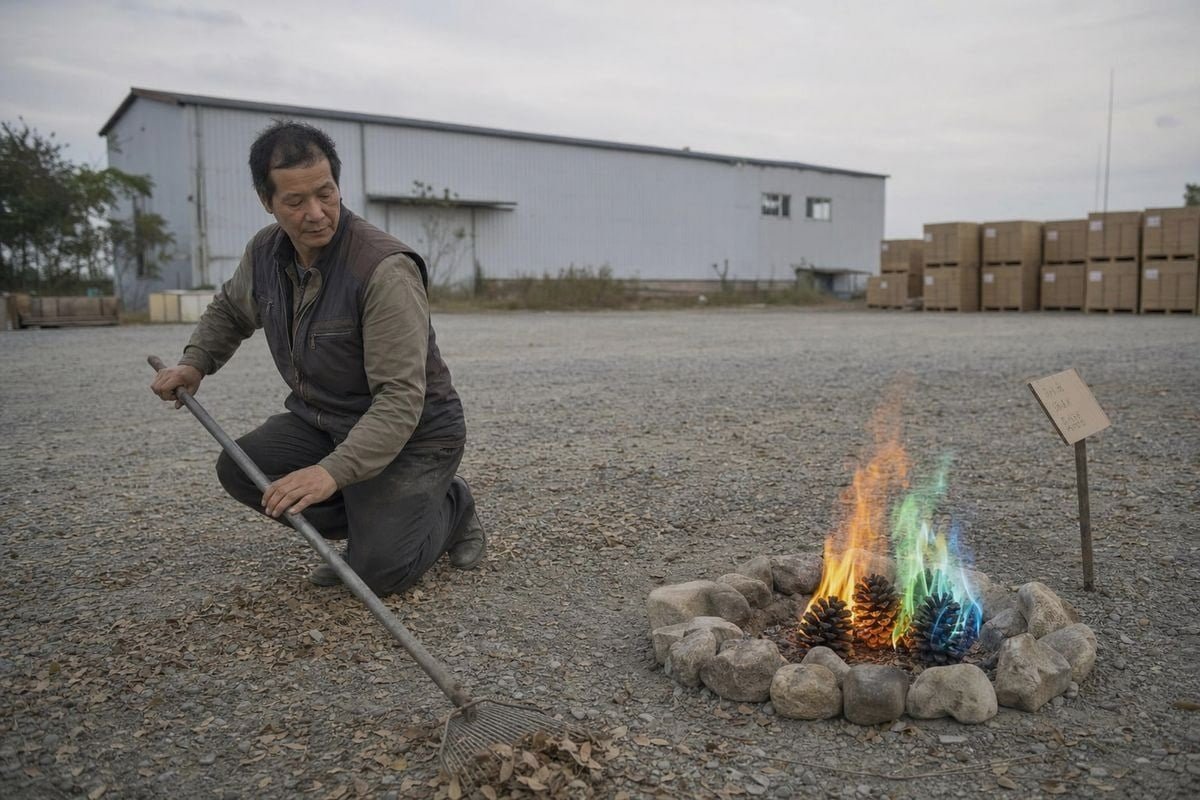
Label each variant with a tested burn-time range, its dominant flame colors, and its intended setting. Use a simple comparison table on the back panel: natural dry cones burn 3–5 minutes, wax-dipped fire starters 8–15 minutes, and color-changing cones display effects for 10–20 minutes.

Buyers trust numbers they can verify at home. So the worst mistake is printing a single vague claim like "long-lasting burn" across every SKU. Each variant behaves differently, and your label should say so plainly.
Build a variant comparison panel
We recommend a compact table on the back of the pouch or jar. It answers the customer's three questions at a glance: how long, what color, and where to use it.
| Variant | وقت الاحتراق النموذجي | تأثير اللهب | Best setting |
|---|---|---|---|
| Natural kiln-dried cone | 3-5 دقائق | Bright orange, fast flare | Indoor or outdoor fire starter |
| Wax-dipped fire starter cone | 8-15 دقيقة | Steady yellow-orange | Fireplace, wood stove, fire pit |
| Color-flame cone | 10–20 minutes of effect | Blue, green, purple color-changing flames | Outdoor fire pit; screened fireplace |
| Decorative painted cone | Not for burning | لا شيء | Display and holiday décor only |
That last row matters more than most buyers expect. We produce hand-painted decorative cones with lacquered finishes and metallic gold accents, and their packaging must state clearly that they are ornamental. Painted coatings are not tested for combustion, so a "do not burn — decorative use only" line prevents dangerous cross-use.
Explain the drivers behind the numbers
A short explainer builds credibility. Burn time depends mostly on moisture and resin content: cones dried to roughly 8–15% moisture ignite cleanly, while wet or closed cones smoke and stall. Wax coating extends burn time because the wax acts as a slow fuel reservoir. Color-changing flames come from أملاح معدنية 4, and the effect appears strongest once the cone is fully engulfed — a detail worth printing, because customers otherwise assume the product failed in the first minute. We also add a storage line: keep cones in a dry container away from heat until use, because reabsorbed moisture quietly shortens the burn time you promised.
What compliance information do I need on my labels for the US and EU markets?
In our experience exporting to the US, Germany, France, and the Netherlands for over seventeen years, the compliance panel is the first thing a serious purchasing manager checks — often before the product itself.
US labels need CPSC-aligned cautionary language, country of origin, net weight, and a scannable barcode. EU labels need CE-relevant conformity information where applicable, CLP hazard pictograms for treated cones, multilingual warnings, importer address, and REACH-compliant ingredient disclosure for any wax or colorant.
Compliance is not decoration. It is the difference between clearing customs smoothly and having a container held at Rotterdam or Long Beach. Our factory holds ISO 9001, BSCI, CE, and SGS/Intertek certifications precisely because our buyers cannot afford that risk, and we hand over the test reports so their labels are backed by documents, not claims.
The core label checklist by market
| عنصر الملصق | متطلب الولايات المتحدة | متطلب الاتحاد الأوروبي |
|---|---|---|
| Cautionary statements | Plain-English fire hazard warnings, "keep away from children" | Multilingual warnings in each destination language |
| Hazard classification | Flammability caution for treated products | CLP pictograms and signal words where colorants or wax trigger classification |
| Origin marking | "Made in China" clearly visible | Country of origin plus EU importer name and address |
| الكشف عن المكونات | Voluntary but expected by major retailers | REACH-aligned disclosure for wax, salts, and coatings |
| Weight and quantity | Net weight in imperial and metric | Metric net weight, e-mark where used |
| التتبع | رمز الدفعة أو الدفعة | Batch code linked to test documentation |
Documentation behind the label
The label is only the visible layer. Behind it, your file should contain SGS or Intertek test reports covering heavy metals and emissions, a declaration for the colorant salts used in color-changing flames, and packaging recyclability marks 5 for markets like Germany and France that enforce extended producer responsibility. We keep batch-linked test records so a buyer can trace any pouch back to its production run. Retail sourcing channels in the Home Depot category audit exactly this chain, and buyers who arrive with complete files negotiate shelf placement much faster. One practical tip: reserve space on your dieline for the importer address block early, because EU rules require it and last-minute artwork changes delay print runs by weeks.
Can Sunrich help me create custom multilingual instructions for different export markets?
A Polish importer recently asked us for one pouch design carrying instructions in five languages, plus a separate French-only version for a fireplace chain. Both shipped from the same production run — that flexibility is the job.
Yes. Sunrich provides full OEM/ODM label services: professionally translated instructions in English, German, French, Dutch, Polish, and other market languages, plus custom warning panels, barcodes, private-label branding, and compliant packaging formats — kraft pouches, jars, or burlap gift sacks — tailored to each export market.

Multilingual labeling is where a real factory beats a trading company. Because we control the production line in Ningbo and the artwork process in-house, we adapt instruction panels without minimum-order penalties that middlemen typically pass along.
How our multilingual instruction process works
- Market brief. You tell us the destination countries and retail channel. A camping brand in Canada needs bilingual English-French by law; a German fireplace distributor needs precise wood stove compatibility language.
- Instruction drafting. We adapt our proven indoor and outdoor instruction templates to your variant — natural kindling cones, wax-dipped fire starters, or color-flame cones — including burn times from our own QC test data.
- Translation and compliance review. Native-language translation, then a check against each market's warning conventions, including CLP phrasing for the EU.
- دمج التعبئة والتغليف. We fit the text to your chosen format: stand-up kraft pouch 6 with a clear window, resealable jar, or rustic drawstring burlap sack for gift lines. Warning legibility rules set minimum font sizes, so we design the dieline around the longest language first.
- Pre-production proof and sample. You approve a printed sample before mass production. Our batch-to-batch quality control means the label and the burn behavior you approve are what ships.
We also handle the small details that stall launches: EAN and UPC barcodes, batch coding 7 for traceability, display-ready cartons, and airflow and ventilation reminders phrased naturally in each language rather than machine-translated. For trial orders, we keep MOQs flexible so you can test one language market before committing to five. In our experience, buyers who launch with properly localized instructions see fewer returns and far fewer retailer compliance queries in the first season.
خاتمة
Clear, market-specific usage instructions turn pine cones from a liability into a shelf-ready product. Split indoor and outdoor guidance, label burn data honestly, meet US and EU compliance, and localize properly.
ملاحظات ختامية
1. Official ISO page for the international standard on effective compliance management systems. ↩︎
2. Official EPA guide on chimney maintenance and creosote prevention. ↩︎
3. Wikipedia article detailing the properties and uses of various essential oils. ↩︎
4. Wikipedia explanation of how mineral salts create colored flames in pyrotechnics. ↩︎
5. European Commission overview of packaging waste regulations and recycling requirements. ↩︎
6. Authoritative overview of stand-up pouch packaging and materials. ↩︎
7. GS1 global standards for product traceability and batch identification. ↩︎



 English
  Spanish
  German
  French
  Arabic
  Portuguese
انضم إلى المحادثة