







Getting compliant EU labels from your supplier sounds simple until Amazon suppresses your listing. On our production line, we have seen buyers lose entire launch windows over one missing label field.
To get compliant EU labels from your supplier, identify your product's EU rule set, build a SKU-level label specification with mandatory fields, translations, and an EU Responsible Person address, send controlled artwork to the supplier, approve a pre-production proof, and verify physical samples before mass production.
This guide breaks that workflow into four practical steps. I will show you what to demand, what to verify, and what to archive. Let's start with the certifications themselves.
What certifications do I need to legally sell fire-starting products on Amazon Europe?
A German distributor once came to us mid-crisis. Their previous factory shipped firestarters with zero test reports, and customs held the container. That experience shaped how we document every batch we export.
Fire-starting products sold on Amazon Europe generally need General Product Safety Regulation compliance, product safety testing reports from accredited labs like SGS or Intertek, CLP labeling where chemical hazards apply, REACH compliance certificates for substance restrictions, and a nominated EU Responsible Person before listing goes live.

The tricky part with fire-starting goods is that they sit between several regulatory regimes. They are not toys. They are not fireworks in the legal sense, if formulated correctly. But they are consumer products with fire-related risk, so regulators look at them closely. In our seventeen years of exporting color-flame packets and wax firestarters to Germany, France, and the Netherlands, we have learned to treat compliance as a stack, not a single certificate.
The compliance stack for fire products
Here is how the layers typically break down for products like flame colorants and wax-dipped firestarters:
| المتطلب | ما تغطيه | من يقدمه |
|---|---|---|
| لائحة سلامة المنتجات العامة | Baseline safety, traceability, manufacturer contact details | Manufacturer + seller |
| REACH compliance certificate | Restricted substances in the powder and packaging | Manufacturer via lab testing |
| CLP labeling requirements 1 | Hazard pictograms and precautionary statements if classified | Manufacturer, verified by seller |
| Product safety testing reports | Burn behavior, composition, heavy metals | Accredited labs (SGS, Intertek) |
| Technical file documentation | Evidence bundle supporting all of the above | Manufacturer, held for authorities |
Note what is missing: CE Marking requirements 2 do not apply to simple flame colorants or firestarters, because no CE directive covers them. The same goes for WEEE directive compliance 3, which targets electronics. If a supplier offers you a "CE certificate" for a powder sachet, treat it as a red flag, not reassurance. A Declaration of Conformity only makes sense where a harmonized directive actually applies.
One more layer matters for Amazon specifically. If you are a non-EU seller, GPSR requires an الشخص المسؤول في الاتحاد الأوروبي 4, sometimes called an EU Authorized Representative, whose name and address must appear on or with the product. Amazon checks this before your listing goes live in most EU marketplaces. We build that address line into artwork from day one so buyers never retrofit labels at a warehouse.
How can I verify my supplier's compliance documents are genuine before placing an order?
Every trade season, buyers show me competitor "test reports" and ask my opinion. Roughly a third have obvious problems: expired dates, mismatched product names, or reports borrowed from a different SKU entirely.
Verify supplier compliance documents by checking the report number directly with the issuing lab, confirming the tested product matches your exact SKU and formulation, checking issue dates against current regulations, cross-referencing any Notified Body numbers in the EU NANDO database, and requesting the full technical file, not a summary page.

Document fraud is not rare in low-cost sourcing. It is common. And Amazon's compliance teams have become far stricter about rejecting documentation that does not match the ASIN. So verification is not paranoia. It is basic procurement hygiene. Here is the process we recommend to our own B2B buyers, because we would rather be verified than doubted.
عملية تحقق من خمس خطوات
- اتصل بالمختبر مباشرة. SGS, Intertek, and TÜV all confirm report authenticity if you provide the report number. A genuine supplier will encourage this. When our buyers email Intertek to confirm our reports, we consider that a good sign, not an insult.
- Match the report to the SKU. Check the product name, model number, material description, and photos inside the report. A report for a wax torch does not cover a color-flame packet. Formulation changes also invalidate old reports.
- Check dates and regulation versions. REACH restriction lists update regularly. A REACH compliance certificate from five years ago may reference outdated substance limits. GPSR replaced the old directive, so pre-GPSR paperwork may miss traceability fields.
- Cross-reference official databases. For any CE-marked category, check the Notified Body number in NANDO. For chemical products, confirm CLP classifications against the ECHA classification inventory.
- Request the technical file documentation. A real factory holds a complete technical file: formulation records, risk assessments, test data, and label artwork history. A trading company usually cannot produce one, because it never existed.
Also verify the factory itself. Ask for the ISO 9001 certificate number and the BSCI audit ID. ISO 9001 quality management standard 5 Both are checkable. A supplier who holds genuine system certifications tends to hold genuine product certifications too, because the discipline is cultural, not cosmetic.
What warning labels and language requirements apply to each EU country I sell in?
Translations are where I see the most avoidable rework. We once reprinted an entire batch of kraft pouches because a buyer's French warning text was machine-translated and legally imprecise. Now we insist on reviewed translations before plates are made.
Each EU country requires warning labels and safety instructions in its official language, so selling on Amazon Germany, France, Italy, and Spain means German, French, Italian, and Spanish label text respectively. Amazon also requires this safety information to appear on the product detail page before purchase.

Language is the multiplier that turns one label into six. EU regulations set what must be said. Each member state decides the language it must be said in. And under GPSR, warnings and safety instructions must reach the consumer in a language they understand, which national authorities interpret as their official language. Amazon enforces the same principle on the detail page, so your listing copy and your physical label must tell the same story.
Country-by-country language snapshot
| السوق | Required label language | Notable extras |
|---|---|---|
| Amazon.de | الألمانية | Packaging EPR registration (LUCID) is mandatory |
| Amazon.fr | الفرنسية | Triman logo and sorting info under French EPR rules |
| Amazon.it | الإيطالية | Environmental labeling of packaging materials |
| Amazon.es | الإسبانية | Standard GPSR and CLP language rules |
| Amazon.nl | الهولندية | Often served via Pan-EU; Dutch warnings still expected |
| Amazon.pl | البولندية | Growing enforcement on language completeness |
For a flame colorant, CLP labeling requirements add another layer. If the formulation triggers any تصنيف المخاطر 6, the pictograms, signal word, and precautionary statements must appear in the local language too. This is why our eco-friendly formulation matters commercially, not just ethically: fewer hazard classifications means fewer mandatory statements crowding a small foil pouch.
Multilingual master vs. localized variants
Buyers often ask whether to print one multilingual label or separate country versions. Both work legally. The trade-off is real, though. A six-language label on a compact sachet becomes unreadable, and regulators do require legibility. Our usual recommendation is a multilingual master for two or three core markets, using ISO 7010 standardized safety pictograms to cut text volume ISO 7010 safety pictograms 7, plus dedicated variants for high-volume marketplaces like Germany and France. Some of our clients now also add QR codes to prepare for future Digital Product Passport requirements, which lightens the physical label further.
Do not forget Extended Producer Responsibility. Germany and France require packaging registration before you sell, and Amazon verifies EPR numbers. It is not a label field, but it fails listings just as fast.
Can my supplier customize packaging and labels to match Amazon's listing requirements?
Private-label work is most of what our Ningbo facility does now. Foil pouches, kraft stand-up bags, flip-top display boxes, jars — every format leaves our line with buyer-specific artwork, barcodes, and warning panels already printed.
Yes, a capable OEM supplier can print custom-compliant labels with your branding, FNSKU or EAN barcodes, localized warning text, EU Responsible Person details, and required symbols directly on packaging. You must supply approved artwork, exact translations, and placement instructions, then sign off a pre-production proof.
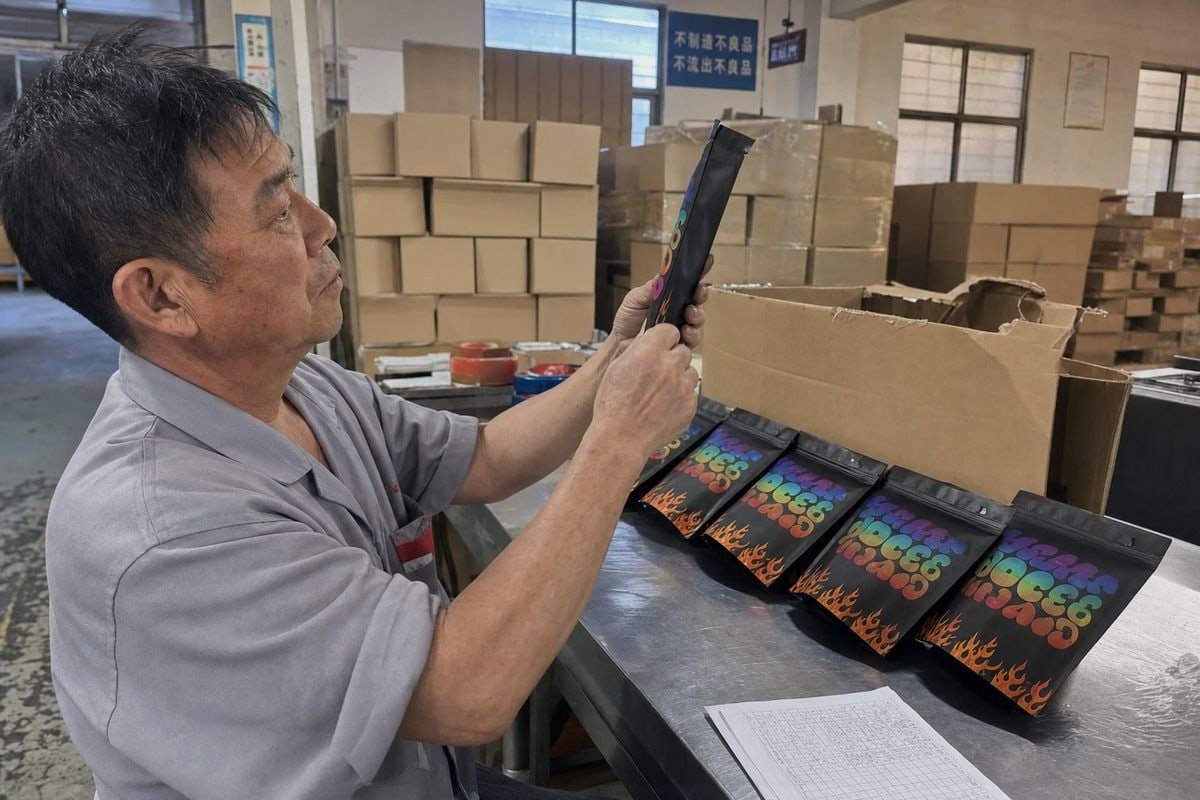
The honest answer has a second half, though: the supplier executes, but you own the compliance risk on Amazon. A factory prints what you approve. So the quality of your artwork brief determines the quality of your label. We have refined a briefing structure over hundreds of OEM projects, and I will share the working version here.
What a complete label brief contains
| Brief element | What to specify | لماذا هو مهم |
|---|---|---|
| Mandatory legal text | Exact wording, per language, locked | Prevents translation drift at the factory |
| EU Responsible Person line | Name, postal address, email | GPSR requirement; Amazon checks it |
| Batch and traceability code | Format and printing method | Enables recalls and market surveillance |
| الرموز الشريطية | EAN plus FNSKU if FBA-labeled at source | Avoids relabeling fees at Amazon warehouses |
| Symbols and pictograms | ISO 7010 icons, recycling marks, Triman | Reduces text load on small pouches |
| Placement map | Which panel carries which element | Small sachets need every millimeter planned |
| Print and durability specs | Ink, abrasion resistance, heat tolerance | Fire products live near heat sources |
The approval loop that prevents disasters
Our process runs in five gates: artwork received, digital proof returned, pre-production physical proof, buyer sign-off with dated approval record, then mass production under batch QC. We photograph the approved proof and keep it in the order file, because when a question comes up eight months later, memory is worthless and evidence is everything. Ask your supplier to mirror this. If they cannot show version control on artwork, they will eventually ship an outdated label.
One caution from experience: never let a factory reuse its generic domestic template "to save setup cost." A label built for the Chinese market will fail EU review on language, traceability, and contact details, and Amazon suppression costs far more than a print plate.
خاتمة
Compliant EU labels are a workflow, not a packaging request. Define the rule set, verify documents, localize languages, control artwork, and archive everything — then Amazon Europe expansion stops being a gamble.
ملاحظات ختامية
1. European Chemicals Agency (ECHA) guide on mandatory labeling for hazardous chemical substances and mixtures. ↩︎
2. Official European Commission page explaining the legal requirements and scope for CE marking on products. ↩︎
3. Official EU environment page detailing the Waste Electrical and Electronic Equipment (WEEE) directive regulations. ↩︎
4. Wikipedia entry defining the role and legal necessity of an authorized representative for non-EU manufacturers. ↩︎
5. Authoritative Wikipedia entry replacing the 403-prone official ISO landing page. ↩︎
6. ECHA explanation of how chemicals are classified based on their physical, health, and environmental hazards. ↩︎
7. Stable Wikipedia reference for ISO 7010 pictograms, avoiding official site 403 errors. ↩︎



 English
  Spanish
  German
  French
  Arabic
  Portuguese
انضم إلى المحادثة