







Every autumn, our production line in Ningbo runs flat out because buyers waited too long to plan their cross-quarter inventory rotation plan for wood fire starters وثائق CE 1. It causes real pain.
A cross-quarter inventory rotation plan for wood fire starters combines quarterly demand forecasting, strict FIFO stock rotation, dated batch labels, zoned storage, and quarterly cycle counts, so older stock sells before it ages, new receipts never block old lots, and reorders align with 8–12 week supplier lead times.
That is the short answer. Now let me walk you through how to build it, step by step, using what I have seen work across dozens of import markets.
How can I calculate seasonal demand shifts to plan my wood fire starter inventory across quarters?
One buyer interaction sticks with me: a German distributor ordered the same volume every quarter for a year, then asked why his warehouse overflowed each June. Flat ordering ignores seasonality.
Calculate seasonal demand shifts by pulling at least two years of quarterly sales data, computing each quarter's share of annual sales, and adjusting for regional climate and channel mix. Then set quarterly target coverage levels so inventory builds ahead of fall and winter peaks and stays lean in summer.

The core idea is simple. Wood fire starters do not sell evenly across the year. Fireplace demand peaks in Q4 and early Q1. Camping and BBQ demand rises in Q2 and Q3 in many markets. If you order the same quantity every quarter, you guarantee overstock in one season and stockouts in another.
Start with a quarterly demand index
Take your last two years of sales. Add up total annual units. Then work out what percentage each quarter contributed. This gives you a demand index you can apply to next year's forecast.
| Quarter | Typical Demand Share | سبتمبر - نوفمبر | Inventory Posture |
|---|---|---|---|
| Q1 | 25–30% | Late-winter heating | Sell through winter stock |
| Q2 | 10–15% | Camping season starts | Keep lean, inspect stock |
| Q3 | 20–25% | BBQ plus fall pre-buy | Build inventory ahead |
| Q4 | 35–40% | موسم التدفئة الرئيسي | Maximum coverage, push old lots |
These shares vary by region. Our US buyers see stronger Q2 camping demand than our Middle East buyers, who skew heavily toward winter. So build a separate index per market or per warehouse if you sell across climates.
Check for cross-season cannibalization
Also ask whether summer camping sales pull from winter fireplace sales. In our experience exporting to 30+ countries, they usually do not. They are different customers with different pack-size preferences. That means you can often transfer stock between regional warehouses ahead of a quarter transition instead of placing a new purchase order. That single habit saves buyers real money.
Finally, layer in external factors. Regional burn bans can suppress a whole quarter of demand overnight. Retail promotions can double it. Note these events in your forecast file so next year's index does not get distorted by a one-off spike or dip.
What lead times should I build into my rotation plan when sourcing from an overseas manufacturer?
At our Liuyang headquarters, we constantly weigh a trade-off for buyers: order early and carry stock longer, or order late and risk missing the peak-season shipping window.
Build in 8–12 weeks of total lead time when sourcing wood fire starters overseas: 3–5 weeks for production, 4–5 weeks for ocean freight, and 1–2 weeks for customs and inland delivery. Place Q4 peak-season orders by late Q2 or early Q3.

Lead time is where cross-quarter planning either works or collapses. If you reorder when shelves are already thin, the goods arrive after the season ends. Then the stock sits through a full off-season, ages, and forces markdowns. I have watched this cycle repeat with new buyers, and it is entirely preventable.
قسّم المهلة الزمنية إلى مراحل
Do not treat lead time as one number. Break it into stages and add a buffer to each.
| المدة النموذجية | ملاحظات | ما الذي يطيله |
|---|---|---|
| تأكيد الطلب وأخذ العينات | 1-2 أسابيع | New private-label artwork, packaging changes |
| الإنتاج | 3-5 أسابيع | Peak-season factory queues, custom burn-time specs |
| الشحن البحري | 4–5 weeks | Port congestion, pre-holiday vessel space shortages |
| Customs and inland transport | 1-2 أسابيع | Documentation gaps, missing test reports |
Two points deserve extra attention. First, peak-season compression is real. From August onward, both factory capacity and vessel space tighten across the fire-products category. An order placed in June ships smoothly. The same order placed in September fights for space. Second, compliance paperwork affects customs speed. Because our products ship with SGS or Intertek 2 and CE documentation, our buyers rarely face customs holds. Buyers sourcing from uncertified suppliers often lose one to three weeks at the border trade facilitation 3, which no rotation plan can absorb.
Set a reorder calendar, not just a reorder point
Translate lead times into fixed calendar triggers. For a Q4 peak, confirm orders by early July. For a Q3 build, confirm by April. A transition buffer of four to eight weeks between quarters protects you when demand ramps faster than expected. We also recommend a smaller trial order in the off-season for new SKUs, so the first full container arrives already validated.
How do I avoid overstock or stockouts during the off-season for wood fire starters?
A lesson we learned early in our 17 years: the off-season is not a dead period. It is when disciplined buyers quietly fix the mistakes of the previous peak.
Avoid off-season overstock and stockouts by classifying SKUs with ABC analysis, setting quarterly depletion targets, running mid-quarter cycle counts, and clearing any lot older than one quarter through bundles, wholesale channels, or controlled markdowns before it sits through a second slow season.

The off-season creates two opposite risks. Overstock ties up cash and lets wax-coated product age in a warm warehouse. Stockouts on your core SKUs mean you lose the early buyers who restock in September. A rotation plan manages both at once.
Classify SKUs before you set rules
Not every fire starter SKU deserves the same treatment. Use a simple تصنيف ABC 4:
- A items — your top-selling starter format or most profitable pack size. Count monthly, never let coverage drop below one quarter of demand.
- B items — moderate movers, such as secondary pack counts. Count quarterly, allow leaner coverage in the off-season.
- C items — seasonal or slow movers, such as niche gift packs. Count quarterly, set hard depletion deadlines, and do not automatically reorder.
This matters because rotation effort is limited. Tight controls on A items protect revenue. Loose controls on C items free up staff time.
Set depletion goals and act on aging stock
At each quarter start, set a target: what percentage of current stock should be gone by quarter end. At mid-quarter, run a cycle count and check lot ages. Any lot older than one quarter gets flagged. Then act before quarter end. Bundle older starters with faster-moving accessories. Move aging cases to wholesale or bulk channels at reduced but positive margin. Run a seasonal promotion. The one rule I push hardest with our distribution partners: never let a lot sit through a second off-peak period. By then, packaging wear and slow ignition-quality drift have eroded both margin and brand perception.
Use metrics to catch drift early
Track four numbers each quarter: inventory turnover 5, days of supply, percent of stock older than one quarter, and fill rate on A items. If aged stock stays high at quarter end, cut order volume or tighten FIFO discipline 6. The numbers tell you which lever to pull.
Which storage and packaging factors should I consider to keep wood fire starters shelf-ready year-round?
During a QC audit at our Ningbo facility, we once traced soft, tacky wax coatings back to a single humid corner of a customer's warehouse. Storage conditions matter more than most buyers expect.
Keep wood fire starters shelf-ready by storing them below roughly 30°C in low-humidity zones, off concrete floors, in sealed moisture-resistant packaging with dated batch labels. Organize storage into receiving, active-pick, and reserve zones, and inspect packaging integrity and dryness at every quarterly rotation.
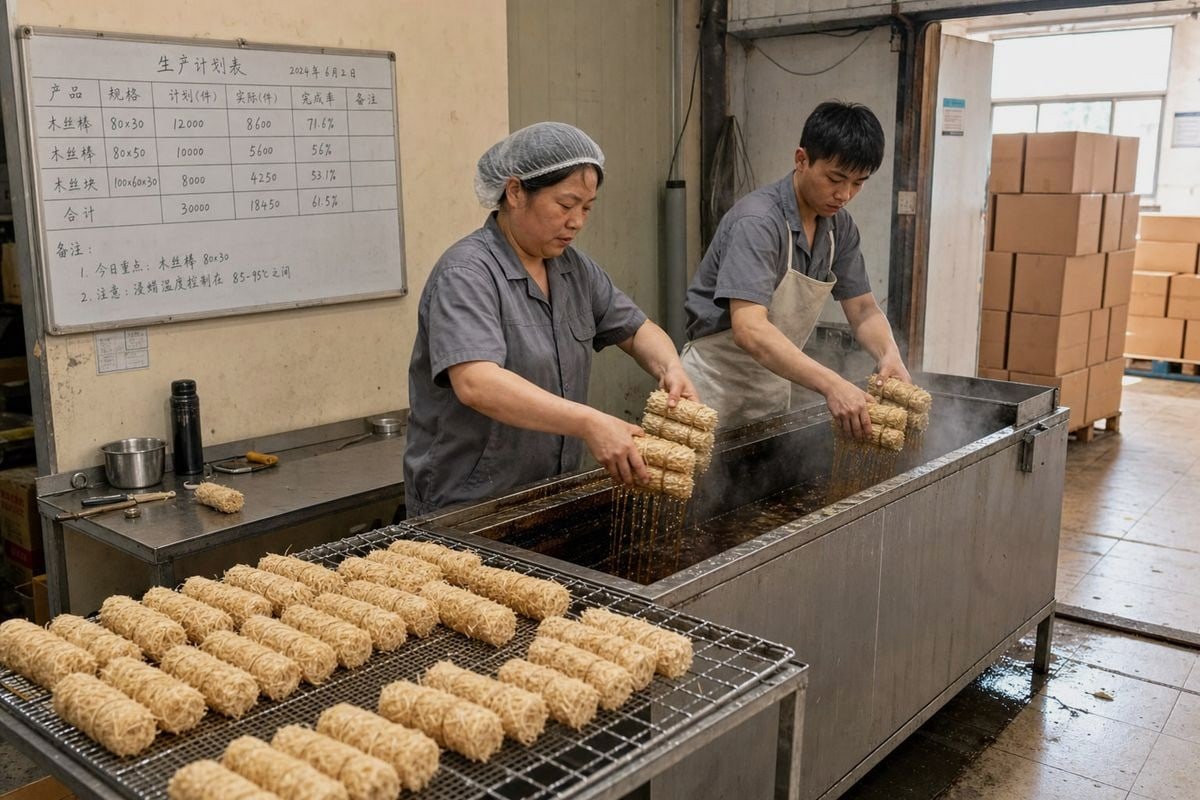
Wood fire starters are dry goods, but they are not inert. The wax-dipped wood rolls we produce combine wood fiber and البارافين 7, and both components respond to their environment. Humidity swells wood fiber and weakens ignition. Heat softens wax and can deform product or stain retail boxes. Crushing damages display packaging and makes cartons unsellable at retail even when the product inside still works. Stored properly, quality fire starters hold up for three to five years. Stored badly, they can look tired within two seasons.
Control the environment first
| عامل | الحالة المستهدفة | المخاطر في حالة التجاهل |
|---|---|---|
| درجة الحرارة | Stable, below ~30°C | Wax softening, product deformation, box staining |
| الرطوبة | Low, ventilated space | Fiber moisture uptake, weaker ignition, mold on cartons |
| ملامسة الأرضية | Pallets, never bare concrete | Moisture wicking into bottom cartons |
| التكديس | Respect carton stacking limits | Crushed retail boxes, unsellable display packs |
| خفيف | Away from direct sun | Faded packaging print, heat buildup |
Design zones and labels that make FIFO automatic
Physical layout is what turns FIFO from a policy into a habit. Split your storage into three zones: a receiving zone for inbound stock, an active-pick zone holding the oldest sellable lots, and a reserve zone for future quarters. New receipts never enter the active-pick zone until older lots clear. Label every lot with SKU, receipt date, supplier batch, storage zone, and inspection date. Color-coded quarter tags work brilliantly: one glance down an aisle shows whether any last-quarter colors remain. On the packaging side, this is also where your supplier helps or hurts you. We design retail boxes, inner wraps, and shipper cartons for our OEM clients specifically to survive ocean freight, quarterly rehandling, and long shelf display — because a rotation plan only protects product that packaging protects first.
خاتمة
Seasonal swings punish unplanned inventory. A cross-quarter rotation plan — forecast, FIFO, zones, lead-time calendars, and quarterly counts — keeps wood fire starters moving, shelf-ready, and profitable. We are glad to help you build it.
ملاحظات ختامية
1. Official EU resource explaining CE marking requirements mentioned as compliance documentation. ↩︎
2. Official site of the testing body named as reducing customs delays for compliant shipments. ↩︎
3. WTO resource on customs procedures relevant to avoiding border delays discussed in the article. ↩︎
4. Explains the inventory prioritization method referenced for classifying fire starter SKUs. ↩︎
5. Defines the key metric buyers should track quarterly per the article's guidance. ↩︎
6. Background on the FIFO stock rotation method central to the article's rotation plan. ↩︎
7. Authoritative chemical reference for the paraffin wax component affecting fire starter storage stability. ↩︎



 English
  Spanish
  German
  French
  Arabic
  Portuguese
انضم إلى المحادثة