







Choosing wood fire starters sounds simple until a container of them fails in the field. On our production line in Ningbo, I've seen how one wrong spec ruins a launch. A starter that lights beautifully in a fireplace can sputter in a damp fire pit. Angry reviews follow, returns pile up, and your retail buyer starts asking hard questions. The fix is [matching burn time, material, and certification to each heating method](https://sunrichfire.com/how-choose-wood-fire-starters-based-usage-scenario/) before you place the bulk order.
Choose wood fire starters by matching burn time and material to the heating method: clean, low-residue wax-and-wood-fiber starters with 8–12 minute burn times for indoor stoves and fireplaces, and longer-burning, weather-resistant starters for outdoor fire pits and camping. Always verify SGS or Intertek test reports first.
Let me break this down the way I walk our B2B buyers through it. We will cover certifications, burn-time matching, private-label options, and how to vet a factory.
What certifications should I check to ensure wood fire starters meet safety and compliance standards?
A German distributor once told me his previous shipment was held at customs for missing test documentation. That conversation shaped how we handle compliance paperwork at our Liuyang headquarters today.
Check for SGS or Intertek third-party test reports, CE marking for the EU, ISO 9001 factory certification, and BSCI social compliance audits. For natural wood fire starters, also request material composition sheets confirming paraffin content and the absence of harmful chemical accelerants.

Compliance is not a nice-to-have in this category. Fire starters are combustible goods. Customs authorities, retailers, and insurers all want proof that the product is safe and legally imported. In our 17+ years exporting to 30+ countries, the paperwork question comes up in almost every first call with a US or European buyer.
المستندات الأساسية المطلوب طلبها
Ask any supplier for these four items before you discuss price:
| شهادة | ما تثبته | من يطلبها |
|---|---|---|
| تقرير اختبار SGS / Intertek | Product safety, composition, burn behavior | Retailers, importers, insurers |
| علامة CE | Conformity with EU safety directives | جمارك وموزعو الاتحاد الأوروبي |
| ISO 9001 | المصنع يدير نظام جودة موثق | قنوات توريد البيع بالتجزئة الكبيرة |
| تدقيق BSCI | ظروف العمل والعمالة الأخلاقية | لماذا يجب أن يكون "صديق للبيئة، لا مواد كيميائية ضارة" قابلاً للإثبات |
Composition transparency matters too
A test report should confirm what the starter is actually made of. Our wax-dipped wood rolls, for example, use natural wood fiber and paraffin with no harmful chemical additives. That matters for جودة الهواء الداخلي 1 and for buyers selling into markets where chemical accelerants 2 face restrictions. If your customers use starters near cooking, ask whether the product qualifies as food-safe fire starters — natural wood wool firelighters without chemical solvents are the safer bet for grilling applications. Some buyers also request FSC-certified wood fiber 3 for sustainability claims on packaging. If a supplier cannot produce current test reports within a day or two, treat that as a red flag. Genuine factories keep these documents on file because their existing customers demand them every season.
How do I match wood fire starter burn time to my customers' fireplaces, wood stoves, or fire pits?
When we calibrate wax saturation on a new batch, we are really tuning one thing: how long the flame lasts. Burn time is the spec that decides whether an end user succeeds or fails.
Match burn time to the heating method: 8–10 minutes suits fireplaces with dry kindling on a grate, 10–12 minutes suits wood stoves with controlled airflow, and 12–15 minutes suits outdoor fire pits where wind and moisture demand a longer, hotter flame.
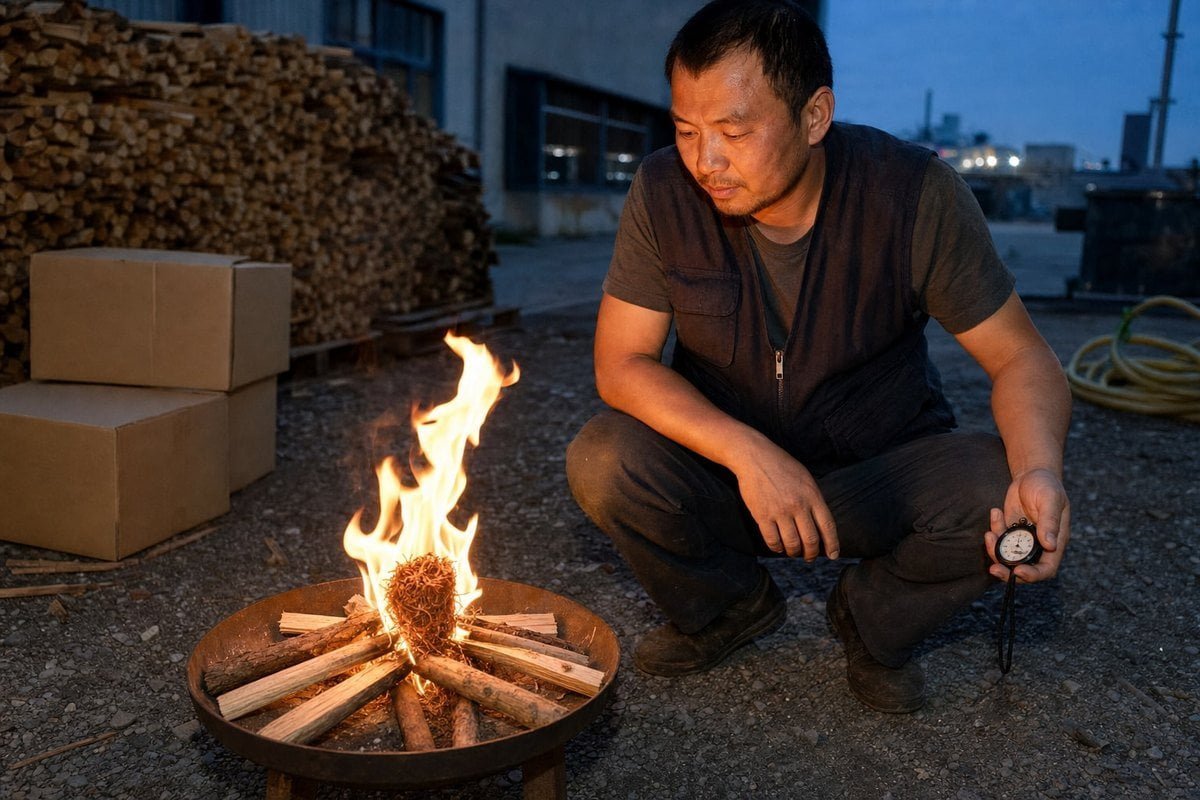
Here is a quick reference we share with distributors when they build their product range:
| Heating method | وقت الاحتراق الموصى به | Key product traits | Typical placement |
|---|---|---|---|
| Fireplace | 8-10 دقائق | Low smoke, low odor, clean residue | Under kindling on the fireplace grate |
| موقد حطب | 10-12 دقيقة | Compact, low ash, catalyst-safe | Beneath or within the kindling stack |
| حفرة نار | 12–15 minutes | Weather-resistant wax coating | Center of a log-cabin stack |
| Camping / backup | 30-60 ثانية | Compact, shelf-stable, water-tolerant | Base of the fuel structure |
Why burn duration beats ignition flash
A starter that flares for two minutes looks impressive but often fails. The flame must transfer heat into kindling wood and then into logs. Industry guidance points to 8–15 minutes as the practical window for reliable fire building, and our own burn tests support that range. Anything shorter forces the user to light a second starter, which reads as product failure in reviews.
Fuel condition changes the math
Even a long-burning starter struggles against wet fuel. Seasoned firewood with محتوى الرطوبة 4 below 20% ignites far more consistently than green wood. If your customers heat with marginal fuel, spec a longer burn time and a higher wax ratio. For outdoor lines, resin-rich options like fatwood sticks or heavily waxed wood wool tolerate damp air better. For indoor تظهر معظم الأسواق موجتين من الطلب. الموجة الكبيرة تمتد من أكتوبر إلى فبراير، مدفوعة بالمواقد والمواقد الخشبية. الموجة الأصغر تمتد من مايو إلى يوليو، مدفوعة بالتخييم وحفر النار والشواء. قم بتقسيم تنبؤك حسب الموجتين، لأن بادئ التشغيل الذي يبيع 40 وحدة يوميًا في نوفمبر قد يبيع 6 وحدات يوميًا في أبريل. 5, prioritize a cleaner, low-residue burn that keeps glass doors clear and limits chimney creosote buildup 6 over a heating season. A good flue draft also helps; some users prime the chimney with a small flame before lighting the main stack. One more spec worth negotiating: pre-scored or breakable formats. A larger starter that snaps into halves lets end users adjust burn time to conditions, which stretches value per unit and cuts your customers' cost per fire.
Can I get custom sizes and private-label packaging for wood fire starters that fit my brand?
Last spring, a UK fireplace brand came to us with only a logo and a shelf-space measurement. Twelve weeks later, their branded display boxes were on pallets heading to Felixstowe. That project is a fair picture of how OEM development actually works.
Yes. Reputable factories offer full OEM/ODM customization of wood fire starters, including roll size, wax ratio, burn time, piece count, and private-label packaging — custom boxes, kraft bags, display packaging, warning labels, and barcodes — usually with flexible MOQs for trial orders.
Customization is where a distributor turns a commodity into a brand asset. On our lines, we adjust three product variables and four packaging variables, and each one affects your positioning and margin.
Product variables you can specify
- الحجم والشكل. Standard rolls are roughly finger-length, but diameter and length can shift to hit a target burn time or a target price point.
- Wax ratio. A 50% wood fiber, 50% paraffin blend is a common baseline. More wax means longer burn time and better weather resistance; less wax means a lighter, faster-lighting piece. Some European buyers now ask about paraffin-free or plant-wax alternatives for eco-positioned lines, which is worth discussing at the sampling stage.
- Piece count per pack. Counts like 24, 50, or 100 pieces let you ladder your retail range from trial packs to value boxes.
Packaging variables that drive shelf performance
Retail buyers judge packaging before they judge the product. We produce custom printed boxes, kraft bags, jars, and counter display units, plus market-specific warning labels, multilingual instructions, and retail barcodes. For US big-box channels, shelf-ready display packaging often decides whether a listing gets accepted at all. My advice: start with a trial order at a modest MOQ, validate sell-through in one channel, then scale the SKU range. A factory that resists small trial runs is telling you something about how they treat new partners.
What should I look for in a manufacturer to guarantee consistent quality across every bulk order?
The hardest lesson in this trade came early in my career: a beautiful sample means nothing if batch ten drifts. That is why we built batch-to-batch QC checkpoints into every stage of our Ningbo production.
Look for a real factory — not a trading company — with ISO 9001 systems, documented batch-to-batch QC, in-house burn testing, 10+ years of export history, and references in your market. Consistency comes from process control, so audit how they test, not just what they promise.

Sample quality and mass-production quality are two different questions. Any supplier can hand-pick a perfect sample. Your real risk sits in container three, six, and nine, when the relationship is mature and attention can slip. Here is how I suggest purchasing managers separate reliable factories from risky ones.
Signals of a dependable factory
| ما الذي يجب التحقق منه | Strong signal | علامة تحذير |
|---|---|---|
| Legal status | Owns production lines you can visit or video-audit | Vague answers about where goods are made |
| نظام الجودة | ISO 9001 certified with batch records | "We check everything" with no documentation |
| Burn testing | In-house tests on ignition speed and burn time per batch | Only tests when a customer complains |
| سجل الأداء | 10+ years exporting to your region | New entity with no verifiable references |
| التواصل | Responsive English contact who answers technically | Slow replies that dodge spec questions |
Questions worth asking on the first call
Ask how they control moisture content in raw wood fiber 7, because humidity swings change ignition behavior between summer and winter production. Ask how wax temperature and dip time are monitored, since these set burn time consistency. Ask what happens when a batch fails internal testing. A factory with real depth answers these in specifics, not slogans. Also confirm they store finished goods properly; fire starters that absorb ambient humidity in a damp warehouse will light slowly out of the box. Finally, ask whether the first sample is pulled from the same process as mass production. In our experience exporting to the US, Germany, and Australia, that single question exposes trading companies faster than any audit form. A trading company reshuffles factories to chase price; a manufacturing partner protects your spec because their name is on the process.
خاتمة
The wrong wood fire starters cost you returns, reviews, and retail trust. Match burn time to each heating method, demand real certifications, and partner with a factory that proves consistency.
ملاحظات ختامية
1. EPA introduction to indoor air quality and the impact of household pollutants. ↩︎
2. Wikipedia overview of substances used to initiate or speed up the spread of fire. ↩︎
3. Official Forest Stewardship Council page on sustainable wood sourcing and labeling standards. ↩︎
4. Michigan State University article explaining the relationship between wood moisture content and heating efficiency. ↩︎
5. Authoritative EPA resource for selecting and operating wood-burning stoves. ↩︎
6. EPA guidance on wood smoke and preventing creosote accumulation for indoor safety. ↩︎
7. Wikipedia entry detailing the structure and industrial applications of wood-derived fibers. ↩︎



 English
  Spanish
  German
  French
  Arabic
  Portuguese
انضم إلى المحادثة