






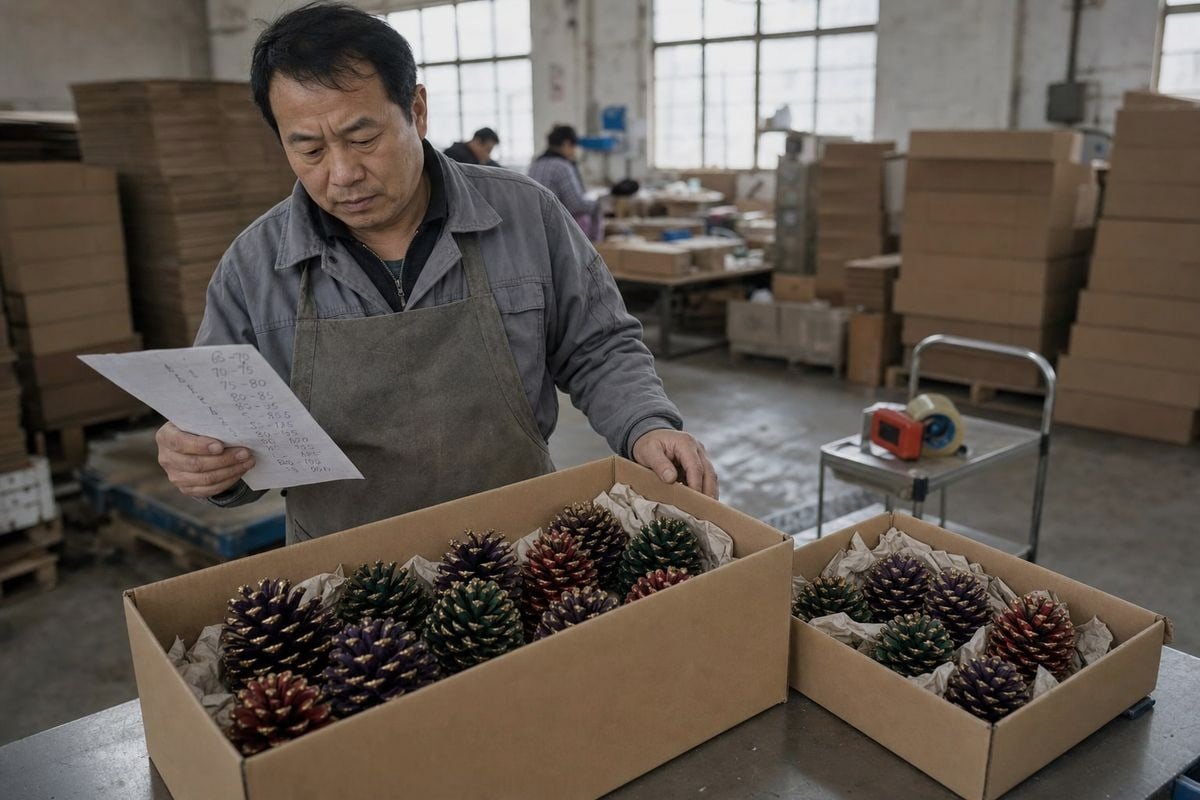
Adjusting carton specs for fireplace colored pine cones sounds simple until crushed cones and surprise freight bills arrive. Our Ningbo packing line has seen exactly how vague requests go wrong.
To ask suppliers to adjust carton specs for fireplace colored pine cones, send a written request stating exact new dimensions, board grade, pack count, palletization, and the reason for the change. Then require a revised quote, a pre-production sample carton, and written spec confirmation before mass production.
That is the short answer. Below, I walk through each step in the order a real purchasing manager would follow, from the first email to the final sample approval.
What information should I give suppliers before requesting carton spec changes?
A German distributor once emailed us just four words: "Make the boxes smaller." Our team at Sunrich spent two weeks clarifying what that actually meant before we could quote anything.
Before requesting carton spec changes, give suppliers your current spec, the exact desired dimensions, corrugated board grade, pack count per master case, gross weight limit, shipping destination, palletization requirements, label and barcode placement, and a one-sentence reason for the change.

The single biggest cause of slow quotes is an incomplete request. When a buyer sends us a clean, apples-to-apples comparison of the current spec versus the desired spec, we can usually return a revised quote within days. When the request is vague, both sides waste weeks guessing.
Build a simple spec sheet
Keep the email itself short. Put the details in a structured attachment. Here is the minimum information your supplier needs:
| بند المواصفات | Current | Desired | لماذا هو مهم |
|---|---|---|---|
| Carton dimensions (L×W×H) | e.g., 60×40×40 cm | e.g., 55×38×35 cm | Affects cube efficiency and freight |
| Board grade / flute type | e.g., double-wall BC flute | State exactly, or ask supplier to propose | Determines corrugated box strength |
| Pack count per master case | e.g., 24 retail units | e.g., 20 retail units | Changes case price and retail math |
| Gross weight limit | e.g., under 15 kg | Confirm carrier limit | Handling safety and surcharges |
| Palletization | e.g., 40 cartons per pallet, 5 layers | Restate or revise | Stacking strength and container fit |
| Labels and barcodes | Current artwork | New placement or artwork file | Warehouse receiving and retail scanning |
State the reason for the change
أخبر المورد لماذا you want the change in one sentence. "We need to fit 40 cartons per pallet for our new 3PL" gets a smarter counter-proposal than a bare dimension request. In our experience exporting hearth and fireplace accessories to 30+ countries, suppliers who understand the goal often propose a better solution than the one the buyer first imagined.
Include compliance context up front
For colored pine cones, mention destination-market requirements early: whether outer cartons need warning labels for مواد تلوين اللهب 1, whether you need a Material صحيفة بيانات السلامة 2 on file, and whether any wood-based pallet or packing material must meet ISPM 15 3 pest-control standards for customs clearance. Missing these details after production is far more expensive than stating them before.
Finally, share your realistic volume forecast. Custom carton sizes and material upgrades price very differently at 500 cartons versus 5,000, and accurate forecasts give you real negotiating room on unit cost.
How do I confirm new carton dimensions won't affect shipping costs or damage rates?
Cutting a carton by three centimeters once pushed one of our US buyers' shipments over a carrier's الوزن الحجمي 4 threshold in the wrong direction. The freight savings they expected turned into a surcharge.
Confirm impact by asking the supplier for the new carton's cube, pallet fit, and container loading plan, then modeling volumetric weight against your carriers' thresholds. Also request the board's Edge Crush Test value and stacking assumptions in writing before approving any dimension change.

Colored pine cones are a low-density, fragile, irregular product. That combination makes them unusually sensitive to carton dimension changes. A carton that is slightly too large ships air and inflates dimensional weight charges. A carton that is slightly too small crushes the cones' scales, and a crushed decorative cone is unsellable even if it still burns with colored flames.
Run the freight math before you commit
Do not rely on unit price alone. Freight cost optimization is about landed cost per sellable unit. Ask your supplier or forwarder to confirm three numbers for the proposed carton:
| فحص | ما يجب أن تطلبه | Risk If Skipped |
|---|---|---|
| Volumetric weight | New carton cube vs. carrier divisor | "Shipped air" surcharges on low-density cones |
| Pallet fit | Cartons per layer, layers per pallet, overhang | Wasted pallet space or unstable stacks |
| Container fill | Cartons per 20ft/40ft container | Paying for empty container volume |
Our team routinely reworks carton dimensions for buyers so master cases align with standard EU and US pallet footprints. A small dimension tweak that adds one full layer per pallet often saves more than any material downgrade could.
Protect against damage, not just cost
Ask the supplier to state, in writing, the corrugated board's Edge Crush Test 5 rating and the maximum stacking height it assumes. Warehouse racking and high-stacking during seasonal storage are where thin-walled cartons fail. For fragile cones, double-walled corrugated cardboard 6 is usually worth the marginal cost, especially for export handling with multiple touch points.
Here is a fair way to raise the tension with your supplier: less packaging means lower cost, but it can raise damage rates and hurt retail appeal. Instead of asking for a cheaper box, ask this: "Can you optimize the carton spec for freight without reducing protection?" That framing invites engineering, not corner-cutting.
What quality and compliance checks should I request after adjusting carton specs?
Certification questions are usually the first thing our EU buyers raise, before price and often before samples. A revised carton is a revised product in the eyes of a customs officer or a retail auditor.
After adjusting carton specs, request written confirmation of board grade and Edge Crush Test values, updated compliance labeling for flame colorant chemicals, a current Material Safety Data Sheet, ISPM 15 conformity for wood-based packing, drop and stacking test results, and barcode scan verification.

A carton change touches more than cardboard. It can shift label positions, alter inner-pack cushioning, and change how moisture behaves inside the box during a long ocean transit. So your post-adjustment checklist should cover structure, chemistry, and compliance together.
Structural checks
Ask the supplier to re-verify the manufacturing specifications on the new carton, not carry over old test data. That means a fresh Edge Crush Test report on the actual production board, a stacking test at your declared pallet height, and a drop test with the real product inside. At our Ningbo facility, we re-run these checks whenever a buyer changes dimensions or pack count, because a smaller carton with the same board can behave very differently under compression.
Chemistry and moisture checks
Colored pine cones carry mineral-based coloring agents, so the carton itself must be chemically neutral. Request confirmation that adhesives and inks used in carton construction will not react with the coating on the cones. Also ask about moisture-resistant packaging measures: seasonal stock often sits in warehouses for months, and humidity can cause blooming or degradation of the color coating. Integrated slots or space for desiccant packets inside the master carton is a simple, cheap safeguard we recommend for buyers in humid markets like Brazil and the Middle East.
Compliance and documentation checks
- Updated exterior warning text and usage instructions where destination regulations require them.
- A current Material Safety Data Sheet matching the shipped formulation.
- Third-party test reports — we supply إس جي إس 7 or Intertek documentation as standard because our buyers treat compliance as a hard requirement, not a nice-to-have.
- ISPM 15 stamps on any wooden pallets or crates.
- A barcode scan test on the new label placement, so warehouse receiving does not stall on arrival.
Get every one of these confirmations in writing and attached to the revised purchase order. Verbal assurances do not survive a customs inspection.
How can I request a sample carton before committing to a full production run?
One lesson our 17 years in this business keeps re-teaching: the sample stage is where problems are cheap. A flawed carton discovered at the sample stage costs days; discovered at the port, it costs a season.
Request a pre-production sample by asking for one fully packed master carton built to the new spec, shipped via courier at your cost if needed. Confirm sample lead time, whether sample fees are credited against the order, and require written sign-off that mass production will match the approved sample.
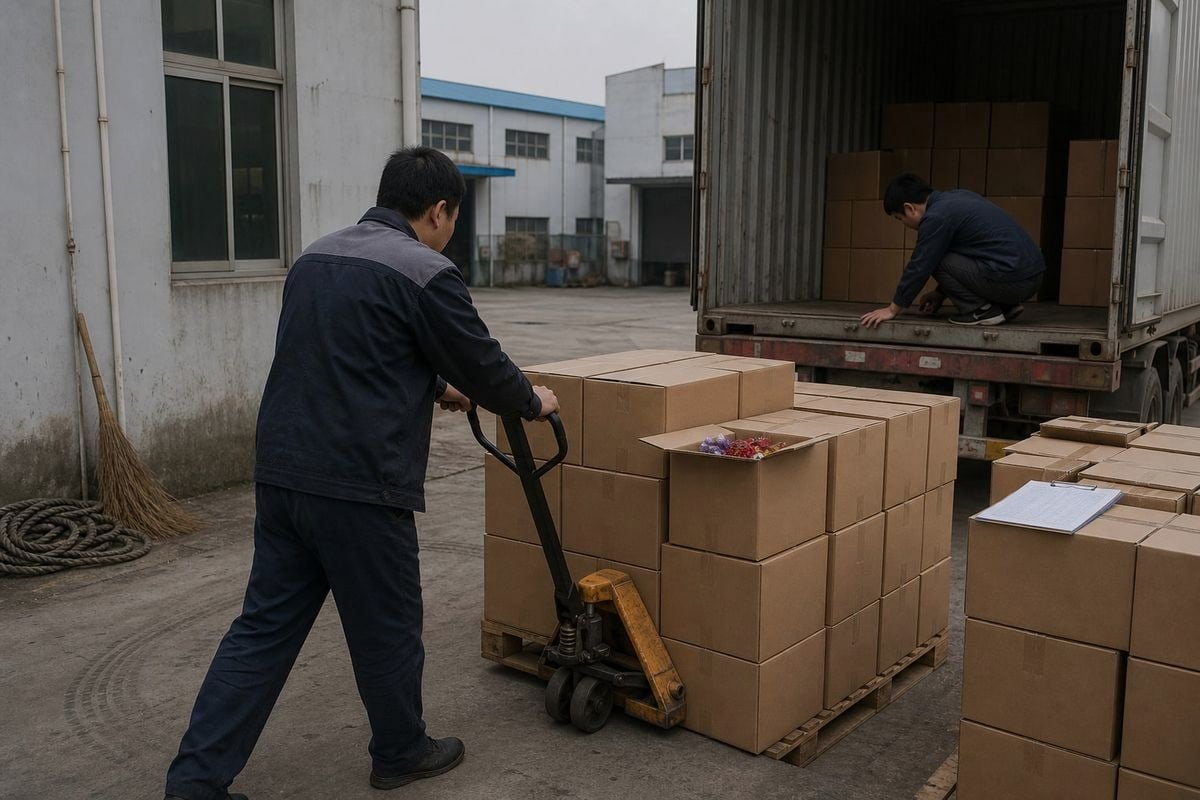
A drawing approval is not a sample approval. Ask for both, in sequence. First, approve the die-line drawing with dimensions, artwork, and label placement. Second, approve a physical carton packed exactly as production will pack it, including inner packs, cushioning, and desiccants.
What to inspect on the sample
| Inspection Point | ما يبدو جيدًا |
|---|---|
| أبعاد | Within stated tolerance of the approved drawing |
| Board and flute | Matches quoted grade; feels rigid at corners and edges |
| Print and branding | Private label packaging artwork, colors, and barcodes correct and scannable |
| Pack-out | Cones seated without movement; no scale crushing when shaken |
| Retail conversion | Perforated tear-away sections fold cleanly into a shelf-ready display, if specified |
| Closure and tape | Seals hold under a realistic drop from waist height |
Ask the right commercial questions alongside the sample
Use the sample request to lock down the commercial terms in the same thread: revised unit price at your forecast volumes, MOQ impact of the new carton, tooling or plate charges for new print, and lead time after sample approval. In our OEM and ODM work, we quote all of these together so buyers can make one decision, not five.
One caution from experience: only work with suppliers whose samples reliably predict mass production. We built our batch-to-batch quality control specifically so the first sample carton a buyer approves is what arrives in every container afterward. If a supplier resists giving written confirmation that production will match the approved sample, treat that as your answer.
Finally, keep a signed or stamped copy of the approved spec and one retained sample carton in your office. When a shipment arrives and something looks off, that retained sample settles the discussion in minutes.
خاتمة
Vague carton requests create damaged cones, surprise freight bills, and missed seasons. A precise spec sheet, freight modeling, written compliance checks, and an approved sample carton prevent all of it.
ملاحظات ختامية
1. Scientific overview of chemicals used to produce colored flames in fireplace products. ↩︎
2. Official OSHA resource for Hazard Communication and Safety Data Sheet (SDS) standards. ↩︎
3. Official international standard for wood packaging to prevent pest spread during global trade. ↩︎
4. Explains the calculation method carriers use to determine shipping costs based on package volume. ↩︎
5. Industry standard test for measuring the compressive strength of corrugated shipping containers. ↩︎
6. Provides technical background on the structural properties of double-walled corrugated materials for fragile goods. ↩︎
7. Global leader in inspection and testing services for product quality and compliance. ↩︎



 English
  Spanish
  German
  French
  Arabic
  Portuguese
انضم إلى المحادثة