






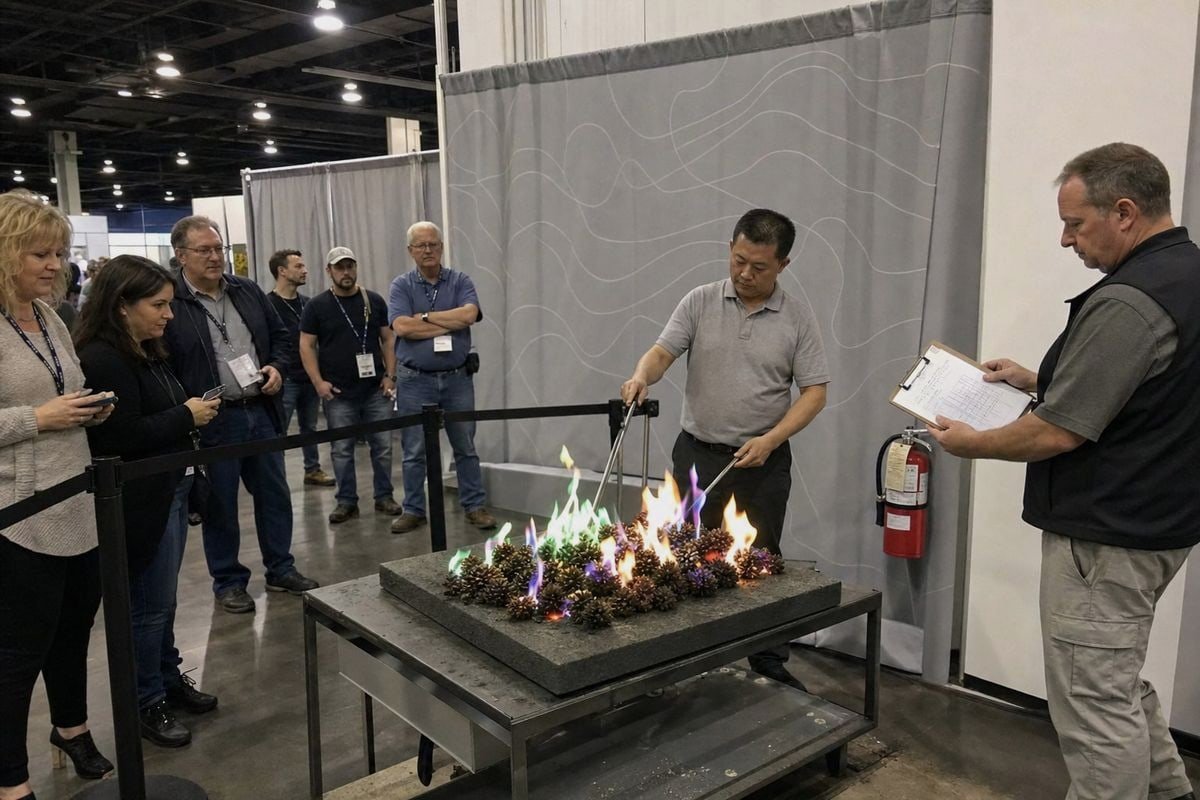
A live burning demo of colored pine cones can pack your booth—or get it shut down. We learned that lesson the hard way at our first European fireplace expo, when open-flame rules almost killed our plan.
To arrange a live burning demo of colored pine cones safely at a trade show, secure written venue and fire marshal approval, use a non-combustible hearth with a three-foot buffer, run short pulse-burns with fume extraction, staff a trained fire watch, and keep an ABC extinguisher within reach.
That is the short answer. The details matter far more. Below, I walk through the permits, the setup, the visitor-facing safety story, and how to turn the flames into signed distribution deals.
What safety certifications and documentation do I need before demonstrating colored pine cones live at a trade show?
Before our team shipped a single sample to a US outdoor show, we spent three weeks on paperwork. In our 17 years exporting color-flame products to 30+ countries, documentation always comes first.
You need an open flame permit from the local fire marshal, Safety Data Sheets for all colorant chemicals, product test reports such as SGS or Intertek, proof of liability insurance covering open-flame demonstrations, NFPA 701 flame-retardant certificates for booth materials, and written venue approval.

The paperwork is not optional. Most convention centers treat any open flame as a special hazard, and exhibition safety regulations vary by city, state, and country. So start early. In our experience, the approval chain runs through at least four parties, and each one wants different documents.
The four approvals you must collect
- Event organizer approval. Contact them first. Many organizers ban open flame outright, and you need to know that before you build anything.
- Venue operations approval. The venue will check your floor plan, your booth's flame retardant materials, and your suppression plan.
- Fire marshal approval. Submit a detailed floor plan and the صحائف بيانات السلامة 1 (SDS) for every metal salt colorant in your cones. The fire marshal may require an on-site inspection before doors open.
- Insurance confirmation. Your general liability policy probably excludes open flame. Get a written rider or a specific endorsement.
Document checklist
| وثيقة | من يطلبها | When to submit |
|---|---|---|
| Open flame / fire safety permit application | Local fire marshal | 30–60 days before the show |
| SDS for all metal salt colorants | Fire marshal, venue | With permit application |
| SGS / Intertek test reports, CE marks | Venue, buyers | Before setup; keep copies at booth |
| NFPA 701 certificates for banners and flooring | Venue, fire marshal | With floor plan |
| Liability insurance rider for open-flame demos | Organizer | At exhibitor registration |
| Written risk assessment for demonstrations | Organizer, venue | 2–4 weeks before the show |
One more point from our factory floor: buyers ask for the same documents. When a purchasing manager sees your fire marshal approval and your ISO 9001 and BSCI certificates side by side, the demo stops being a stunt and becomes proof of a compliant supply chain.
How do I choose a safe demo setup and ventilation plan for an indoor booth burn test?
There is a real trade-off we weigh at every show: bigger flames draw bigger crowds, but they also produce more smoke and more risk. After testing setups in our Ningbo facility, we always choose small and controlled.
Use a raised non-combustible hearth of slate or steel, keep a minimum three-foot buffer between flame and audience, burn only fully dried cones in a small established wood fire, run two-minute pulse-burns once per hour, and capture smoke at the source with a portable fume extraction system.
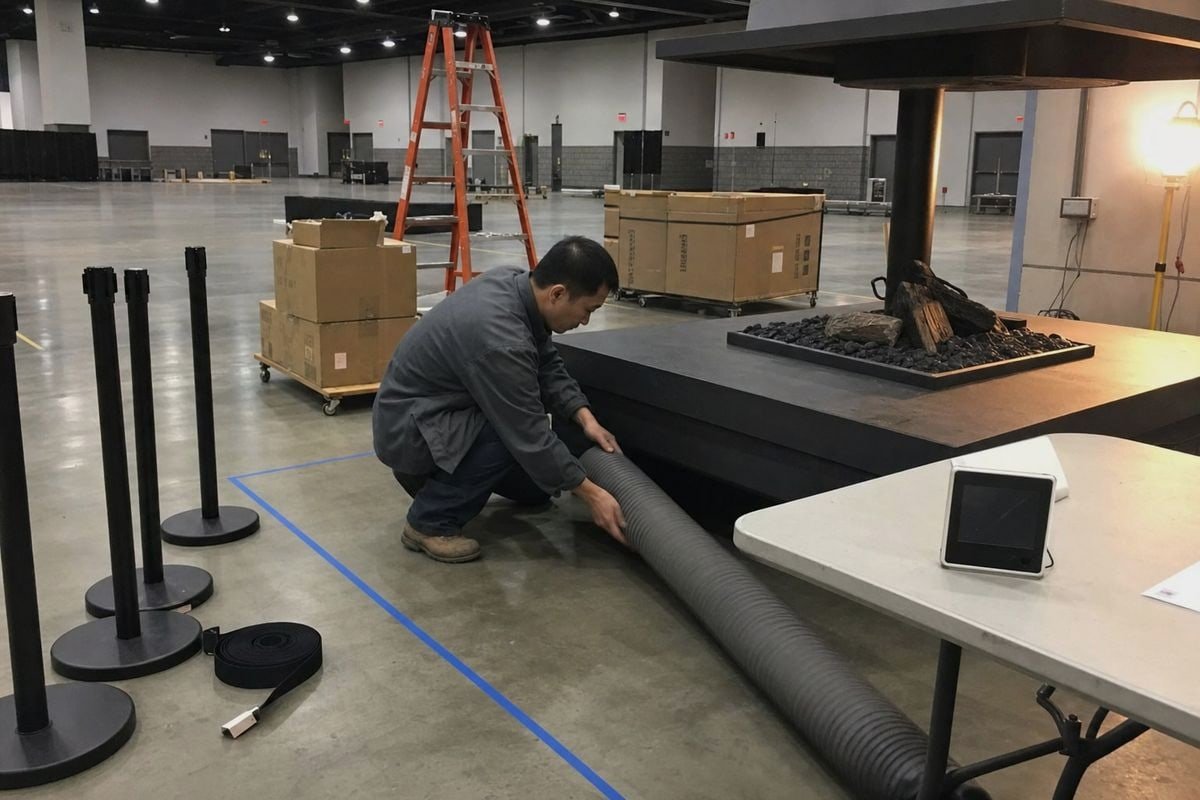
Trade show booth safety starts with the surface. Never burn directly on carpet or a standard table. A raised metal or slate hearth isolates heat, catches embers, and gives the fire marshal a clear containment story. Around it, mark a stand-off zone with physical barriers—stanchions work better than floor tape when crowds get dense.
Ventilation and smoke extraction
Indoor halls trap smoke fast. A high-volume portable fume extractor or a downdraft table pulls particulate and vapor away at the source, before it reaches visitors. We also recommend real-time PM2.5 and VOC sensors 2 inside the booth. Live air-quality data does two things: it proves to the fire marshal that ventilation and smoke extraction are working, and it reassures visitors watching the numbers stay green.
The pulse-burn schedule
Continuous burning builds cumulative heat and haze. Instead, run a "pulse-burn" format: a two-minute live burn once per hour, announced in advance. Scarcity actually helps you—visitors gather before each scheduled burn, and your booth gets a predictable crowd surge.
| Setup element | Minimum standard | لماذا هو مهم |
|---|---|---|
| Demo surface | Raised slate or steel hearth | Non-combustible, contains embers |
| Audience buffer | 3 feet (about 1 meter), barriered | Prevents contact and crowding |
| نوع النار | Small established wood fire | Cones are not for gas appliances |
| مدة الاحتراق | 2-minute intervals, hourly | Limits heat and smoke buildup |
| Extraction | Portable fume extractor at source | Captures particulates and vapors |
| Monitoring | PM2.5 and VOC sensors | Live proof of safe air quality |
One material rule from our production line: only fully dried cones go into a demo batch. Partially damp cones smoke heavily and burn unpredictably. We also pre-sort by color, because mixed batches produce muddy flames and complicate handling mid-demo. And never place the demo near food service—color-flame cones must stay away from any cooking fire.
What precautions should I take to reassure visitors about smoke, fumes, and chemical safety during the demo?
A German distributor once stopped mid-conversation at our booth and asked, point-blank, what was in the smoke. That question taught me to make chemical safety visible, not just compliant.
Reassure visitors by displaying SDS sheets and third-party test reports at the booth, showing live PM2.5 air-quality readings, using only safe metal salt colorants that avoid permanganates, nitrates, and chlorates, stationing a visible fire watch with an ABC extinguisher, and clearly stating the cones are not for cooking fires.
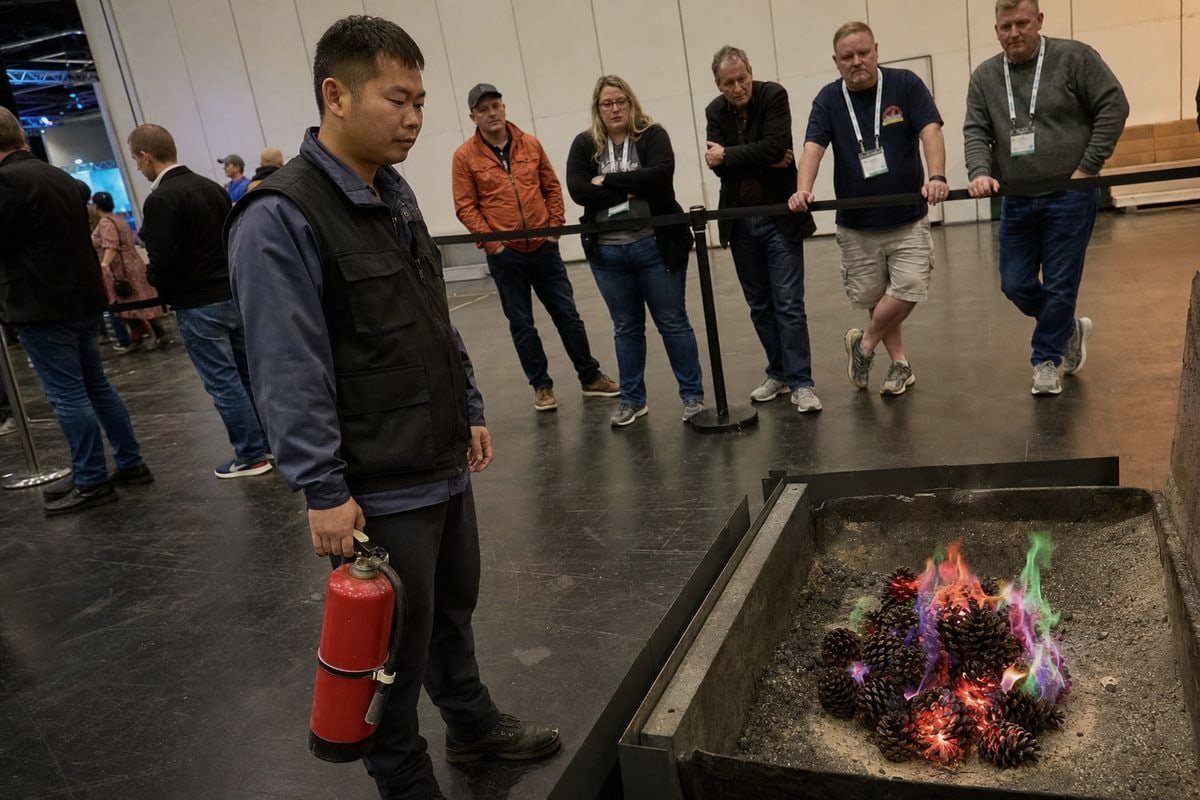
Visitors at fireplace and camping shows are often industry buyers. They know that flame colors come from metal salts, and they know some chemistry is safer than other chemistry. So meet the question head-on.
Be transparent about the chemistry
Colored flames come from compounds like كبريتات النحاس 3 for blue-green effects. What matters is what you avoid. Technical guidance warns against permanganates, nitrates, and chlorates because they release harmful byproducts when burned. Our own color-flame packets and pinecones use eco-friendly formulations with no harmful chemicals—and we put the تقارير SGS و Intertek 4 on the counter where buyers can read them. Transparency converts skeptics.
Visible safety staffing and PPE
Assign a dedicated fire watch—one trained person whose only job is watching the flame, with an unobstructed view, a certified ABC fire extinguisher 5, and a fire blanket within arm's reach. Fire extinguisher requirements vary by venue, so confirm the class and count in advance. When staff handle treated cones, they wear chemical-resistant gloves 6 and safety goggles. Visitors notice PPE. It signals seriousness, not danger.
Handle waste correctly
Ash from cones treated with copper or strontium salts may contain heavy metal residue and cannot go into standard venue trash. Set up a sealed metal ash container, let residues cool fully, and follow a hazardous waste disposal 7 protocol agreed with the venue. Ventilate the booth thoroughly after each burn and wipe down surfaces before the next session.
Finally, post a simple sign: this product is for wood fireplaces, campfires, and fire pits—never for cooking food or BBQ grills. Clear limits build trust faster than any sales pitch.
How can I turn a live burning demo into a compelling sales tool for potential distributors and buyers?
The best order we ever closed at a trade fair started with a two-minute blue-and-purple burn. The buyer did not ask about price first—he asked about batch consistency, and our demo answered before we spoke.
Turn the demo into a sales tool by pairing scheduled burns with macro video loops, displaying retail-ready private-label packaging beside the flame, handing buyers compliance documents on the spot, capturing leads during each burn window, and framing the demo itself as proof of product consistency and safety.

A flame draws feet. A system converts them. Here is how we structure it at shows across the US and Europe.
Build the digital-physical hybrid
You cannot burn all day, so bridge the gaps. A high-definition macro video loop of rainbow flames—red, green, blue, purple—keeps the visual hook alive between pulse-burns. When the live burn starts, the screen switches to a countdown. Buyers who missed the flame stay for the next one.
Show the shelf, not just the spectacle
Distributors buy packaging as much as product. Next to the hearth, we display the full retail range: kraft stand-up pouches with clear windows for camping channels, burlap drawstring sacks for fireplace and gift retail, hand-painted decorative cones with gold-tipped scales for holiday décor lines. Each format tells a buyer where the product sits in their assortment. Because we run true one-stop OEM/ODM, we can also show custom boxes, وسجلات التبخير لمعظم أسواق الوجهة. يضيف الصنوبر الملون طبقة أخرى: اختبار سلامة الملونات،, and barcodes for their own brand.
Match the demo message to the buyer
| Buyer type | What the demo should prove | What to hand them |
|---|---|---|
| علامات تجارية للتخييم / في الهواء الطلق | Vivid color in a real fire, rugged packaging | Kraft pouch sample plus test reports |
| Fireplace / BBQ distributors | Clean burn, no gas-appliance use, safe ash | Burlap sack sample plus SDS copies |
| Large retail sourcing | Compliance and batch consistency | Certification pack, MOQ and lead-time sheet |
| Festival and gift traders | Visual wow, giftable formats | Decorative cone set, private-label options |
Use the demo as a compliance argument
Here is the deeper play. Some buyers will object that live fire demos are too risky and that many venues ban them—so why bother? Flip that objection. If your fire safety permit, risk assessment, and air-quality data got this demo approved, the same rigor stands behind every container you ship. The demo is not just a spectacle. It is your compliance capability, on fire, in public. And if a future venue does refuse open flame, the video wall, sealed display props, and LED-fire effects carry the same story without the match.
خاتمة
A live burning demo of colored pine cones works only as a controlled, permitted, well-ventilated event. Get approvals first, burn small, prove safety visibly, and let compliance close the sale.
ملاحظات ختامية
1. Explains OSHA hazard communication rules requiring SDS documentation for chemical products like colorants. ↩︎
2. EPA guidance on indoor air quality monitoring supports the article's smoke and particulate safety claims. ↩︎
3. Background reference on the chemical compound cited as a source of blue-green flame color. ↩︎
4. Links to a globally recognized third-party testing and certification body referenced for product verification. ↩︎
5. Official FEMA resource explaining fire extinguisher types and how to choose the correct ABC-rated unit. ↩︎
6. OSHA's PPE guidance backs the recommendation for protective gloves when handling treated cones. ↩︎
7. EPA hazardous waste regulations support proper disposal of metal-salt ash residue described in the article. ↩︎



 English
  Spanish
  German
  French
  Arabic
  Portuguese
انضم إلى المحادثة