






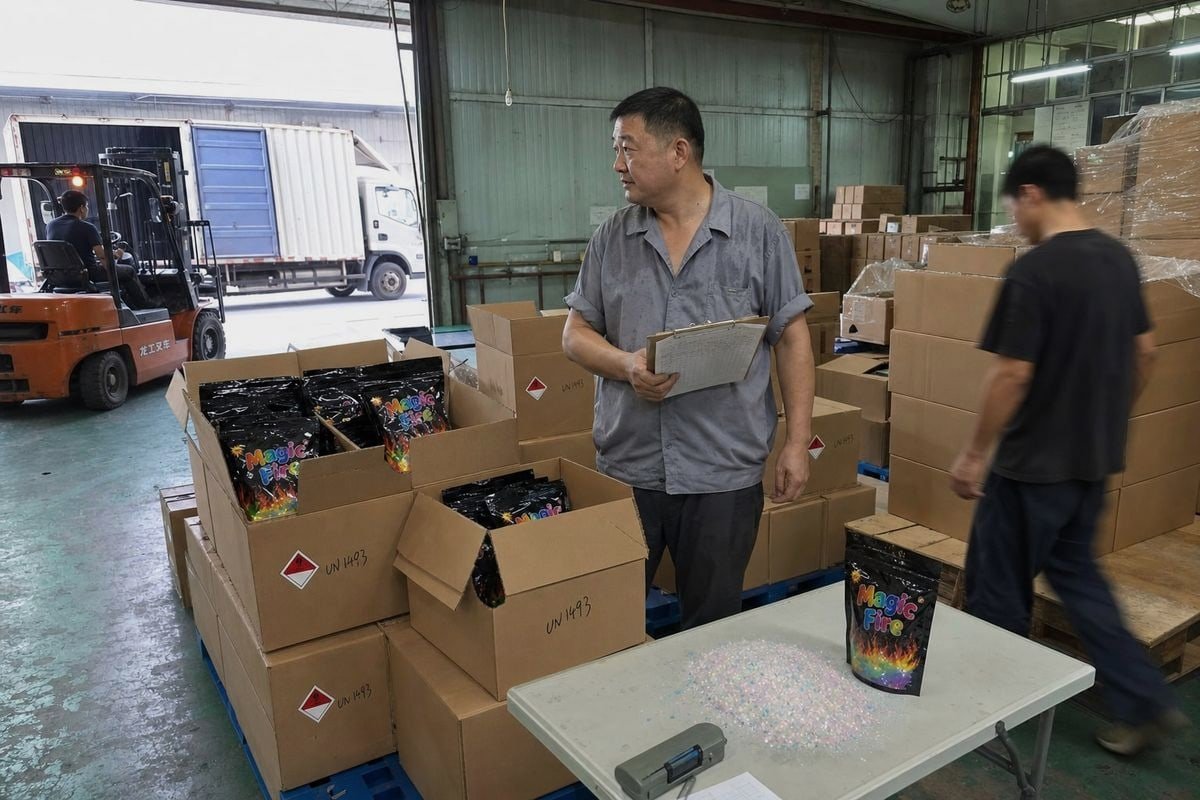
Adjusting shipment quantities for Magic Fire Powder in Amazon hazmat warehouses trips up many of our buyers. Their shipments get blocked, capital sits idle, and listings run out of stock.
To adjust shipment quantities for Magic Fire Powder in Amazon hazmat warehouses, confirm the ASIN's dangerous-goods classification, upload an accurate Safety Data Sheet, apply Limited Quantity packing rules, check your hazmat capacity in Seller Central, then reduce units per carton and split inventory into smaller compliant shipments.
That is the short version. Below, I walk through each step in detail, based on what our export team sees when supporting FBA sellers in the US and Europe.
What Documents Do I Need to Adjust Hazmat Shipment Quantities on Amazon?
Last spring, one of our US distributors had a full container of color-flame packets stuck in classification limbo. The missing piece was not the product — it was paperwork. Our compliance desk fixed it in days.
To adjust hazmat shipment quantities on Amazon, you need a current Safety Data Sheet (SDS) or exemption sheet, accurate product regulation data including UN identification number and hazard class, test reports from labs like SGS or Intertek, and confirmed Dangerous Goods program enrollment in Seller Central.

Documentation is the foundation of every quantity decision. Amazon cannot tell you how much you may send until it knows exactly what you are sending. That is why the hazmat review process starts with data, not logistics.
مجموعة المستندات الأساسية
Here is the document stack we prepare for buyers who resell our Magic Fire color-flame packets through FBA:
| وثيقة | الغرض | من يقدمها |
|---|---|---|
| صحيفة بيانات السلامة 1 (صحيفة بيانات السلامة) | Confirms composition, flash point, hazard class | الشركة المصنعة |
| ورقة الإعفاء | Proves the product is not regulated, if applicable | Manufacturer or seller |
| تقارير اختبار الطرف الثالث 2 (SGS/إنترتيك) | تحقق مستقل من ادعاءات السلامة | الشركة المصنعة عبر المختبر |
| Product regulation data | UN identification number 3, transport category | الشركة المصنعة |
| Limited Quantity declaration | Supports LTD QTY packing status | Seller with manufacturer input |
The SDS matters most. Amazon uses it to decide whether your powder falls under a تصنيف المواد الصلبة القابلة للاشتعال 4 or qualifies for an exemption. If the flash point or hazard class fields are wrong, Amazon may impose permanent quantity restrictions or reject shipments outright. We have seen sellers lose weeks because a supplier sent a generic SDS that did not match the actual formulation.
Why the SDS Transport Section Drives Quantity
Section 14 of the SDS covers transport information. It lists the UN identification number, packing group, and any Limited Quantity provisions. This is where your per-package maximums come from. Read it before you create any shipping plan. If the SDS shows a limited-quantity transport path, you can often pack more favorably than a fully regulated product — but only if your cartons stay within those thresholds.
Our factory keeps SDS documents updated batch by batch. When a buyer requests documentation for ASIN compliance, we send the current version within one business day, because an outdated SDS is as harmful as a missing one.
How Do I Determine the Right MOQ for Amazon Hazmat FBA Compliance?
There is a trade-off we discuss with almost every new FBA buyer: order enough to keep freight costs sane, but not so much that Amazon's capacity limits leave pallets sitting in a 3PL.
Determine your MOQ by working backward from Amazon's constraints: check hazmat capacity in the Capacity Monitor, calculate the maximum units per carton under Limited Quantity rules, estimate monthly sell-through, then set your order at two to three compliant inbound shipment cycles of inventory.

Most sellers set MOQ from a pure cost angle. For hazmat, that logic breaks. Your real ceiling is not what your budget allows. It is what Amazon will physically accept into hazmat-certified space.
A Backward-Planning Method
I recommend this sequence, which our export team uses when quoting trial orders:
- Open the Capacity Monitor in Seller Central and note your current limits for flammable and aerosol categories.
- Read the SDS transport section to find your per-package Limited Quantity threshold.
- Calculate units per carton that keep each box under that threshold.
- Check your recent sell-through rate for the ASIN.
- Set inbound shipment size at four to six weeks of demand, within capacity.
- Set your factory MOQ at two to three of those shipment cycles.
Balancing Factory MOQ Against Amazon Limits
Here is how the numbers typically interact for a lightweight sachet product like a color-flame packet:
| عامل | Typical Constraint | Practical Response |
|---|---|---|
| Factory MOQ | Production-run economics | Ask for flexible trial MOQs |
| Hazmat capacity | Dynamic, reassessed by Amazon | Hold buffer stock at a 3PL |
| Limited Quantity packing | Per-carton weight/volume caps | Reduce units per case |
| حدود تخزين FBA | Separate from hazmat capacity | Manage both dashboards weekly |
Our production lines can run flexible trial quantities precisely because FBA sellers face this squeeze. A buyer who orders three months of stock but can only inbound three weeks of it needs a supplier who supports staged replenishment. That is a supply-chain design question, and it belongs in your first sourcing conversation, not your first blocked shipment.
One more point. Smaller, more frequent shipments raise inbound labor and freight costs per unit. That is real. But a rejected oversized shipment costs far more in return freight, relabeling, and lost sales rank. In our experience exporting to the US, the sellers who accept slightly higher logistics costs for compliant staging outperform those who gamble on one big inbound.
Why Do Amazon Hazmat Warehouses Limit My Magic Fire Powder Shipment Sizes?
A German fireplace distributor once asked me, half frustrated, why Amazon treated a novelty campfire sachet like industrial chemicals. The answer sits in fire codes 5, not in Amazon's mood.
Amazon hazmat warehouses limit Magic Fire Powder shipment sizes because each fulfillment center has a Maximum Allowable Quantity per hazard category under local fire codes, hazmat-certified storage space is scarce and shared among sellers, and dangerous goods require segregated handling, storage, and transport compliance.

The limits feel arbitrary from the outside. From the inside, they follow clear logic. Understanding that logic helps you plan instead of react.
Three Layers of Limits
Amazon stacks several constraints on top of each other:
| Limit Layer | What Controls It | Can You Influence It? |
|---|---|---|
| Fire-code MAQ per warehouse | Local regulations per hazard category | No — fixed by law |
| Your seller hazmat capacity | Store performance and current space use | Yes — sell through, keep metrics healthy |
| Per-package Limited Quantity caps | Transport regulations and your SDS | Yes — adjust packing configuration |
The first layer is aggregate. Every hazmat seller shipping flammable goods into a given fulfillment center draws from the same fire-code pool. When that pool fills, the Send to Amazon workflow throws an error, no matter how good your account health is. This is why hazmat capacity is dynamic. If a shipment is blocked today, capacity can reopen within 24 to 48 hours as other inventory sells or gets removed.
Why Sellers Should Not Fight the System
I understand the seller viewpoint: these caps slow replenishment and inflate box counts. But the regulatory side is not negotiable. Flammable solids stored in bulk change a building's fire risk profile. Amazon's Fulfillment Center capacity rules exist so the warehouse can legally hold your product at all. The practical move is to work within the system: monitor the بضائع خطرة 6 Inventory Report, watch for Reserved-status units that still count against your limits, and split large inbounds so excess units route to alternative hazmat-certified centers. Multiple smaller shipments across different facilities often move more total volume than one large blocked shipment ever could.
Product design helps too. Because our color-flame packets use eco-friendly formulations with no harmful chemicals, several of our buyers achieve more favorable classifications than sellers of solvent-based flame products — and better classification means looser caps.
Can I Work with My Supplier to Repackage Orders for Amazon Hazmat Approval?
Repackaging requests land on my desk every month. A UK camping brand recently asked us to shrink their sachet case-pack from 100 units to 40 so each carton stayed inside Limited Quantity thresholds. We retooled the line in one production cycle.
Yes, a capable supplier can repackage orders for Amazon hazmat approval by reducing units per carton to meet Limited Quantity thresholds, applying correct LTD QTY labels and warning marks, adjusting inner packaging weight, and supplying matching SDS documentation for the new configuration.
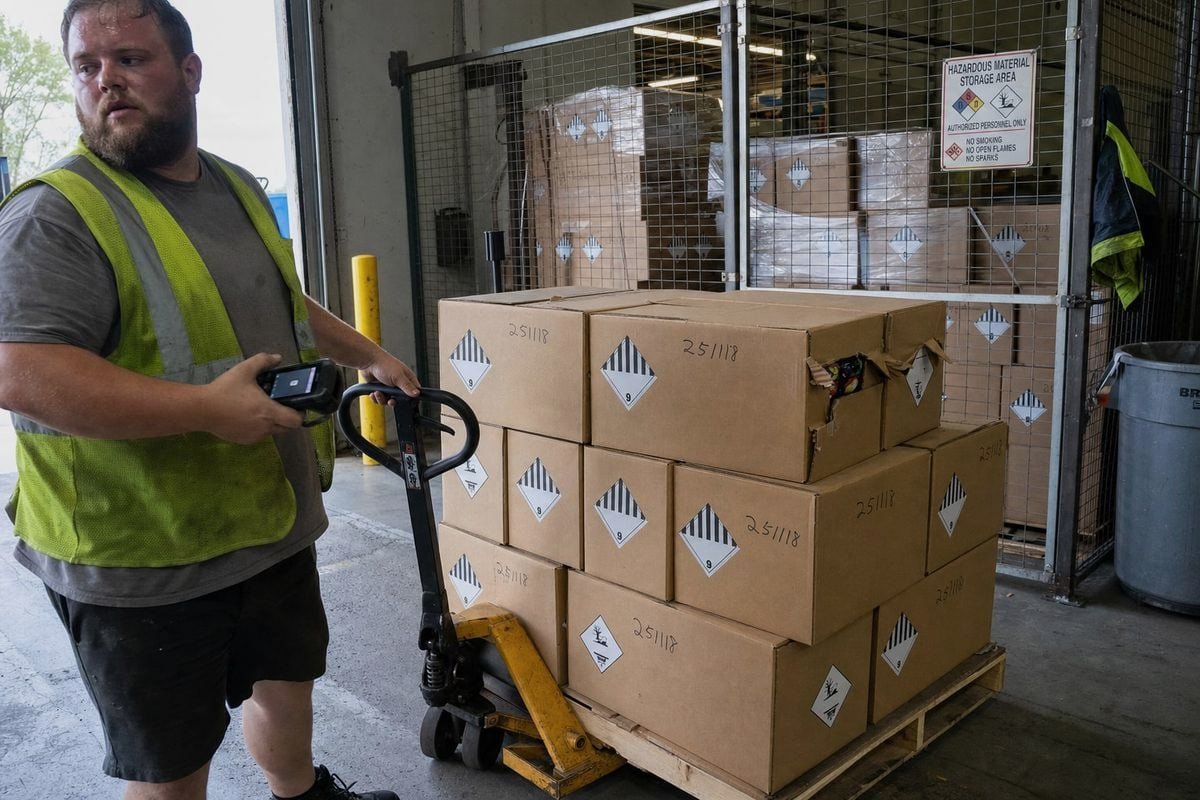
This is where manufacturing depth matters more than price. Repackaging for hazmat is not just putting fewer pouches in a box. Several elements must change together, and they must stay consistent batch after batch.
What a Proper Repackaging Project Includes
At our Ningbo facility, a hazmat-driven repack covers these steps:
- Review the target market's transport rules and the ASIN's current classification status.
- Recalculate net quantity per inner pack and per carton against Limited Quantity caps.
- Redesign the case-pack — often fewer consumer units per case, not just smaller cases.
- Print and apply Limited Quantity labels, warning labels, and barcodes to Amazon's spec.
- Update the SDS and exemption documentation to reflect the new configuration.
- Run a pilot batch and hold it against the golden sample before mass production.
Notice step three. Adjusting shipment quantity usually means lowering units per case, because per-package limits still apply even if you split the same volume across more cartons. A supplier who does not understand this will "solve" your problem in a way Amazon still rejects.
أسئلة لطرحها على المورد الخاص بك
Before committing, I suggest buyers ask: Can you provide an SDS specific to my private-label version? Are your lines certified under ISO 9001 7 and audited under BSCI? Can you add moisture-shield over-bagging so the crystalline powder does not clump and trigger quantity-mismatch flags at receiving? Can you support a rolling inbound schedule with staged shipments instead of one bulk delivery?
Our OEM/ODM service covers all of these — custom pouch sizes, kraft bags, jars, display boxes, warning labels, and barcodes — because shelf-ready for FBA now means compliance-ready, not just attractive packaging. A supplier who treats the shipping plan modification as your problem alone is not a long-term partner. One who redesigns the case-pack with you turns hazmat approval from a recurring headache into a settled process.
خاتمة
Hazmat quantity limits are not obstacles — they are rules you can plan around. With accurate SDS data, smart case-packs, and a compliance-ready factory partner, Magic Fire Powder ships smoothly.
ملاحظات ختامية
1. Explains the standardized document format central to hazmat classification decisions. ↩︎
2. Reference to SGS, a named independent testing lab used for hazmat compliance verification. ↩︎
3. Background on the standardized numbering system used for dangerous goods transport classification. ↩︎
4. Regulatory reference for how flammable solids are classified and regulated for safety. ↩︎
<span



 English
  Spanish
  German
  French
  Arabic
  Portuguese
انضم إلى المحادثة