







Le risque de stock dormant pour les allume-feux en bois peut silencieusement drainer votre trésorerie. J'ai vu des acheteurs sur-commander nos rouleaux de bois trempés dans la cire avant un hiver doux, puis transporter des palettes pendant un an.
Évaluer le risque lié aux stocks à rotation lente pour les allume-feux à bois en extrayant 12 mois de ventes historiques, en calculant le ratio de rotation des stocks et le nombre de jours de stock disponible, en comparant le stock disponible à la demande saisonnière sur le délai de livraison, puis en ne commandant que les quantités que vous pouvez vendre dans un délai de 90 à 180 jours.
C'est la réponse courte. La réponse plus longue implique les certifications, la capacité du fournisseur, la flexibilité des MOQ et la fiabilité du fabricant. Je vais examiner chaque point, car je vois ces questions de la part des acheteurs à chaque saison d'approvisionnement.
Quelles certifications dois-je vérifier avant de m'engager dans une commande en gros d'allume-feu en bois ?
Lors d'un audit d'usine l'année dernière, un acheteur allemand m'a dit que son expédition précédente était restée bloquée en douane pendant six semaines en raison de rapports de test manquants. Ce retard a poussé son stock directement dans la basse saison.
Avant une commande en gros d'allume-feu en bois, vérifiez la norme ISO 9001 pour les systèmes de qualité, la BSCI pour la conformité sociale, le marquage CE pour l'accès au marché européen et les rapports de test de tiers SGS ou Intertek. Les certifications manquantes entraînent des retards douaniers qui transforment du stock saisonnier en stock à rotation lente du jour au lendemain.
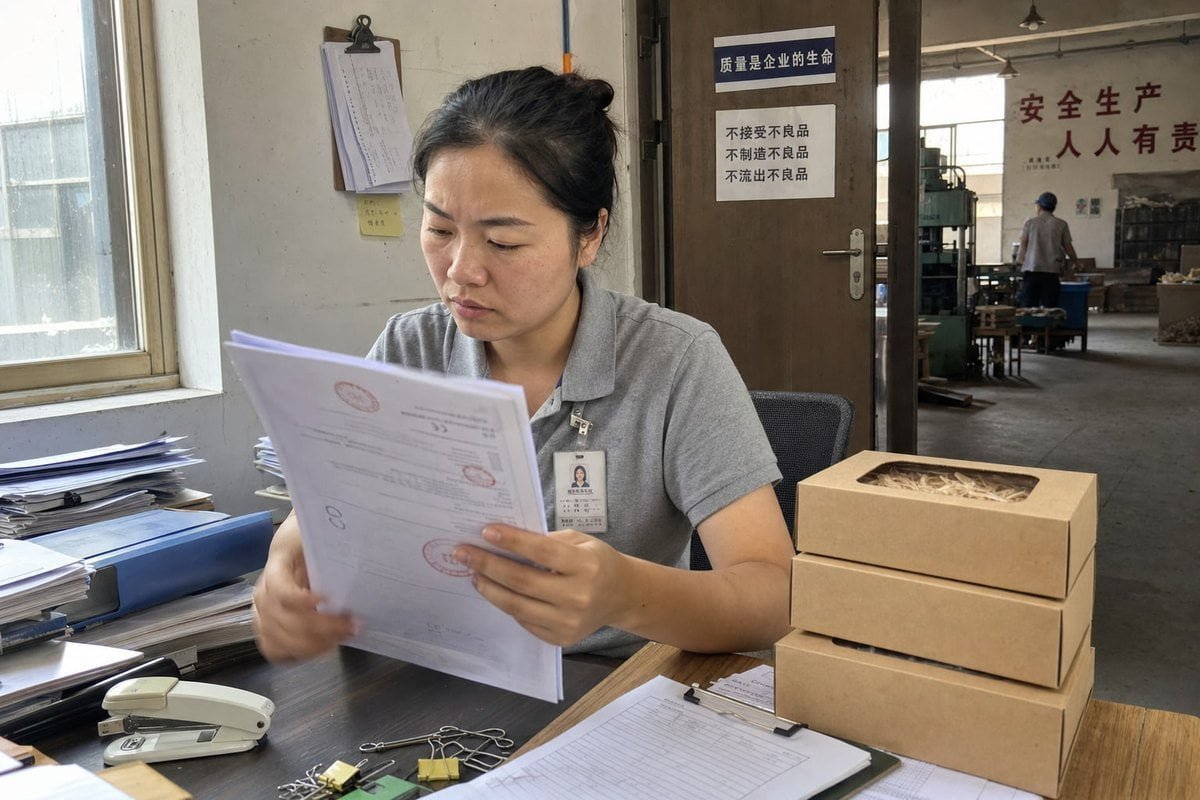
Les certifications peuvent sembler être un sujet de conformité, pas un sujet de stock. En réalité, elles sont liées. Une expédition retenue en douane pendant votre période de vente la plus intense arrive dans votre entrepôt comme un stock quasi mort. La saison est passée pendant que les marchandises étaient dans un parc à conteneurs. La vérification des certifications est donc votre première ligne de prévention contre le stock mort.
Dans notre usine de Ningbo, nous conservons ISO 9001 1, BSCI, CE et rapports SGS/Intertek à jour pour cette raison exacte. Nos acheteurs aux États-Unis, en Allemagne et au Royaume-Uni les traitent comme des exigences strictes. Vous devriez en faire autant.
Les documents essentiels à demander
Demandez des copies PDF réelles, pas des assurances verbales. Vérifiez ensuite les numéros de certificat auprès de la base de données de l'organisme émetteur.
| Certification | Ce qu'il prouve | Risque de stock en cas d'absence |
|---|---|---|
| ISO 9001 | Système de gestion de la qualité cohérent | La variation d'un lot à l'autre crée des retours et des stocks invendables |
| BSCI | Conformité éthique et sociale | Les chaînes de distribution rejettent les marchandises ; vous conservez des SKUS invendables |
| Rapports CE / tests | Sécurité du produit pour le marché européen | Saisie douanière ou re-étiquetage forcé retarde votre saison |
| Rapports SGS / Intertek | Vérification indépendante par un tiers | Les acheteurs de détail refusent les listes ; la rotation des ventes s'effondre |
La transparence de la composition est également importante
Un allume-feu étiqueté fibre de bois 50% et 50% de paraffine 2 doit réellement tester cette composition. Si une inspection aléatoire révèle des substances nocives les accélérants chimiques 3, les détaillants retirent le produit des étagères. Soudain, votre quantité totale en stock devient un risque de liquidité au lieu d'un actif. Nous publions les détails de composition sur notre emballage et les soutenons par des rapports de test, car un carton conforme est un carton vendable. Un carton non certifié est une facture d'entreposage en attente.
Comment puis-je juger si la capacité de production d'un fournisseur correspond à mon taux de vente ?
Un compromis que j'évalue constamment sur nos lignes de production : les acheteurs veulent un réapprovisionnement rapide en novembre, mais le trempage dans la cire et le séchage prennent du temps réel. Les affirmations de capacité sur papier ne disent rarement toute l'histoire.
Évaluez l'adéquation de la capacité en comparant la production mensuelle vérifiée et le délai de livraison du fournisseur à votre taux de vente hebdomadaire pendant la haute saison. Un fournisseur qui peut réapprovisionner en 30 à 45 jours vous permet de commander de plus petites quantités plus souvent, réduisant ainsi considérablement le risque d'inventaire à rotation lente.

La logique est simple. Si votre fournisseur a besoin de 90 jours pour produire et expédier, vous devez acheter toute votre saison en une ou deux grosses commandes. Cela vous oblige à prévoir des mois à l'avance, et l'erreur de prévision est la principale cause de stock dormant. Si votre fournisseur peut traiter les commandes en 30 à 45 jours, vous pouvez acheter en plus petites vagues qui suivent la demande réelle.
Une vérification de capacité étape par étape
- Demandez la production mensuelle de l'usine pour votre SKU spécifique, pas la capacité globale sur tous les produits.
- Demandez les enregistrements de production ou une visite vidéo en direct de la chaîne. Nous le faisons régulièrement pour les nouveaux acheteurs, et une vraie usine n'hésite jamais.
- Confirmez la variabilité des délais de livraison, pas seulement le délai moyen. Un délai annoncé de 35 jours qui s'étire parfois à 70 détruit vos calculs de réapprovisionnement.
- Calculez votre rotation des ventes en haute saison. Pour les allume-feux, concentrez-vous sur la fenêtre de chauffage de 120 jours, pas sur les moyennes annuelles.
- Testez le ratio : votre quantité commandée doit être approximativement égale à la demande attendue sur le délai de livraison plus un cycle de réapprovisionnement, plus un modeste niveaux de stock de sécurité 5.
Pourquoi le calendrier saisonnier amplifie les calculs
Les allume-feux en bois suivent les jours de chauffage 6. La demande augmente souvent juste après le premier gel régional, lorsque les consommateurs achètent par panique. Si votre fournisseur ne peut pas produire pendant votre fenêtre de pré-saison car ses lignes sont réservées, vous commandez trop tôt ou manquez le pic. D'après notre expérience d'exportation dans plus de 30 pays, les acheteurs qui confirment les créneaux de production en été évitent ces deux problèmes. La prévision de la demande saisonnière ne fonctionne que lorsque le calendrier de l'usine prend en charge vos dates de livraison.
Quelles options de MOQ et d'emballage m'aident à éviter le surstockage de références à faible rotation ?
Un distributeur néerlandais nous a un jour demandé de diviser une grosse commande en trois formats d'emballage au lieu de tout engager dans une boîte de vente au détail de 100 pièces. Ses données de rotation des ventes ont ensuite prouvé que cette seule décision lui a évité une saison de démarques.
Choisissez des fournisseurs offrant des MOQ flexibles pour les commandes d'essai, les conteneurs mixtes de SKUs et plusieurs tailles d'emballage telles que de petites boîtes de vente au détail, des sacs de taille moyenne et des cartons en vrac. Les formats d'emballage plus petits vous permettent de tester la volatilité de la demande avant de vous engager dans des volumes qui dépassent les ventes saisonnières réalistes.

L'inadéquation de la taille de l'emballage est l'une des causes les plus sous-estimées de stock dormant. Une boîte de 100 pièces offre un bon rapport qualité-prix par unité, mais si votre client typique utilise deux feux par semaine, cette boîte lui dure un an. Votre cycle d'achat répété s'allonge, et votre vitesse de rotation en rayon semble faible même si le produit lui-même est populaire.
Adapter le format d'emballage à la vitesse du canal
Différents canaux écoulent les allume-feux à des vitesses très différentes. L'analyse des ventes historiques par canal devrait guider vos décisions d'emballage.
| Canal | Vitesse typique | Format d'emballage recommandé | Risque de surstock |
|---|---|---|---|
| Marché en ligne | Rapide, de base toute l'année | Sacs de taille moyenne, adaptés à l'abonnement | Faible à modérée |
| Grande distribution | Pics saisonniers marqués | Boîtes d'exposition de 100 pièces | High if ordered late in season |
| Camping / outdoor stores | Spring–summer peak | Small trial packs, kraft bags | Modéré |
| Fireplace distributors | Autumn–winter peak | Bulk cartons for repacking | Modéré à élevé |
Use MOQ Flexibility as a Risk Tool
We deliberately keep trial-order MOQs accessible because we would rather earn a reorder than force a buyer into overstock. A smart pre-order sequence looks like this: run a small test buy in one channel, measure 60-day sell-through, then scale the winning SKU while dropping the laggards. That is SKU rationalization in practice. It also protects you from carrying costs on formats your market never wanted. Remember that fire starters are volumetric goods — they eat warehouse space fast relative to their margin. Also ask about storage-friendly packaging: wax-coated starters stored in hot summer warehouses can suffer wax migration, and packaging that shields product quality preserves the value of any stock you do carry.
Comment évaluer la fiabilité d'un fabricant pour réduire le risque de stock à long terme ?
Seventeen years in this business taught me a hard lesson early on: one inconsistent batch damages a buyer's trust more than any price increase. Reliability is measurable, and you should measure it before ordering.
Évaluez la fiabilité du fabricant en vérifiant les années d'exploitation, en vérifiant la propriété de l'usine par rapport au statut de négociant, en testant la cohérence de la production d'échantillons à la production de masse, en examinant l'historique des livraisons à temps et en confirmant la réactivité de la communication. Des fabricants fiables stabilisent votre cycle de réapprovisionnement, vous permettant de maintenir des stocks plus faibles en toute confiance.

Reliability connects directly to inventory risk through one mechanism: predictability. When deliveries arrive on time and quality matches the approved sample, you can safely run lower safety stock levels. When a supplier is erratic, you compensate by over-ordering. That padding is exactly where slow-moving inventory is born.
The Five Reliability Signals That Matter
First, longevity. A factory with 17+ years of export history has survived multiple demand cycles, raw material swings, and regulation changes. Second, factory ownership. A trading company adds a layer between you and the production line, which increases lead time variability and dilutes quality accountability. Ask for the factory address and audit it — ours sits in Ningbo, with headquarters in Liuyang, and we welcome visits. Third, batch consistency. Request the golden sample process 7: does the factory keep sealed reference samples and run batch-to-batch QC against them? Fourth, delivery record. Ask for recent shipment timelines to your region. Fifth, communication speed in English, because slow answers during a production issue become slow inventory decisions on your side.
Scoring Reliability Before You Buy
| Reliability Factor | Feuille verte | Signal d'alarme |
|---|---|---|
| Historique | 10+ years, exports to 30+ countries | New entity, vague export history |
| Ownership | Verifiable factory, welcomes audits | Refuses video walkthroughs |
| QC process | Documented batch checks against golden samples | "Trust us" answers |
| Livraison | Consistent on-time record | Frequent excuses, shifting dates |
| Communication | Same-day English replies | Multi-day silences |
A reliable partner also helps on the demand side. We advise buyers on burn-time customization, private-label packaging, and regional labeling, so their SKUs are shelf-ready and move faster. Faster movement means a healthier ratio de rotation des stocks, and a healthier ratio is the ultimate protection against dead stock.
Conclusion
Slow-moving inventory risk is avoidable. Verify certifications, match capacity to sell-through, use flexible MOQs, and partner with a proven factory — then every fire starter order works for you.
Notes de bas de page
1. Official ISO standard reference for quality management systems buyers must verify before ordering. ↩︎
2. Background reference explaining the wax material commonly used in wood fire starter composition. ↩︎
3. Comprehensive Wikipedia definition and explanation of chemical accelerants and their properties in fire development. ↩︎
4. SGS is a leading third-party inspection body cited for verifying fire starter compliance documents. ↩︎
5. Defines the inventory management concept buyers rely on to balance reliability with lean stock. ↩︎
6. Explains the seasonal demand metric that drives fire starter buying spikes after first frost. ↩︎
7. Alibaba.com sourcing platform commonly references golden sample QC practices used in manufacturing trade. ↩︎



 English
  Spanish
  German
  French
  Arabic
  Portuguese
Rejoignez la conversation